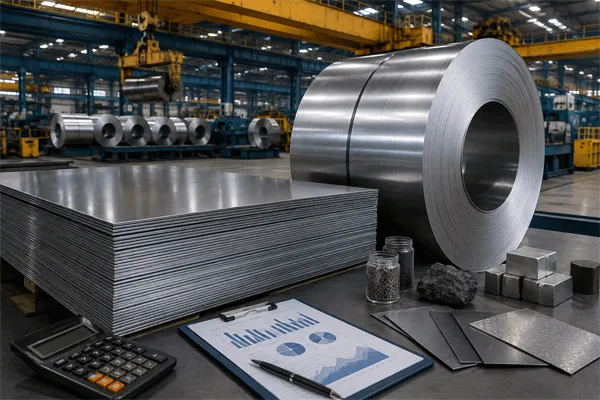
Galvanized steel coil is carbon steel coated with zinc to slow corrosion. For a bulk buyer, the useful specification is not the word “galvanized” alone: grade, thickness, zinc coating, width, coil dimensions, inspection documents, and the intended forming process must agree before production is booked.
What the coating specification controls
Zinc coating provides sacrificial protection when the steel is exposed to moisture, but coating weight does not replace correct drainage, edge protection, or compatible downstream forming. A procurement request should state the coating designation, test method, surface requirement, and whether the strip will be roll-formed, bent, slit, or cut into blanks.
Buyer field
What to confirm
Why it matters
Steel grade
DX51D or SGCC for the intended application
Controls formability and the applicable standard
Thickness
Published GI range 0.18–0.30 mm
Affects stiffness, weight, and forming setup
Zinc coating
GI reference Z120; application pages also mention ranges up to Z275
Sets the coating target for the exposure and processing route
Width and coil data
Width, inner diameter, outer diameter, coil weight, and tolerance
Prevents decoiler, slitting, and freight mismatches
Luyuan Steel GI coil reference
Luyuan Steel’s published product information lists GI Coil DX51D/SGCC Z120 with a 0.18–0.30 mm thickness range. The company’s broader manufacturing information says that coating weight, width, and processing can be customized by product and application. Treat these as a starting reference; the purchase order should carry the final agreed values.
Custom galvanized coils in the Luyuan Steel media library.
Grades and uses
DX51D is commonly selected where forming is important, while SGCC is a designation buyers may encounter in Asian-market specifications. The correct choice depends on the governing standard and the finished part. Roofing panels, ductwork, electrical enclosures, greenhouse components, and general fabrication can require different combinations of thickness, coating, surface finish, and edge condition.
Compared with generic supplier pages that stop at a list of uses, a useful buying brief connects each parameter to the buyer’s line: roll-forming clearance, minimum bend requirement, slit-edge handling, exposed cut edges, and packaging for the destination climate.
Inspection and shipment documents
The Luyuan source library states that shipments can include an English Mill Test Certificate and that pre-shipment inspection, batch traceability, chemical and mechanical testing, surface inspection, and third-party inspection by SGS, BV, Intertek, or a buyer-appointed inspector are available. These are service and documentation claims; the exact inspection scope should be written into the order and checked against the final MTC.
Common purchasing mistakes
Quoting only “Z120” without stating the steel grade, thickness tolerance, width, or standard.
Assuming a heavier zinc coating automatically solves cut-edge corrosion or poor drainage.
Accepting a coil that fits the nominal thickness but not the customer’s decoiler, slit-width, or maximum coil-weight limits.
Using a generic certificate statement instead of requesting the actual MTC and inspection records for the shipped batch.
Practical RFQ checklist
State the product, governing standard, grade, thickness, width, coating designation, surface, and edge.
Give the forming route and finished application so the supplier can confirm suitability.
Agree the inspection point before production and retain the approved specification with the purchase order.
FAQ
Is Z120 enough for every galvanized coil application?
No. The required coating depends on exposure, forming, cut edges, design life, and the governing project specification. Confirm the target with the fabricator or engineer.
Can galvanized coil be customized?
Luyuan’s service information describes customization of dimensions, coating weight, and processing depending on the product. The final capability and minimum order should be confirmed in the quotation.
What should arrive with the shipment?
Request the agreed MTC, packing and marking records, inspection report where applicable, and traceability information for the shipped batch.






 08-13 2026