Luyuan Steel Technical Team | Steel Product Specification Support, Shandong Luyuan Metal Materials Co., Ltd. | Published / Last updated: 27 August 2026
Nominal pipe size is a label, not a measurement. A 2 inch galvanized steel pipe has an outside diameter of 60.3 mm, and DN50 describes the same pipe. Wall thickness is set separately by schedule (SCH 40, SCH 80) or by EN series (medium, heavy), so two pipes with the same size marking can differ in weight by more than 6%.
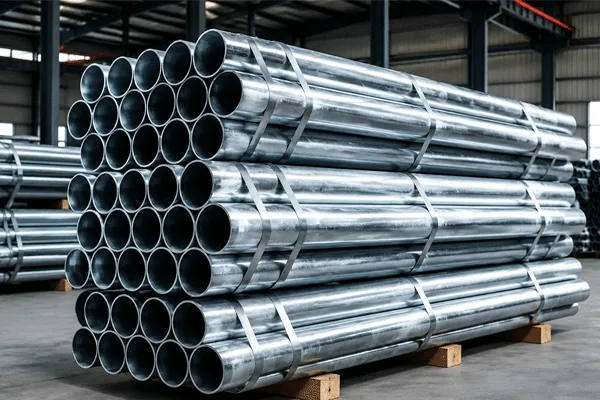
Galvanized Steel Pipe Sizes: NPS, DN and Wall Thickness
Why nominal size stopped matching reality
The inch-based system dates from a period when pipe was designated by its approximate bore. As wall thicknesses were standardised and then thickened for higher pressures, the outside diameter had to be frozen so that threads, couplings and fittings stayed interchangeable. The inside diameter moved instead. The name never changed.
That leaves three consequences a buyer feels directly:
- Below NPS 14, the nominal number matches neither the OD nor the ID. NPS 1 has an OD of 33.4 mm.
- From NPS 14 upward, the nominal number isthe OD in inches. NPS 14 has an OD of 355.6 mm.
- DN is a metric label attached to the same pipe, not a millimetre dimension. DN50 is not 50 mm anywhere on the pipe.
Purchase orders that say only “2 inch galvanized pipe, 500 tons” leave wall thickness, standard, coating class and length entirely to the mill’s interpretation. The tables below exist so that the order can say the rest.
Quick answer: NPS (nominal pipe size, inches) and DN (diamètre nominal, metric) are two labels for the same pipe. Neither equals a physical dimension below NPS 14. The outside diameter is fixed for a given NPS; wall thickness varies by schedule or series.
NPS to DN to actual outside diameter
This is the conversion buyers need most often. The OD column follows the ASME B36.10M / ASTM A53 dimensional series, which is the series used by most Chinese mills producing to ASTM or API requirements.
| NPS |
DN |
OD (in) |
OD (mm) |
| 1/2″ |
DN15 |
0.840 |
21.3 |
| 3/4″ |
DN20 |
1.050 |
26.7 |
| 1″ |
DN25 |
1.315 |
33.4 |
| 1-1/4″ |
DN32 |
1.660 |
42.2 |
| 1-1/2″ |
DN40 |
1.900 |
48.3 |
| 2″ |
DN50 |
2.375 |
60.3 |
| 2-1/2″ |
DN65 |
2.875 |
73.0 |
| 3″ |
DN80 |
3.500 |
88.9 |
| 4″ |
DN100 |
4.500 |
114.3 |
| 5″ |
DN125 |
5.563 |
141.3 |
| 6″ |
DN150 |
6.625 |
168.3 |
| 8″ |
DN200 |
8.625 |
219.1 |
| 10″ |
DN250 |
10.750 |
273.0 |
| 12″ |
DN300 |
12.750 |
323.8 |
Two notes on reading this table. First, the OD is a nominal value with its own tolerance, covered further down. Second, the DN column is only valid for this dimensional series. European tube standards attach several of the same DN labels to different diameters, which is the subject of a separate section below because it causes real rejections at site.
Wall thickness by schedule
Schedule is a dimensionless number, not a thickness. The same SCH 40 designation gives 2.77 mm at DN15 and 9.53 mm at DN300. A specification that says “SCH 40” is complete; one that says “3 mm wall, SCH 40” is contradictory at almost every size.
| NPS |
DN |
OD (mm) |
SCH 10 (mm) |
SCH 40 (mm) |
SCH 80 (mm) |
| 1/2″ |
DN15 |
21.3 |
2.11 |
2.77 |
3.73 |
| 3/4″ |
DN20 |
26.7 |
2.11 |
2.87 |
3.91 |
| 1″ |
DN25 |
33.4 |
2.77 |
3.38 |
4.55 |
| 1-1/4″ |
DN32 |
42.2 |
2.77 |
3.56 |
4.85 |
| 1-1/2″ |
DN40 |
48.3 |
2.77 |
3.68 |
5.08 |
| 2″ |
DN50 |
60.3 |
2.77 |
3.91 |
5.54 |
| 2-1/2″ |
DN65 |
73.0 |
3.05 |
5.16 |
7.01 |
| 3″ |
DN80 |
88.9 |
3.05 |
5.49 |
7.62 |
| 4″ |
DN100 |
114.3 |
3.05 |
6.02 |
8.56 |
| 5″ |
DN125 |
141.3 |
3.40 |
6.55 |
9.53 |
| 6″ |
DN150 |
168.3 |
3.40 |
7.11 |
10.97 |
| 8″ |
DN200 |
219.1 |
3.76 |
8.18 |
12.70 |
| 10″ |
DN250 |
273.0 |
4.19 |
9.27 |
15.09 |
| 12″ |
DN300 |
323.8 |
4.57 |
9.53 |
17.48 |
Note what happens between DN50 and DN65 in the SCH 40 column: the wall jumps from 3.91 mm to 5.16 mm, a 32% step, while the OD rises only 21%. Weight per metre nearly doubles across that one size increment. Contractors sizing a handrail or a sprinkler main by “the next size up” often discover this when the freight invoice arrives rather than at the design stage.
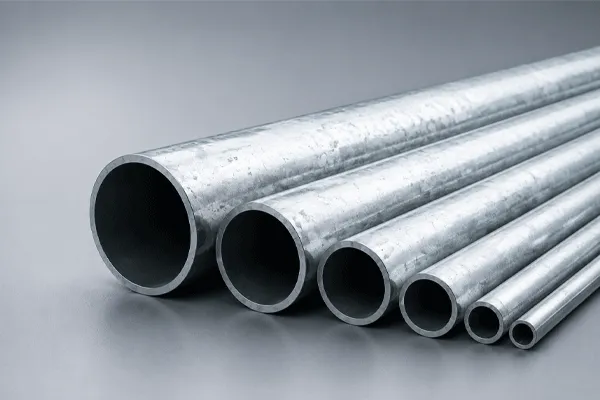
Galvanized Steel Pipe Sizes: NPS, DN and Wall Thickness
Wall thickness by EN series
Threadable galvanized tube sold into European, African and Middle Eastern markets is frequently specified to EN 10255, the standard that replaced BS 1387. Many tender documents still write “BS 1387” out of habit; mills read that as EN 10255. The system uses named series rather than schedule numbers.
| DN |
OD (mm) |
Medium (M) wall (mm) |
Heavy (H) wall (mm) |
| DN15 |
21.3 |
2.65 |
3.25 |
| DN20 |
26.9 |
2.65 |
3.25 |
| DN25 |
33.7 |
3.25 |
4.05 |
| DN32 |
42.4 |
3.25 |
4.05 |
| DN40 |
48.3 |
3.25 |
4.05 |
| DN50 |
60.3 |
3.65 |
4.50 |
| DN65 |
76.1 |
3.65 |
4.50 |
| DN80 |
88.9 |
4.05 |
4.85 |
| DN100 |
114.3 |
4.50 |
5.40 |
| DN150 |
165.1 |
4.85 |
5.40 |
EN 10255 also defines a lighter series with thinner walls. It is not interchangeable with medium series in threaded water service, and several national plumbing codes exclude it. If a quotation comes back unusually cheap on a DN25–DN50 threaded scope, the series is the first thing to check.
The range stops at DN150. Above that, EN 10219 (structural hollow sections) or EN 10217/10224 (pressure and water pipe) take over, each with its own diameter list.
Where the two systems disagree
Compared with the size charts most regional distributors and service centres publish, which usually present one system in isolation, the practical risk sits in the overlap. Five DN labels carry a different outside diameter depending on which standard the buyer and the mill each had in mind.
| DN |
ASME B36.10M / ASTM A53 OD (mm) |
EN 10255 / ISO 65 OD (mm) |
Difference |
| DN20 |
26.7 |
26.9 |
0.2 mm |
| DN25 |
33.4 |
33.7 |
0.3 mm |
| DN32 |
42.2 |
42.4 |
0.2 mm |
| DN65 |
73.0 |
76.1 |
3.1 mm |
| DN150 |
168.3 |
165.1 |
3.2 mm |
The small differences at DN20 to DN32 sit inside most threading tolerances and rarely cause a problem. DN65 and DN150 do. A DN65 grooved coupling cut for 76.1 mm will not seal on 73.0 mm pipe, and a DN150 flange bored for 168.3 mm will not clamp 165.1 mm tube. Neither error is visible in a photograph of the bundle, and both are found after the container is discharged.
Chinese national standard GB/T 3091, which governs much of the galvanized welded pipe produced for water and low-pressure liquid service, lists more than one diameter series and includes both 73.0 mm and 76.1 mm as valid entries. That is why a mill can supply “DN65 galvanized pipe” in good faith and still send the wrong pipe. The fix is one line in the purchase order: state the OD in millimetres alongside the DN label.
Quick answer: DN65 is 73.0 mm under ASME/ASTM and 76.1 mm under EN 10255/ISO 65. DN150 is 168.3 mm under ASME/ASTM and 165.1 mm under EN 10255. Always specify the OD in millimetres, not the DN label alone.
What the tolerance actually permits
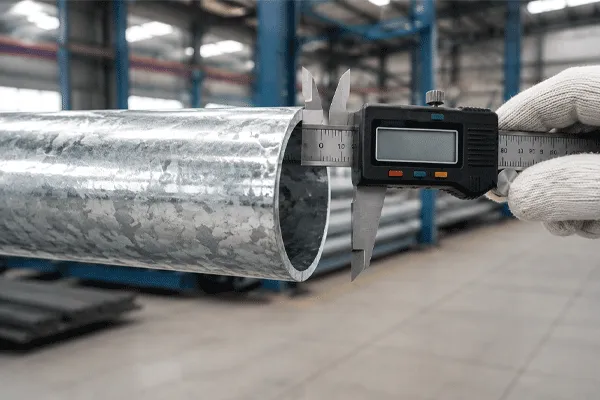
Published dimensions are targets. The contract dimension is the target plus its tolerance, and a mill delivering at the permitted minimum has delivered conforming pipe.
ASTM A53/A53M sets the following limits for welded and seamless pipe:
| Parameter |
Permitted variation |
| OD, NPS 1/2″ to 1-1/2″ |
±0.4 mm (±1/64 in) |
| OD, NPS 2″ and larger |
±1% |
| Wall thickness |
−12.5% of nominal, no specified plus limit |
| Weight, single length |
+10% / −3.5% |
| Length, single random |
4.88–6.71 m |
| Length, double random |
6.71 m minimum, 10.7 m average minimum |
The wall tolerance is where most weight disputes originate. DN50 SCH 40 nominal wall is 3.91 mm; the minimum acceptable wall is 3.42 mm. Across a full container, pipe produced at minimum wall weighs roughly 12% less than pipe produced at nominal. If the order was priced per metre and the buyer resells per tonne, that gap lands on the buyer. If the order was priced per tonne, it lands on the buyer differently: the same tonnage now yields more metres than the project schedule assumed, but each piece is thinner than the drawing shows.
Neither outcome is a defect. Both are avoidable by stating whether the wall tolerance is symmetrical, one-sided, or whether a minimum-wall requirement applies.
Zinc coating changes the dimension too
Galvanized pipe is ordered by two different coating logics, and the two are not converted by a single factor.
| Basis |
Standard family |
Expressed as |
Applies to |
| Coating mass |
ASTM A53, EN 10240 |
g/m² or oz/ft² |
Total surface, or per surface — state which |
| Coating thickness |
ASTM A123/A123M |
µm, by material category and steel thickness |
Hot-dip galvanizing after fabrication |
ASTM A53 states its galvanized coating requirement as a minimum mass on the total surface area, meaning the inside and outside surfaces combined. EN 10240 defines coating classes for tubes galvanized in automatic plants, with class A1 covering internal and external coating together. A buyer who writes “400 g/m² zinc” without saying whether that is per surface or total has written a requirement that can be met two ways, one of which uses roughly half the zinc.
Two dimensional effects follow:
- Coating adds to the outside diameter. A heavy coating on small-bore threaded pipe can interfere with fitting engagement, which is why threads are normally cut after galvanizing and then protected separately. Confirm with the mill whether thread protection is applied and what it consists of.
- Coating adds to the shipped weight. For DN50 with a total surface area of about 0.354 m² per metre, a 400 g/m² total-surface coating adds roughly 0.14 kg/m, near 2.6% of the bare pipe weight. On a per-tonne contract, that is 2.6% of the invoice buying zinc rather than steel — expected and correct, but worth knowing when comparing a pre-galvanized quotation against a hot-dip quotation.
Pre-galvanized pipe, made by forming and welding zinc-coated strip, carries no zinc on the weld seam or on cut ends. Hot-dip galvanizing after welding coats the seam, the bore and the ends. For a greenhouse frame in a dry climate the distinction may not matter. For buried drainage or a humid processing plant, it decides service life. The two are not substitutes at the same price point, and a quotation that does not say which process was used is not comparable to one that does.
Galvanized Steel Pipe Sizes: NPS, DN and Wall Thickness
Weight per metre, and why it decides the quotation
Steel pipe is quoted per tonne in most export contracts and installed per metre on most sites. The conversion is a single formula:
W (kg/m) = (OD − WT) × WT × 0.02466
where OD and WT are in millimetres and 0.02466 derives from the density of steel at 7.85 g/cm³. Worked values for common sizes, bare pipe before coating:
| Size |
OD (mm) |
Wall (mm) |
Weight (kg/m) |
Metres per 25 MT |
| DN25 SCH 40 |
33.4 |
3.38 |
2.50 |
10,000 |
| DN50 SCH 40 |
60.3 |
3.91 |
5.44 |
4,596 |
| DN50 EN medium |
60.3 |
3.65 |
5.10 |
4,902 |
| DN80 SCH 40 |
88.9 |
5.49 |
11.29 |
2,214 |
| DN100 SCH 40 |
114.3 |
6.02 |
16.07 |
1,556 |
The DN50 comparison is the one to sit with. SCH 40 and EN medium series carry the same OD and the same DN label. A 25 MT container of the EN medium product delivers about 306 metres more pipe, roughly 25 additional 12 m lengths. Priced per tonne, the two quotations look identical. Delivered to site, they are not.
Theoretical weight calculated by this formula is also what most mills invoice against. Where actual weighed weight governs instead, say so in the contract, because the two figures will differ by the wall tolerance discussed above.
Square and rectangular sections use a different logic
NPS and DN apply to round pipe. Square hollow sections (SHS) and rectangular hollow sections (RHS) are designated by their actual outside dimensions and wall thickness — 50 × 50 × 2.5 mm, 100 × 50 × 3.0 mm — with no nominal-size abstraction involved. There is no schedule number, and asking for “2 inch square pipe” produces a guess rather than a dimension.
Corner radius is the parameter buyers most often omit. EN 10219-2 and ASTM A500 both specify permitted external corner profiles as a function of wall thickness, and the radius governs whether a section will accept a given clamp, sleeve or standard bracket. It also affects the coating: sharp corners drain differently in a galvanizing bath than radiused ones.
Luyuan Steel’s published parameters for its pipe products are as follows. These are the values on the product pages and are the starting point for a specification, not a substitute for a confirmed order specification.
The API 5CT product carries a ±5% tolerance and is supplied with a Mill Test Certificate. A specific galvanized round pipe SKU with its own published diameter and coating range is not currently listed at product level, so coating class, diameter series and wall series should all be confirmed in writing at the enquiry stage rather than assumed from the category page. Cutting, bending, punching, welding and other processing are available depending on the product.
Length and packing follow from size
Standard export lengths are 6 m and 12 m. The choice is not only a site preference:
- 6 m bundles load into a 20 ft container, which is the practical unit for orders around 20–25 MT.
- 12 m bundles require a 40 ft container or a flat rack. Internal length of a standard 40 ft high cube is close to 12.03 m, which leaves almost nothing for bundle strapping and dunnage, so many mills supply 11.8 m when 12 m is nominated for a standard box.
- Random and double-random lengths under ASTM A53 arrive as a mixed-length bundle, not a uniform one. For projects with fixed-cut requirements this generates offcut waste that the price per tonne does not show.
End finish is a separate line item: plain end, bevelled end, threaded and coupled, or grooved. Threaded and coupled adds the question of whether couplings are supplied loose or fitted, and whether thread protectors are included.
Price context
Indicative public listing prices for galvanized steel pipe are approximately USD 608–623 per metric ton. Across Luyuan’s listed product range, published reference prices run from roughly USD 410 to USD 650 per metric ton depending on product type and specification. These are reference listing figures, not quotations. Final pricing moves with steel grade, dimensions, coating weight, surface treatment, processing, order quantity, Incoterms and destination. Any specification without a verified public listing price should be treated as price on request.
RFQ checklist for galvanized pipe
Send these twelve items and a mill can quote without a follow-up email.
- Dimensional standard and edition: ASTM A53/A53M, EN 10255, GB/T 3091, JIS G 3444 or other.
- Nominal size in bothconventions: NPS and DN.
- Outside diameter in millimetres, stated explicitly.
- Wall thickness: schedule number, EN series designation, or a millimetre value with its tolerance basis.
- Steel grade: Q235B, Q355B, ASTM A53 Grade B, S195T or equivalent.
- Galvanizing process: pre-galvanized from coated strip, or hot-dip galvanized after welding.
- Coating requirement with basis: g/m² or µm, and whether per surface or total surface.
- Interior coating requirement, stated separately if applicable.
- Length: fixed 6 m, fixed 12 m, or random/double-random with the permitted range.
- End finish: plain, bevelled, threaded and coupled, or grooved; couplings and thread protectors included or not.
- Tolerance regime: standard tolerance, or a tighter agreed limit on OD, wall or straightness.
- Documentation: Mill Test Certificate scope, third-party inspection by SGS, BV, Intertek or a buyer-appointed inspector, and whether invoicing is on theoretical or actual weight.
FAQ
Q: What is the actual outside diameter of 2 inch galvanized steel pipe?
A: 60.3 mm, equivalent to 2.375 inches, under both ASME B36.10M and EN 10255. DN50 is the metric label for the same pipe. The 2 inch figure describes neither the outside diameter nor the bore.
Q: Is DN25 the same as 1 inch pipe?
A: They are the same nominal size, but the outside diameter depends on the standard: 33.4 mm under ASME/ASTM and 33.7 mm under EN 10255/ISO 65. The 0.3 mm difference is normally absorbed by threading tolerance. At DN65 and DN150 the equivalent difference exceeds 3 mm and is not absorbable.
Q: How thick is the wall of 3 inch galvanized pipe?
A: For DN80 the SCH 40 wall is 5.49 mm and SCH 80 is 7.62 mm; under EN 10255 medium series it is 4.05 mm and heavy series 4.85 mm. Schedule is not a thickness, so the answer only exists once the size is fixed.
Q: Does the zinc coating count toward wall thickness?
A: No. Coating thickness is measured and specified separately, and it is added to the outside diameter rather than to the steel wall. Structural and pressure calculations use the steel wall only.
Q: What is the difference between pre-galvanized and hot-dip galvanized pipe?
A: Pre-galvanized pipe is roll-formed from already-coated strip, leaving the weld seam and cut ends bare. Hot-dip galvanized pipe is coated after welding, so the seam, the bore and the ends receive zinc. Pre-galvanized costs less and suits dry indoor or short-service applications; hot-dip is the choice for buried, humid or outdoor exposure.
Q: Should I order galvanized pipe by weight or by length?
A: Either works, but state which governs. Per-tonne pricing with theoretical weight is the export norm; per-metre requirements should be converted using W = (OD − WT) × WT × 0.02466 before comparing quotations, because two pipes of the same DN can differ by 6% or more in weight per metre.
Q: Can galvanized pipe be threaded after coating?
A: Yes, and it usually is. Threads cut after galvanizing expose bare steel, so the applicable standard requires the exposed thread to be protected. Confirm at the enquiry stage what protection the mill applies, because practice varies.
Q: Which sizes are available in 12 m lengths?
A: Most sizes can be produced at 12 m, but the constraint is usually shipping rather than production. A 12 m bundle needs a 40 ft container or flat rack, and the fit is tight enough that 11.8 m is often supplied instead. Confirm the exact cut length before the container is booked.






 08-27 2026