







Schedule 40 vs Schedule 80 Steel Pipe: How to Choose the Right Wall Thickness
Explore galvanized steel pipe sizes, OD, wall thickness, and schedule 40 charts. Learn how to measure galvanized pipe size and astm a53 specifications.
10-22 2026

 08-28 2026
 Luyuan Steel Technical Team | Steel Product Specification Support, Shandong Luyuan Metal Materials Co., Ltd. | Published / Last updated: 28 August 2026
Most price pages open with a number and let the reader assume it applies to their order. This one opens with a table that separates the two cases.
| Product line | Indicative listing range (USD/MT) | Band width above the low end |
| Cold rolled steel coil | 585–635 | 8.5% |
| PPGI / PPGL colour-coated coil | 460–650 | 41.3% |
| Galvanized steel pipe | 608–623 | 2.5% |
| H-beam structural steel | 440–568 | 29.1% |
| Selected roofing steel products | 410–450 | 9.8% |
| All listed products, overall | 410–650 | 58.5% |
| Product line | Status |
| Hot rolled coil and sheet | Price on request |
| Deformed bar / rebar | Price on request |
| Round bar and rod | Price on request |
| Galvanized and Galvalume coil | Price on request |
| Stainless steel sheet, coil, pipe, bar | Price on request |
| Aluminium and copper products | Price on request |
The second table is the honest half. A supplier that publishes a number for every line it sells is either quoting a base specification and adjusting later, or averaging across specifications that do not belong in the same average. Where no verified listing price exists, the answer is price on request rather than a band invented to fill the row.
Quick answer: Cold rolled steel coil lists at approximately USD 585–635 per metric ton as of August 2026. Where a product line has no published listing price, quotations are issued per specification rather than from a standing band.
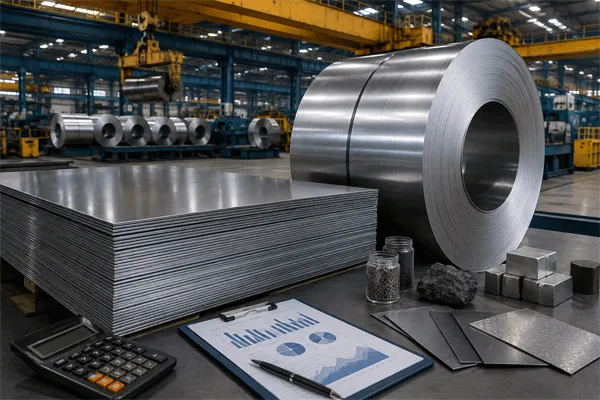
Cold Rolled Steel Prices in 2026: Ranges and Cost Drivers
Read the right-hand column of the first table again. It is the single most useful number on this page.
Galvanized pipe spans 2.5% from the bottom of its band to the top. The product is defined by a small set of standardised sizes and grades, so once diameter and wall are fixed there is little left to negotiate. PPGI spans 41.3%. Colour-coated coil carries a substrate choice, a zinc or aluminium-zinc coating weight, a primer and topcoat system, a backer coat, a RAL colour and a gloss level, and each of those is a separate cost line. Two PPGI orders can sit at opposite ends of that band and both be correctly priced.
H-beam at 29.1% behaves differently again: section size and grade drive it, and the spread mostly reflects the range of sections in the catalogue rather than a range of quality for one section.
The practical rule follows directly. When you receive an offer, first ask how wide the band is for that product. In a 2.5% band, a quote 10% below the market is a red flag about the product. In a 41.3% band, it may simply be a thinner substrate with a cheaper paint system, which is a legitimate offer for the wrong specification.
Compared with the index and benchmark trackers that dominate this search, which report regional averages for a defined base specification, a mill quotation is a single specification at a single moment with a specific delivery term attached. Four gaps explain most of the difference:
None of this makes indices useless. It makes them a directional check on whether the market is rising or falling, not a benchmark for whether your specific offer is fair.
Cold rolled coil is the clearest case because its band is narrow enough to attribute. Luyuan’s published parameters for the line:
| Parameter | Published value |
| CR Coil thickness | 0.12–5.0 mm |
| Coil inner diameter | 508 mm / 610 mm |
| CR Sheet thickness | 0.20–0.50 mm |
| Common grades referenced for manufacturing applications | SPCC, SPCD, SPCE |
| CR Rod grades | 1.2436, D7, SKD2, X210CrW12 |
| Processing available | Cutting, bending, punching, annealing, black annealing, welding, decoiling |
| Indicative listing range | USD 585–635/MT |
Four variables move an order inside that band, roughly in this order of impact:
Grade. SPCC is the general commercial quality under the JIS system. SPCD is a drawing quality, SPCE a deep drawing quality. Each step adds constraints on chemistry and on annealing, and rejects at the customer’s press are what the grade is buying insurance against. Ordering SPCC for a part that needs SPCE saves money on the coil and spends it on scrap. Ordering SPCE for a flat panel spends money on a property the part never uses.
Thickness. The published range runs from 0.12 mm to 5.0 mm, a factor of over 40. Thin gauge costs more per tonne because rolling passes multiply, line speed drops, and yield loss on head and tail becomes a larger share of a lighter coil. Below roughly 0.3 mm the cost curve steepens noticeably. A buyer who nominates 0.25 mm when 0.35 mm would work has moved themselves up the band for nothing.
Tolerance and flatness. Standard tolerance is included in the published range. A tightened gauge tolerance, a flatness requirement expressed in I-units, or an edge condition requirement are all separately costed because they change how the mill runs the line and how much of the coil it can ship.
Surface and annealing condition. Black annealed, full hard, and skin-passed material are different products with different downstream behaviour. Black annealing appears in the published processing list; specifying it or not specifying it changes both price and what arrives.
Coil inner diameter is the variable buyers forget. 508 mm and 610 mm are both offered. If your decoiler is built for one, receiving the other means a mandrel adapter or a rejected coil, and the price difference between them is nil. This is a specification that costs nothing to state and something to omit.
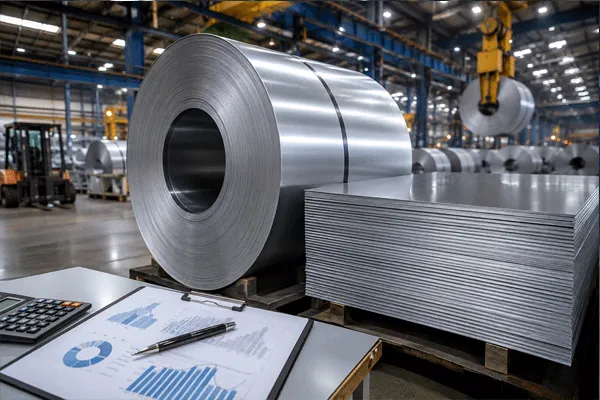
Cold Rolled Steel Prices in 2026: Ranges and Cost Drivers
For galvanized and colour-coated products, coating weight is quoted in grams per square metre across both surfaces, while the coil is sold by mass. That mismatch produces an effect most buyers underestimate.
Steel mass per square metre is thickness in millimetres multiplied by 7.85. Zinc adds the coating class directly. Running the arithmetic:
| Coil thickness | Steel mass (kg/m²) | Z120 zinc as % of mass | Z275 zinc as % of mass |
| 0.20 mm | 1.57 | 7.6% | 17.5% |
| 0.30 mm | 2.36 | 5.1% | 11.7% |
| 0.50 mm | 3.93 | 3.1% | 7.0% |
| 1.00 mm | 7.85 | 1.5% | 3.5% |
At 0.20 mm, a Z275 coating is over 17% of what you pay for by weight. At 1.00 mm the same coating class is 3.5%. This is why a per-tonne price for coated coil is meaningless without both the gauge and the coating class, and why “upgrade the coating, keep the price” is not a request a mill can grant on thin gauge.
Luyuan’s published coated-product parameters give the context: GI coil is listed at Z120 in grades DX51D/SGCC, with zinc ranges up to Z275 referenced on agriculture and manufacturing application pages depending on the product. Galvalume coil is published at 0.21–0.50 mm. PPGI thickness is published at 0.21–0.50 mm. Coating weight, paint type and RAL colour are supported as customisation at company level, which is precisely why the PPGI band is the widest on the page.
An offer of USD 585 and an offer of USD 640 can be the same commercial proposition. Incoterms 2020, published by the International Chamber of Commerce, defines who pays for what; the per-tonne number absorbs whichever costs sit on the seller’s side of the line.
| Term | Included in the seller’s price | Buyer arranges and pays |
| EXW | Product at the works | Loading, inland haulage, export clearance, ocean freight, insurance, import duty, delivery |
| FOB | Product, inland haulage, export clearance, loading on vessel | Ocean freight, insurance, import duty, delivery |
| CFR | Product plus ocean freight to named port | Insurance, import duty, delivery from port |
| CIF | Product, ocean freight, minimum insurance cover | Import duty, delivery from port |
Two offers cannot be compared until both are restated on the same term. The common error runs the other way: a buyer compares an EXW figure from one supplier against a CFR figure from another, selects the lower number, and discovers the difference at the freight booking. Ask for the term in writing on every offer, and ask for the named port, because CFR to two ports in the same country is two different prices.
Import duty, anti-dumping measures and safeguard quotas in the destination market sit outside all four terms and outside any supplier’s price. They are frequently larger than every specification variable on this page combined. Check the tariff classification for the specific product before you compare offers at all.
Volume affects price, but not smoothly and not always in the direction buyers assume.
If your annual requirement is large but fragmented, consolidating specifications is often worth more than negotiating the price of the fragmented list.
Every offer that is materially below the band has an explanation. Six are common, and none of them are visible in the price line:
The list is not an argument that cheap offers are dishonest. It is an argument that a price comparison between two offers is invalid until these six lines are equalised.
Steps 1 to 4 resolve most of the apparent price differences buyers bring to us. Step 8 is the one that turns a price check into a specification check, which is the more valuable exercise.
Quality documentation is part of what a per-tonne price includes, and it should be priced in deliberately rather than discovered as an omission:
Company-level certifications claimed on the website cover ISO 9001, ISO 14001, ISO 45001 and RoHS. Certificate numbers should be requested and verified directly against the issued certificates rather than taken from any web page, including this one.

Cold Rolled Steel Prices in 2026: Ranges and Cost Drivers
Send these and the returned quotation will be comparable to any other:
A: The indicative listing range is approximately USD 585–635 per metric ton as of August 2026. Position inside that band depends mainly on grade, thickness, tolerance and annealing condition. Delivered prices at your port will be higher by the freight and insurance component of the Incoterm used.
A: Indices report an average for a defined reference specification at a defined delivery point over a past period. A quotation prices your specification, on your delivery term, for a forward shipment. Both can be correct and different at the same time.
A: Galvanized and Galvalume coil are quoted on request rather than from a published band, because coating class and gauge move the per-tonne figure substantially. Zinc is between 1.5% and 17.5% of a coil’s mass depending on those two variables alone.
A: Rebar has no published listing price and is quoted per specification. Grade, diameter, length or coil format, and destination standard all affect the figure.
A: The indicative listing range is approximately USD 440–568 per metric ton. The spread mostly reflects the range of section sizes rather than quality variation within a single section.
A: Hot rolled material generally sits below cold rolled per tonne because it skips the cold reduction and annealing steps. Luyuan does not publish a listing range for hot rolled products, so the comparison should be made on two live quotations rather than on published figures.
A: Round bar and rod are quoted on request. Grade is the dominant variable, and tool steel grades such as 1.2436, D7, SKD2 and X210CrW12 sit in a different pricing category from commercial carbon rod entirely.
A: An export offer prices raw material the mill has not yet bought, plus a freight rate that has not yet been booked. Both move. A long validity window is either priced with a risk margin or not honoured.
A: Not by itself. A larger order of one specification usually does. A larger order split across several specifications can price close to several smaller orders, because each specification is a separate production run and inspection lot.
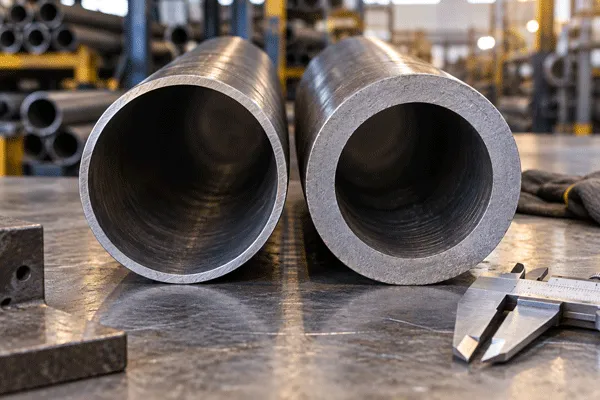
Explore galvanized steel pipe sizes, OD, wall thickness, and schedule 40 charts. Learn how to measure galvanized pipe size and astm a53 specifications.
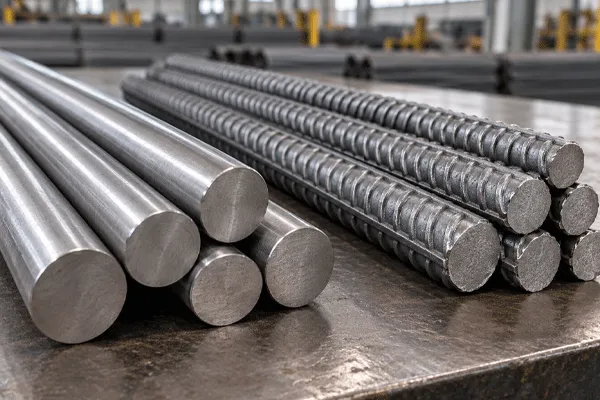
Compare plain round bar and deformed bar in this steel reinforcement guide. Learn which type of steel bar and rebar is best for your construction project.
We will reply you within 24 hours. If for urgent case, please add WhatsApp/WeChat: +86 15066120072,. Or call +86 15066120072 directly.
*We respect your confidentiality and all information are protected.
We will only use your information to respond to your inquiry and will never send unsolicited emails or promotional messages.