Luyuan Steel Technical Team | Shandong Luyuan Metal Materials Co., Ltd. | Published: 26 August 2026 | Last technical review: August 2026
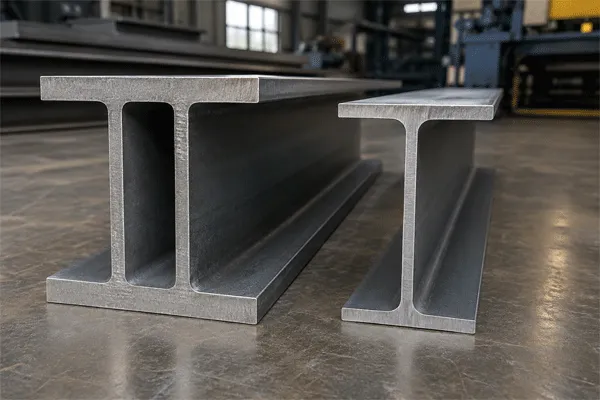
An H beam and an I beam differ mainly in flange geometry. H sections have parallel inner flange faces and a wider flange relative to depth, which raises weak-axis stiffness and suits columns. Taper-flange I sections are narrower and deeper for their weight, and work best in laterally restrained bending.
f you arrived here looking for connecting rods: “H-beam vs I-beam” is also used for forged automotive engine rods, where the cross-section is machined rather than rolled and the selection logic is about inertia and RPM, not flange width. This article is about hot-rolled structural sections for buildings, frames and infrastructure. Nothing below applies to engine components.
H Beam vs I Beam: Choosing Sections for Structural Work
The one difference that drives everything else
Both sections put material at the top and bottom, where bending stress is highest, and connect it with a web that carries shear. The divergence is in what happens to the flange.
A traditional I-beam has flanges whose inner faces slope toward the tip. In the Chinese hot-rolled I-section series the inner face runs at a taper in the region of 1:6; the American S-shape and the European IPN use comparable slopes, with exact values fixed by each dimensional standard. The taper is a rolling-era artefact: it let mills roll the section on simpler stands.
An H section has parallel inner flange faces. It also carries a wider flange for a given depth. The flange width is the point. Widening the flange increases the second moment of area about the minor axis far faster than it increases weight, which changes what the section can be used for.
| Geometric feature |
H section (HW/HM/HN, W-shape, HEA/HEB, IPE) |
Taper-flange I section (GB I-series, S-shape, IPN) |
| Inner flange face |
Parallel |
Sloped, commonly around 1:6 |
| Flange tip thickness |
Equal to root thickness |
Thinner than root |
| Depth-to-width ratio (h/b) |
1:1 to about 3:1 depending on series |
Roughly 1.5:1 rising past 3:1 in deep sizes |
| Minor-axis stiffness (I<sub>y</sub>) |
High in wide-flange series |
Low; the section is deliberately narrow |
| Largest common hot-rolled depth |
900 mm in narrow-flange H series; larger available as welded built-up sections |
630 mm in the Chinese hot-rolled I-section series |
| Bolted connection to flange |
Flat bearing surface |
Requires taper washers or a machined seat |
| Availability as welded plate girder |
Standard practice |
Rare; if it is welded, it is an H section |
One consequence buyers underestimate: modern narrow-flange H series were designed as the replacement for the taper-flange I-beam in beam applications. In a lot of current construction, a section that a drawing calls an “I-beam” is in fact specified and supplied as a parallel-flange H section. Reading the designation matters more than reading the word.
Why the weak axis decides most of these selections
For a beam bending about its strong axis with the compression flange restrained by a slab, decking or purlins, the narrow deep section is efficient. It puts more of its mass further from the neutral axis, so it delivers a given strong-axis section modulus at lower kilograms per metre.
That efficiency disappears the moment the compression flange is unrestrained or the member takes axial load.
Lateral-torsional buckling. An unrestrained beam fails by the compression flange swinging sideways and twisting. Resistance scales with minor-axis stiffness and torsional properties. A narrow section loses capacity quickly as the unrestrained length grows; a wide-flange section holds a much larger fraction of its plastic moment at the same span.
Column buckling. A column buckles about its weaker axis. With a taper-flange I-section, the radius of gyration about the minor axis is a small fraction of the major-axis value, so the effective slenderness about that axis governs and the section is uneconomic. Wide-flange sections with h/b near 1:1 bring the two axes closer together, which is exactly why they exist as a separate series.
Torsion. Neither open section is good in torsion. If the load path applies significant torsion, the answer is usually a closed hollow section, not a wider flange. This is worth saying plainly, because “use an H beam, it’s stronger in torsion” is a common shortcut that misleads.
H Beam vs I Beam: Choosing Sections for Structural Work
Reading the designation instead of the picture
This is where most general comparison pages stop short. They describe the flange sketch and end there. For anyone buying across borders, the designation system is the part that has to be right, because the same profile carries four different names and each name is tied to a different dimensional standard and tolerance regime.
| Region |
Wide-flange / H family |
Taper-flange I family |
Dimensional standard |
Common material specification |
| China |
HW / HM / HN (and thin-wall HT) |
I-series, e.g. I20a, I36b, I63c |
GB/T 11263 (H and split-T); GB/T 706 (I-section, channel, angle) |
GB/T 700 (Q235B); GB/T 1591 (Q355, formerly designated Q345) |
| Japan |
H |
I |
JIS G 3192 |
JIS G 3101 (SS400) |
| United States |
W-shape (wide flange) |
S-shape (American Standard Beam) |
ASTM A6/A6M |
ASTM A992 for W-shapes; ASTM A36 |
| Europe |
HEA / HEB / HEM; IPE |
IPN |
EN 10365 (dimensions and masses); EN 10034 (I and H tolerances) |
EN 10025-2 (S235JR, S355JR) |
Two traps live in that table.
IPE is not a taper-flange section. The name says “I”, the geometry says parallel flanges. IPE is a narrow parallel-flange section that behaves like the HN family, not like IPN. A buyer who substitutes IPN for IPE on the basis of the letter has changed the section properties and the connection detail at the same time.
W and S are not interchangeable in the same nominal depth. A W-shape and an S-shape may both be nominally 250 mm deep and have entirely different flange widths, weights and capacities.
The Chinese H series splits by proportion, which makes selection quicker once the logic is clear:
| Series |
Approximate h/b |
Typical size range |
Where it is normally used |
| HW (wide flange) |
About 1:1 |
100×100 up to 400×400 |
Columns, heavily loaded posts, members with axial load |
| HM (medium flange) |
About 1.33:1 to 1.75:1 |
150×100 up to 588×300 |
Beam-columns, portal frames, members carrying both moment and axial force |
| HN (narrow flange) |
2:1 and above |
200×100 up to 900×300 |
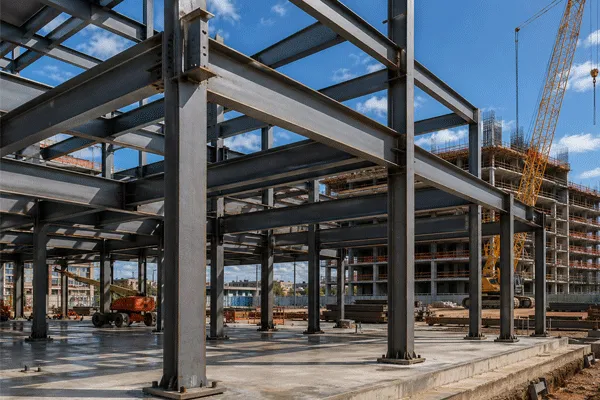
Floor beams, rafters, purlin supports, long-span bending members with restraint |
Where each one is still the right answer
| Application |
Typical section choice |
Reason |
| Building column, multi-storey frame |
HW / HEB / W-shape |
Minor-axis radius of gyration governs; near-square proportion is economical |
| Floor beam with composite slab or decking |
HN / IPE / W-shape |
Compression flange restrained; narrow deep section is efficient per kilogram |
| Portal frame rafter, long unrestrained length |
HM or HN with restraint design |
Lateral-torsional buckling governs; restraint spacing is part of the specification |
| Crane runway beam |
Wide-flange section, often with cap channel |
Lateral load from crane surge acts on the minor axis |
| Short-span lintel, light platform, machine base |
Taper-flange I-section where locally standard and stocked |
Lowest cost per metre in small depths, availability driven |
| Trusses and lattice girders |
H sections or hollow sections |
Bolted flat flange faces simplify gusset connections |
| Members with significant torsion |
Neither; consider hollow section |
Open sections have low torsional constant |
Compared with the general-purpose stockist listings that dominate this search, which quote a nominal depth and a price per tonne, project procurement needs three additional data points before an order can be placed: the designation series, the dimensional and tolerance standard, and the material grade with its impact-test condition. A section ordered on depth alone will arrive as whatever the mill happens to roll.
Fabrication consequences buyers pay for later
The taper is not only a stiffness question. It changes shop work.
Bolting through a sloped flange requires taper washers to seat the bolt head square, or a machined bearing surface. Every one of those is a line item and an inspection point. Parallel flanges take a flat washer and a standard torque check.
Flange-to-web connection detailing differs too. On a taper-flange section, the flange thickness at the fastener line is not the thickness printed on the section table, which affects bearing and prying calculations if it is read carelessly.
Coating cost tracks surface area, not weight. A wide-flange section carries more painted or galvanized area per tonne than a narrow one of the same mass. For a project specifying hot-dip galvanizing, that difference shows up in the coating invoice and in the bath-size constraint on member length.
What Luyuan publishes for H Beam, and what still needs to be quoted
The specifications below are taken from Luyuan’s published H Beam product listing. Anything marked “not published” is a genuine gap that has to be closed in the quotation, not an omission this article can fill.
| Parameter |
Published position |
What to do at RFQ stage |
| Product |
H Beam (hot-rolled section steel) |
Confirm series: HW, HM or HN |
| Listed grade |
Q345 |
See the Q345/Q355 note below; state the grade and standard edition you require |
| Length |
1,000–12,000 mm |
State whether fixed length, multiple length or cut-to-length is required |
| Section size range |
Not published at SKU level |
Provide the exact h × b × t<sub>w</sub> × t<sub>f</sub> or the designation |
| Dimensional tolerance |
Not published for H Beam |
Nominate the tolerance standard (GB/T 11263, EN 10034, JIS G 3192 or ASTM A6/A6M) |
| Impact test condition |
Not published |
Specify test temperature and required energy if the project demands it |
| Surface / coating |
Not published for H Beam |
State bare, primed, or hot-dip galvanized with the coating standard |
| Documentation |
English Mill Test Certificate supplied with shipment |
Confirm the certificate reports the tests your inspector will verify |
| Inspection |
100% pre-shipment inspection; SGS, Bureau Veritas, Intertek or buyer-appointed inspectors accepted |
Nominate the inspection body and scope in the contract |
| Indicative price |
Approximately USD 440–568 per metric ton (reference listing range, H-beam steel) |
Not a quotation; final price depends on section, grade, length, coating, quantity, Incoterms and destination |
The Q345 note. Q345 is a legacy Chinese low-alloy structural grade designation. Under the current GB/T 1591 revision, the equivalent grade is designated Q355, with subgrades B, C, D and E distinguished by impact-test temperature. Product listings across the Chinese steel market, including Luyuan’s, still carry Q345 as the familiar market name. This is a naming question rather than a material substitution question, but it becomes contractual once a mill certificate is issued, so the purchase order should name both the grade and the standard edition it is called up under. Ask which designation will appear on the MTC before the order is confirmed.
H Beam vs I Beam: Choosing Sections for Structural Work
Adjacent sections in the same product line, for buyers packaging a frame order:
| Product |
Published grades |
Published dimensions |
Published tolerance |
| H Beam |
Q345 |
Length 1,000–12,000 mm |
Not published |
| C Beam (channel) |
Q195–Q420 |
Thickness 3–24 mm; length 1–12 m customised |
Not published |
| L Beam / angle bar |
Q195–Q420 |
Hot rolled or cold rolled |
±10% |
| Steel pile |
Q235 / Q345 / SS400 / S235–S460 |
Thickness 0.12–15 mm customised |
Not published |
Hot-rolled grades referenced at solution level across Luyuan’s project pages include Q235B, Q345B, A36, S235JR and S355JR. Those appear as application references rather than SKU-level entries on the H Beam listing, so treat them as availability to confirm rather than confirmed stock.
A selection sequence you can actually run
- Establish whether the member carries axial load. If it does, and the load is significant relative to the moment, start in the wide-flange series (HW, HEB, W-shape) and stop considering taper-flange sections.
- For pure bending members, identify the restraint condition. Write down the actual distance between points of lateral restraint to the compression flange, not the span.
- Size the section for strong-axis moment first, then check lateral-torsional buckling at that unrestrained length. If the check fails by a wide margin, adding restraint is usually cheaper than moving up a series.
- Check web shear and web bearing at supports and at point loads. Deep narrow sections are the ones that fail bearing checks and need stiffeners.
- Check deflection against the serviceability limit the client contract names. Deflection frequently governs long floor beams before strength does.
- Convert the chosen profile into the designation system your supplier rolls to, using the cross-reference table above. Do not translate by nominal depth alone.
- Fix the tolerance standard and the material standard edition in the purchase specification.
- Confirm length availability against the 12,000 mm published maximum before the connection layout is frozen, since splices added late change both the steel tonnage and the erection programme.
Three misconceptions worth correcting before you order
“H beams are always stronger.” Stronger about which axis, and per what. Kilogram for kilogram, a narrow deep section carries more strong-axis moment when its compression flange is restrained. The wide-flange section wins on minor-axis stiffness, buckling resistance and connection practicality. “Stronger” without an axis is not a specification.
“H beam and I beam are just two names for the same thing.” In casual site language they often are, and in modern practice a great many members drawn as I-beams are supplied as parallel-flange H sections. But when a drawing calls up IPN 300 and a supplier ships HEA 300, the section properties, the weight and the connection detail all change. The designation, not the silhouette, is the contract.
“The mill certificate proves the section meets the standard.” An MTC reports chemistry and mechanical test results for the heat. Dimensional conformity against the section tolerance standard is a separate verification, usually carried out at pre-shipment inspection. Ask for both, and name the tolerance standard when you do, otherwise there is nothing for the inspector to measure against.
RFQ checklist for hot-rolled sections
- Section designation and series (for example HN400×200, IPE 300, W12×26), plus the dimensional standard it is called up under.
- Steel grade, standard and edition (for example S355JR to EN 10025-2, or the current Chinese designation to GB/T 1591), and confirmation of which designation will be printed on the MTC.
- Impact test requirement: temperature, energy, and whether testing is per heat or per batch.
- Dimensional tolerance standard to be applied and verified at inspection.
- Length: fixed, multiple, random within a range, or cut-to-length, with the cutting tolerance stated.
- Quantity by piece count and by tonne, with the tonnage basis (theoretical mass from the section table, or actual weighed mass) stated.
- Surface condition: bare, shop-primed with a named primer system, or hot-dip galvanized with the coating standard and required coating mass.
- End condition: as-rolled, square cut, coped or drilled, with a drawing if any shop work is included.
- Marking and traceability: heat number, section designation and batch identification on each piece.
- Inspection: third-party body, scope, and whether dimensional checks are inside that scope.
- Packing and loading method, especially bundle mass limits for the destination port’s handling equipment.
- Incoterms, destination port, and required shipping documents.
FAQ
Q: Is an H beam the same as a wide flange beam?
A: In common usage, yes. “Wide flange” is the American term for the parallel-flange section designated W; “H beam” is the term used in Chinese and Japanese practice, subdivided into HW, HM and HN by depth-to-width ratio. The European equivalents are the HEA, HEB and HEM series.
Q: Which one is cheaper per metre?
A: In small depths, taper-flange I-sections are often cheaper where they are locally stocked, because the mass per metre is lower. At larger sizes and for anything carrying axial load, the comparison should be made on delivered cost for the required capacity, not on price per metre. Luyuan’s published reference range for H-beam steel is approximately USD 440–568 per metric ton, which is a listing indication rather than a quotation.
Q: Can I substitute an H section for an I section of the same depth?
A: Not without checking. Same nominal depth does not mean same section modulus, same weight or same flange width. The substitution also changes the connection geometry, the bolt gauge lines and often the coating area. Run the checks, and get the substitution approved by the engineer of record.
Q: What is the maximum length available?
A: Luyuan’s published H Beam listing states 1,000–12,000 mm. Longer members are normally achieved by splicing, which needs to be designed rather than decided in the field.
Q: What does HN400×200 mean?
A: HN identifies the narrow-flange H series. The numbers are nominal depth in millimetres by nominal flange width in millimetres. Web and flange thicknesses come from the dimensional table in the governing standard, which is why the standard has to be named alongside the designation.
Q: Which section is better for a column?
A: A wide-flange section, in almost every case. Column capacity is limited by buckling about the weaker axis, and the near-square proportion of the HW, HEB or W series brings the two axes closer together. Narrow sections used as columns are inefficient at anything but very short heights.
Q: Do I need to specify impact testing?
A: It depends on the service temperature, the plate thickness and the design code the project is built under. Many European and Chinese grades carry subgrade letters that correspond to impact-test temperatures. If the specification names a subgrade, the testing requirement travels with it and should appear on the certificate.
Q: Does Luyuan supply sections other than the listed grade?
A: The H Beam product listing publishes Q345. Other hot-rolled structural grades including Q235B, Q345B, A36, S235JR and S355JR appear on solution-level pages, which indicates application experience rather than a confirmed SKU. Send the required grade and standard in the RFQ so availability can be confirmed against actual rolling programmes.
Q: How do I verify the section I receive matches what I ordered?
A: Name the dimensional tolerance standard in the purchase order, then include dimensional verification in the pre-shipment inspection scope. Luyuan states that 100% pre-shipment inspection is carried out and that SGS, Bureau Veritas, Intertek or buyer-appointed inspectors are accepted, so the checks can be witnessed independently.






 08-26 2026