Luyuan Steel Technical Team | Product Specification & Export Documentation | Published: August 14, 2026
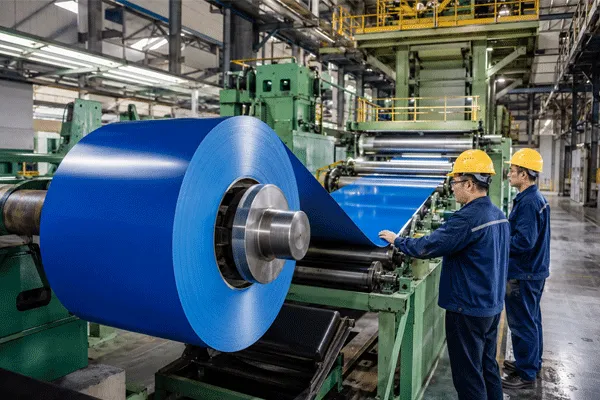
PPGI is pre-painted steel on a zinc-coated substrate; PPGL is pre-painted steel on an aluminium-zinc substrate. The paint process is the same. What changes is the metal underneath, and that decides corrosion behaviour, cut-edge performance and price. Luyuan publishes PPGI coil at 0.21–0.50 mm in DX51D.
PPGI Sheet Guide: Coatings, Thickness and PPGL Options
What the two abbreviations actually specify
A prepainted coil is four layers stacked on one another, and each layer is a separate line in a purchase order:
- Base steel— the substrate grade, DX51D for forming applications, structural grades where the profile carries load.
- Metallic coating— zinc (Z-class) makes it PPGI, aluminium-zinc (AZ-class) makes it PPGL.
- Pretreatment— chemical conversion layer that makes paint adhere. Rarely specified by buyers, frequently the cause of adhesion failures.
- Organic coating— primer plus topcoat on the exposed face, backer coat on the reverse.
Most explainer pages on this keyword stop at layer two, which is where the confusion starts. Compared with the marketplace listings and short definition posts that dominate this term, the parameters that actually change a quotation sit in layers three and four, and none of them appear in a definition.
The abbreviations themselves are trade shorthand, not standard designations. Continuously organic-coated flat steel products are covered by EN 10169 in the European system, with the metallic-coated substrate covered by EN 10346; ASTM International covers coil-coated metallic-coated sheet in ASTM A755/A755M; the Japanese Industrial Standards Committee maintains JIS G3312 for prepainted zinc-coated sheet and JIS G3322 for the prepainted 55% aluminium-zinc equivalent. None of those standards contains the word “PPGI.” When a specification needs to survive a dispute, the standard designation belongs in the contract and the abbreviation belongs in the email.
The DX51D+AZ naming question
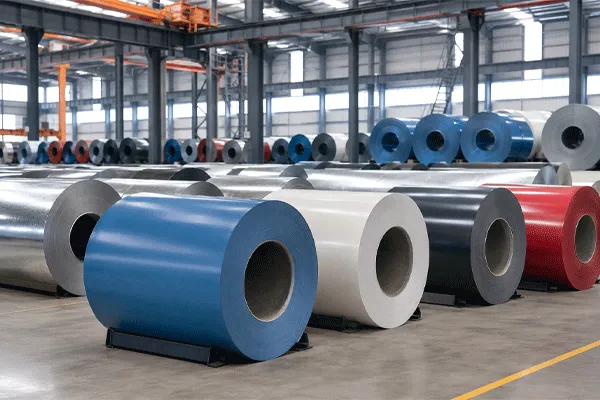
Luyuan’s product listing reads PPGI Steel Coil DX51D+AZ. Read strictly, an AZ substrate designation describes an aluminium-zinc coated base, which under the trade convention above would be sold as PPGL rather than PPGI.
This is not unique to one supplier. Across Chinese and Southeast Asian export listings, “PPGI” is routinely used as a category name for all prepainted coil regardless of substrate, with the substrate letter carried separately in the grade string. A buyer scanning product titles alone can order what they believe is a zinc-substrate product and receive an aluminium-zinc one, or the reverse.
The fix is one line in the enquiry: require the substrate coating type and coating mass to be stated explicitly, in the same notation the MTC will use. For example, “DX51D + Z120, coating mass in g/m² both surfaces” or “DX51D + AZ150, coating mass in g/m² both surfaces.” Once that line exists, the product title stops mattering.
PPGI Sheet Guide: Coatings, Thickness and PPGL Options
PPGI against PPGL: what actually differs
| |
PPGI (zinc substrate) |
PPGL (aluminium-zinc substrate) |
| Metallic coating |
Zinc, Z-class designation |
Nominal 55% Al / 43.4% Zn / 1.6% Si, AZ-class |
| Luyuan published substrate reference |
GI Coil DX51D/SGCC at Z120 |
Galvalume Coil S350GD at AZ150 |
| Open atmospheric exposure |
Shorter service life at equal coating mass |
Longer service life at equal coating mass |
| Cut and sheared edge |
Stronger sacrificial protection of bare edge |
Weaker edge protection; matters on perforated or heavily trimmed parts |
| Contact with wet concrete, mortar, alkaline materials |
Tolerates better |
Attacked; avoid direct contact |
| Heat reflectivity |
Lower |
Higher, relevant in hot-climate roofing |
| Forming and bending |
More forgiving at tight radii |
Coating is harder; check minimum bend radius before switching |
| Typical use split |
Appliance panels, interior, sandwich panel, general cladding |
Exposed roofing in hot or humid climates, long unpainted-adjacent runs |
| Price at same paint spec |
Usually lower |
Usually higher |
The decision is rarely “which is better.” It is which failure mode your product will meet first. A corrugated roof panel fixed as a large uncut sheet in a hot coastal climate favours the aluminium-zinc substrate. A perforated ceiling panel or a component with dense punching and shearing favours zinc, because the bare edge is where corrosion starts and the zinc substrate protects that edge more actively.
Paint slows both failure modes but does not remove them. Every cut edge, every drilled fixing hole and every scratch through to metal is a location where the substrate choice is doing the work alone.
Published thickness and substrate parameters
| Product |
Grade on listing |
Thickness (mm) |
Metallic coating on listing |
| PPGI / PPGL Coil |
DX51D+AZ |
0.21–0.50 |
Custom coating weight supported at service level |
| Galvalume Coil |
S350GD |
0.21–0.50 |
AZ150 (category page lists Z121–Z180) |
| GI Coil |
DX51D / SGCC |
0.18–0.30 |
Z120 |
Custom thickness, width, coating weight, paint type and RAL colour are supported at the service level rather than being fixed by the catalogue, so a requirement above 0.50 mm or a specific coating class outside the published figures belongs in the enquiry rather than being ruled out.
Two things this table does not tell you, and both are quotation-critical. The published thickness is base metal thickness, so confirm it is quoted that way rather than as total coated-plus-painted thickness. And no paint film thickness is published at product level, which brings us to the layer buyers most often leave unstated.
Paint systems: the parameter nobody writes down
Paint type is where two prepainted quotations diverge most and where the specification is usually thinnest. The common coil-coating systems, as designated across the industry:
| System |
Typical topcoat film build |
Realistic exposure behaviour |
Usual application |
| PE (polyester) |
Around 15–20 µm |
Shortest colour and gloss retention of the group |
Interior, sandwich panel facing, cost-driven roofing in mild climates |
| SMP (silicone modified polyester) |
Around 20 µm |
Better chalk and fade resistance than PE, harder film |
Mid-range exposed roofing and cladding |
| HDP (high durability polyester) |
Around 20–25 µm |
Improved fade resistance over PE at lower cost than PVDF |
Exposed cladding where PVDF is not budgeted |
| PVDF / PVF2 |
Around 25 µm |
Longest colour retention of the group |
Architectural facades, long-warranty projects, aggressive UV |
| Plastisol |
Around 100–200 µm |
Thick, textured, good impact and forming resistance; poorer UV performance in high-heat climates |
Industrial cladding, cold climates, high-abrasion handling |
These film builds are industry reference figures, not Luyuan published values. Paint type is supported as a customisable parameter, and the film thickness that will appear on your MTC is the one agreed in your order. Ask for topcoat µm, primer µm and backer coat µm as three separate numbers, and ask whether the µm figure is nominal or minimum. A “20 micron polyester” from two suppliers can differ by a third once you find out one figure includes the primer.
The backer coat gets forgotten. For sandwich panel production the backer specification affects adhesive bonding; for exposed underside roofing it affects appearance and condensation behaviour. State it.
RAL colour needs the same discipline: name the RAL number, state gloss level, and agree a colour tolerance and a signed reference sample. Colour matching across separate production batches is one of the few complaints that cannot be fixed at destination.
For buyers supplying appliance or electrical-equipment manufacturers, coating composition also has a compliance dimension. The relevant EU instrument is Directive 2011/65/EU on the restriction of hazardous substances in electrical and electronic equipment. Luyuan states company-level ISO 9001, ISO 14001, ISO 45001 and RoHS certification obtained in 2018, with RoHS certificates of conformity issued by Guangdong KEYS Testing Technology Co., Ltd. Certificate numbers are not published in accessible page text and should be requested as original documents rather than copied from a website, particularly where a tender requires them.
Where prepainted steel disappoints
- It does not repair itself at a cut edge.Site cutting with an abrasive disc burns the paint back and heats the metallic coating. Specify shear cutting or nibbling in the fabrication instruction, not angle grinders.
- Colour fades unevenly by orientation.South-facing and horizontal surfaces chalk faster than vertical north-facing ones on the same building, which produces a mismatch complaint that has nothing to do with material defect.
- Storage staining happens before installation.Wet-packed coil or stacked panels in a humid yard mark the paint. Packaging specification and site storage instructions carry as much weight as the coating system.
- Tight forming can craze the film.Higher film builds and harder paint systems have real minimum bend radii. Test with the actual coil, at the actual line speed, before committing a full order.
- Warranty language is not a material property.A stated durability class describes expected performance in a defined environment. Coastal, industrial and high-UV environments each shorten it, and the reduction is rarely printed on the same page as the headline figure.
On the other side of the ledger, the reason prepainted coil dominates roofing and cladding remains: consistent factory-applied colour across a whole project, no site painting, and a finished surface that survives roll forming. Neither list is complete without the other.
PPGI Sheet Guide: Coatings, Thickness and PPGL Options
Fixing the specification before you request a quote
- Substrate grade and standard together: “DX51D to EN 10346,” not “DX51D.”
- Metallic coating type and mass, with notation stated: “Z120, g/m² total both surfaces” or “AZ150, g/m² total both surfaces.”
- Base metal thickness in mm, with tolerance, and the words “excluding coating and paint.”
- Coil width, inner diameter and maximum coil weight your decoiler and crane accept.
- Paint system, topcoat µm, primer µm, backer coat µm, and whether figures are nominal or minimum.
- RAL number, gloss level, colour tolerance, and whether a signed reference sample is required before mass production.
- Protective film requirement, and whether it must survive roll forming.
- Documents and inspection: English MTC, packing list, and your nominated inspection body. Luyuan states 100% pre-shipment inspection, batch traceability from furnace number to shipment, and accepts SGS, Bureau Veritas, Intertek or a buyer-appointed inspector.
Points 5 and 6 are the two that separate a comparable quotation from a cheap-looking one.
FAQ
Q: Is PPGL always better than PPGI?
A: No. PPGL generally performs better in open atmospheric exposure and hot climates. PPGI generally protects cut and sheared edges better and tolerates contact with alkaline materials such as wet mortar. Heavily punched or perforated components often favour PPGI.
Q: What thickness does Luyuan publish for PPGI coil?
A: 0.21–0.50 mm on the current product listing, in DX51D. Requirements outside that range fall under custom production and should be raised in the enquiry alongside width and coating class.
Q: Does the published thickness include the paint?
A: Specify base metal thickness explicitly and require the MTC to report it that way. A supplier quoting total thickness including metallic coating and paint film will appear cheaper at the same nominal number.
Q: What is the difference between PE and PVDF in practice?
A: Colour retention over years of UV exposure, and price. PE is the entry system; PVDF holds colour longest and costs the most. SMP and HDP sit between them. The choice should follow the project’s exposure and warranty requirement, not the sample card.
Q: Can I get PPGI in a specific RAL colour?
A: Custom RAL colours, paint types and coating weights are supported at service level. Agree gloss level, colour tolerance and a signed reference sample before production, since batch-to-batch colour matching cannot be corrected after shipment.
Q: Does PPGI come with a certificate?
A: A full English Mill Test Certificate is supplied with shipments. Company-level certifications include ISO 9001, ISO 14001, ISO 45001 and RoHS. SKU-level certificate numbers are not published publicly and should be requested against a specific order.





 08-14 2026