Luyuan Steel Technical Team | Product Specification & Export Documentation | Published: August 14, 2026
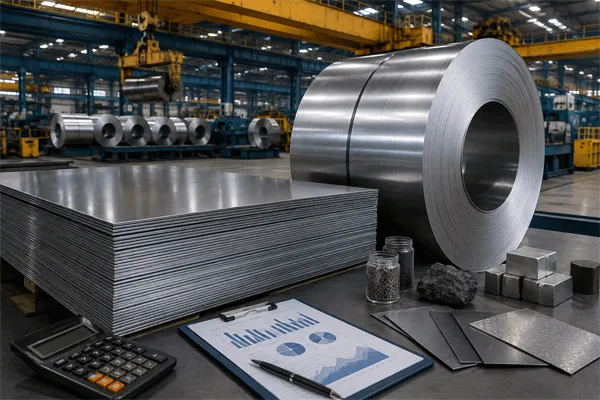
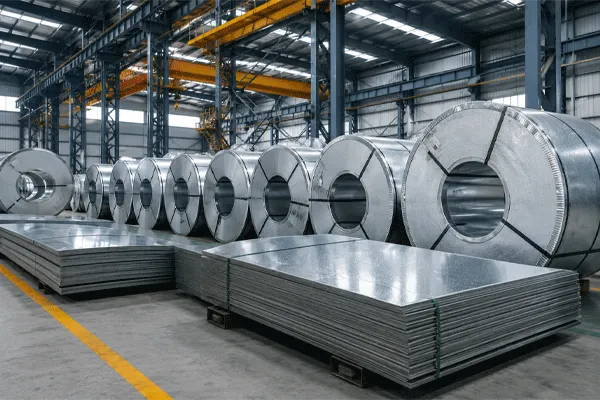
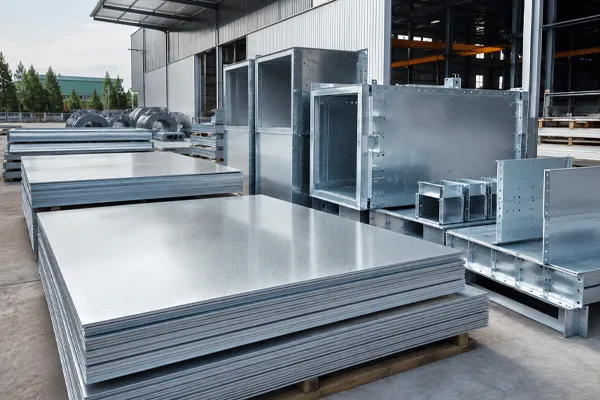
GP sheet means galvanized plain sheet: flat, uncorrugated, zinc-coated steel sold as sheet or coil. It is a regional trade term, not a standard designation. Nothing about the abbreviation tells you the grade, zinc coating mass or thickness, which is why a GP enquiry rarely returns comparable quotations.
What Is a GP Sheet? Galvanized Plain Sheet Specs and Uses
Four letters that describe the same family
Buyers meet these abbreviations in different markets, often within the same tender document:
| Term |
Full form |
What it actually specifies |
What it leaves open |
| GP |
Galvanized plain |
Zinc-coated, flat, uncorrugated form |
Grade, coating mass, thickness, width, surface |
| GI |
Galvanized iron |
Zinc-coated steel, any form |
Form, plus everything GP leaves open |
| GC |
Galvanized corrugated |
Zinc-coated, roll-formed into a corrugated profile |
Profile geometry, pitch, depth, plus base material spec |
| GL |
Galvalume / aluminium-zinc coated |
Aluminium-zinc alloy coating rather than pure zinc |
Coating class, grade, thickness |
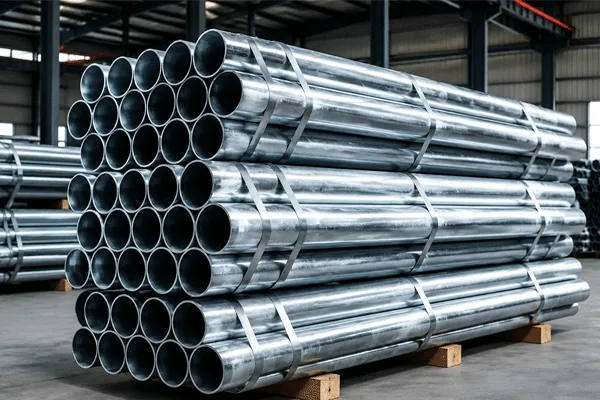
GP and GI are frequently used interchangeably in South Asian, Middle Eastern and East African trade. The practical distinction is form: GP is the flat product before profiling, GC is what a roll-former produces from it. A distributor buying GP is buying input material; a distributor buying GC is buying a finished roofing product with a fixed profile.
GL sits in a different category entirely, because the coating chemistry differs. Substituting an aluminium-zinc product against a zinc specification changes corrosion behaviour at cut edges and in contact with alkaline materials, and it changes price. If a quotation answers a GP enquiry with a GL product, that is a substitution, not an equivalent.
Why importers keep receiving unusable quotations
Send “GP sheet, 500 tons” to five suppliers and you will receive five prices that cannot be compared. The reason is arithmetic rather than dishonesty. Zinc coating mass alone moves cost across the entire tonnage, and the spread between a light and a heavy coating class is large enough to swallow any negotiated discount.
Compared with the trader listings that dominate this search term, where a product is described by little more than the abbreviation and a price per kilogram, an import contract needs four numbers fixed before price means anything: base metal thickness, zinc coating mass, grade with its standard, and width. Two of those four are where quotations quietly diverge.
Zinc coating class: three notations, one measurement
The most common cause of a rejected shipment on this product is a coating figure read in the wrong system. Three notations are in active use, and all three describe total coating mass across both surfaces:
| System |
Standard |
Notation |
Approximate g/m² total, both surfaces |
| European |
EN 10346 (CEN) |
Z100, Z120, Z275 |
The number is the g/m² figure directly |
| Japanese |
JIS G3302 (JISC) |
Z08, Z12, Z18, Z27 |
Multiply by 10; Z12 ≈ 120 g/m², Z27 ≈ 275 g/m² |
| American |
ASTM A653/A653M |
G30, G40, G60, G90 |
Triple-spot in oz/ft²; G40 ≈ 120 g/m², G90 ≈ 275 g/m² |
Read that table across one row and the point becomes obvious: Z120, Z12 and G40 describe roughly the same coating. A buyer who receives an offer quoting “Z12” against a Z120 requirement, and reads it as one tenth of what was asked, rejects correct material. A buyer who reads “G90” as heavier than “Z275” pays for a difference that does not exist.
State the notation system in the enquiry, and require the MTC to report coating mass in the same system with the unit written out. One sentence removes an entire category of dispute.
Coating mass also has a physical consequence that catalogue tables do not show. Heavier zinc coatings sit thicker on the surface, which affects tight bending, deep drawing and welding behaviour. Specifying Z275 for a component that will be formed to a small radius can produce coating flaking at the bend, so the coating class should follow the exposure environment and the forming severity together, not the environment alone.
What Luyuan publishes, and where the band ends
| Product |
Grade on listing |
Thickness (mm) |
Zinc coating on listing |
| GI Coil |
DX51D / SGCC |
0.18–0.30 |
Z120 |
| Galvalume Coil |
S350GD |
0.21–0.50 |
AZ150 (category page lists Z121–Z180) |
| PPGI / PPGL Coil |
DX51D+AZ |
0.21–0.50 |
Coating weight customisable at service level |
The published GI band is thin material: 0.18–0.30 mm, at Z120. That range covers light roofing sheet, ceiling and partition components, ducting, packaging strapping applications and general light fabrication. It does not cover structural decking, heavier fabricated sections or components requiring a heavy zinc reserve.
Application-level pages elsewhere on the site reference zinc coating ranges up to Z275, which is the class typically specified for agricultural structures, humid environments and longer unpainted service life. Since Z275 is not printed on the GI coil product listing, treat it as an available option to confirm rather than a catalogue guarantee. Custom thickness, width and coating weight are supported at the service level, so a requirement outside the published band belongs in the enquiry.
For distributors carrying stock, this matters commercially. A warehouse holding only Z120 in 0.18–0.30 mm serves one segment. Adding a heavier coating class or a wider thickness band opens agricultural and industrial buyers, and that decision is a stocking question rather than an availability question.

What Is a GP Sheet? Galvanized Plain Sheet Specs and Uses
DX51D and SGCC are two designations, not one
The GI coil listing carries both. They come from different standards families and are not automatically interchangeable in a contract.
| |
DX51D |
SGCC |
| Standard family |
EN 10346 (CEN) |
JIS G3302 (JISC) |
| Position in the family |
Lowest forming grade, general bending and roll forming |
Commercial quality, general purpose |
| Guaranteed yield strength |
Not specified as a design value |
Not specified as a design value |
| Coating notation used alongside |
Z100, Z120, Z275 |
Z08, Z12, Z27 |
| Where buyers meet it |
European-referenced specifications, Middle East and Africa tenders |
Japanese-referenced specifications, Southeast Asia |
Both are commercial forming grades and both are the correct starting point for general sheet applications. What differs is the standard the tolerances, testing and reporting follow. If a project specification names one, do not accept the other without written confirmation that the substituted grade meets the referenced standard’s requirements. ASTM International’s equivalent for hot-dip zinc-coated sheet is ASTM A653/A653M, which uses commercial steel and structural steel designations rather than either letter code above.
The line to put in a purchase order is grade plus standard together: “DX51D to EN 10346” or “SGCC to JIS G3302.” A grade letter alone is a category, not a specification.
Surface condition, and the defect that appears in transit
Surface is the parameter importers specify least and complain about most.
- Regular spangle shows the crystalline zinc pattern; minimised and zero spangle produce a more uniform surface. Anything that will be painted, powder coated or used where appearance is visible should specify the spangle requirement, because paint over regular spangle can telegraph the pattern.
- Chromate or chrome-free treatment slows white rust formation during shipping and storage. State whether passivation is required and whether chrome-free is mandatory for your market.
- Protects during transit but must be compatible with downstream processing. An oiled coil arriving at a powder-coating line creates a cleaning step nobody budgeted.
- Skin pass.Improves flatness and surface uniformity, relevant where the sheet is visible or will be painted.
White rust is the failure that generates the most claims on this product, and it is largely a packaging and storage outcome rather than a material defect. Zinc corrodes into a white powdery deposit when moisture is trapped between tightly wound coil laps or stacked sheets. Sea freight with condensation cycles is a common trigger. Specify the packing method, require moisture-barrier packing where the voyage is long or the destination humid, and state on the contract that coils must be stored under cover and ventilated on arrival. Luyuan states 100% pre-shipment inspection and batch traceability from furnace number through to shipment, which gives a documented reference point if condition is disputed at destination.
What Is a GP Sheet? Galvanized Plain Sheet Specs and Uses
What belongs on an importer’s purchase order
- Form and product name: galvanized plain sheet or coil, and whether the material will be re-slit or profiled after arrival.
- Grade with standard: “DX51D to EN 10346” or “SGCC to JIS G3302.”
- Base metal thickness in mm plus tolerance, with the words “excluding zinc coating.”
- Zinc coating mass with the notation system stated: “Z120 per EN 10346, g/m² total both surfaces.”
- Width and, for coil, inner diameter and maximum coil weightyour handling equipment accepts. For sheet, length and squareness tolerance.
- Surface condition: spangle type, passivation, oiling, skin pass.
- Packing: moisture-barrier requirement, coil eye orientation, and whether sea-worthy export packing is included in the quoted price.
- Documents and inspection: English MTC covering chemical composition and mechanical properties, packing list, and your nominated inspection body. SGS, Bureau Veritas, Intertek or a buyer-appointed inspector are accepted.
- Customs classification.Flat-rolled zinc-coated steel of 600 mm width or more generally falls under HS heading 7210, and narrower material under 7212, with the subheading depending on coating method and further working. Confirm the exact code with your broker before the shipment sails, since duty and any trade-remedy measure attaches to the code rather than to the trade name.
Point 9 is the one that separates importers from end users. A GP shipment classified incorrectly can carry a duty exposure larger than the negotiating margin on the whole order.
FAQ
Q: Is GP sheet the same as GI sheet?
A: In most trade usage, yes, with one distinction: GP specifically means the plain, uncorrugated form, while GI is the broader term for zinc-coated steel in any form. Neither abbreviation specifies grade, coating mass or thickness.
Q: What is the difference between GP and GC sheet?
A: GC is corrugated, produced by roll-forming a flat galvanized sheet into a profile. GP is the flat material before that step. Buyers purchasing GP are usually buying input for their own forming line.
Q: What zinc coating does Luyuan publish for GI coil?
A: Z120 on the current product listing, in DX51D or SGCC, at 0.18–0.30 mm. Application pages elsewhere reference zinc coatings up to Z275, which should be confirmed against a specific order rather than assumed.
Q: Does Z275 mean a thicker steel sheet?
A: No. Z275 refers to zinc coating mass of approximately 275 g/m² across both surfaces, not to steel thickness. Base metal thickness and coating mass are two independent parameters and both belong in the specification.
Q: Why did my galvanized coil arrive with white marks?
A: That is most likely white rust from trapped moisture during transit or storage, not a coating defect. Passivation, moisture-barrier packing and covered ventilated storage on arrival are the controls. Specify all three in the contract.
Q: What certificate comes with the material?
A: A full English Mill Test Certificate is supplied with shipments. Company-level certifications include ISO 9001, ISO 14001, ISO 45001 and RoHS, obtained in 2018. SKU-level certificate numbers are not published publicly and should be requested against a specific order.






 08-14 2026