Luyuan Steel Technical Team | Product Specification & Export Documentation | Published: August 14, 2026
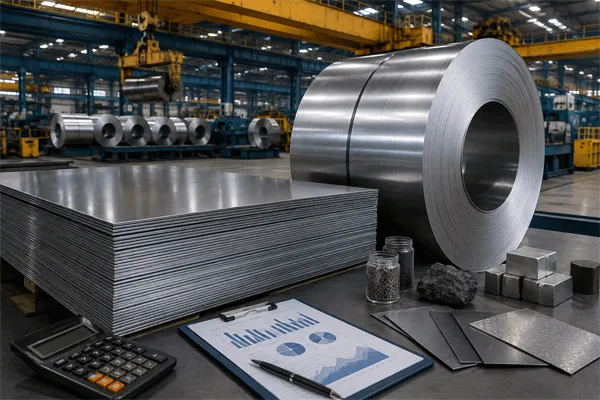
Luyuan Steel lists galvalume coil at 0.21–0.50 mm thickness, grade S350GD, coating designation AZ150. Three parameters decide whether two quotations are actually comparable: base metal thickness in mm, aluminium-zinc coating mass in g/m², and the grade with the standard it belongs to. This page covers each one.
Galvalume Sheet Specs: Thickness, AZ Coating and Grades
Why gauge numbers fall apart at coil level
Search for galvalume specifications and most of what surfaces is written for a buyer walking into a North American service center: 24 gauge, 26 gauge, 29 gauge, sold as flat sheet or a finished panel profile with a paint warranty attached. Compared with those gauge-and-panel listings, a coil purchase order works from a different set of numbers, and gauge is the first thing that stops being useful.
Gauge is a nominal category, not a dimension. It also drifts by product family, and the conversion table a US panel roller uses is not the one an EN-referenced mill certificate reports against. A roll former commissioning a new line, or a roofing sheet manufacturer feeding an existing profile, needs the value the mill actually measures and certifies: base metal thickness in millimetres, stated separately from coating.
The distinction matters commercially. Coating mass sits on top of the base metal, so a 0.30 mm quotation from a supplier reporting base metal thickness and a 0.30 mm quotation from one reporting total coated thickness are not the same product. On thin roofing material the difference runs into real tonnage across a container load.
Published thickness ranges for Luyuan coated flat products
| Product |
Grade shown on listing |
Thickness (mm) |
Coating shown on listing |
| Galvalume Coil |
S350GD |
0.21–0.50 |
AZ150 (product designation); category page lists Z121–Z180 |
| GI Coil |
DX51D / SGCC |
0.18–0.30 |
Z120 |
| PPGI / PPGL |
DX51D+AZ (PPGI listing) |
0.21–0.50 |
Custom coating weight supported at service level |
Two limits are worth reading carefully before you build a specification around this table.
First, the published galvalume band tops out at 0.50 mm. Roofing and cladding work usually lives inside it, but structural decking, purlin-adjacent components and heavier fabricated sections do not. Luyuan supports custom thickness, width, coating weight, paint type and RAL colour at the service level rather than the catalogue level, so anything above the listed band belongs in the enquiry, not in an assumption.
Second, agriculture and manufacturing application pages reference zinc coating ranges up to Z275. That figure is a zinc coating value tied to those applications and is not interchangeable with an AZ aluminium-zinc designation, which brings us to the part of galvalume purchasing that goes wrong most often.
Galvalume Sheet Specs: Thickness, AZ Coating and Grades
AZ and Z are not the same coating, and neither is a single number
An AZ designation describes an aluminium-zinc alloy coating, nominally 55% aluminium, 43.4% zinc and 1.6% silicon by weight. A Z designation describes a zinc coating. They corrode differently, they weld and paint differently, and they carry different prices at the same numeric value.
The Luyuan galvalume product carries the designation AZ150, while the category-level page expresses a coating range in Z-class notation (Z121–Z180). Before a purchase order is issued, confirm in writing which notation the quotation is written in and require the MTC to report coating mass in the same system. That single line in an enquiry eliminates the most common galvalume dispute at destination.
A second layer of confusion sits inside the AZ number itself, because two standards families count it differently:
| Designation system |
Reference standard |
Basis |
Rough equivalence |
| AZ100 / AZ150 / AZ185 |
EN 10346 (CEN) |
Total coating mass, both surfaces, g/m² |
AZ150 ≈ 150 g/m² total |
| AZ50 / AZ55 / AZ60 |
ASTM A792/A792M |
Triple-spot total, both surfaces, oz/ft² |
AZ50 ≈ 150 g/m², i.e. close to AZ150 |
| Japanese practice |
JIS G3321 |
Coating mass, both surfaces, g/m² |
Reported in g/m², check the exact class |
ASTM International maintains the specification covering 55% aluminium-zinc alloy-coated sheet, CEN’s steel standards programme covers continuously hot-dip coated flat products in EN 10346, and the Japanese Industrial Standards Committee maintains JIS G3321 for the equivalent Japanese product. A buyer who reads “AZ50” as half of “AZ150” ends up rejecting the correct material. Both figures describe roughly the same coating mass, expressed in different units.
Cite the exact standard number and current edition in your specification. Note that a standard being technically applicable is not the same as a supplier holding certification to it — Luyuan publishes ISO 9001, ISO 14001, ISO 45001 and RoHS at company level, obtained in 2018, with no SKU-level coating certificate number disclosed publicly. Any certificate number you use in a tender document should come from the original certificate, not from a catalogue.
S350GD vs DX51D: structural grade or forming grade
Grade designation is where a roofing manufacturer’s decision gets made, and the two grades appearing across Luyuan’s coated listings sit at opposite ends of the same standard.
| |
S350GD |
DX51D |
| Family |
Structural steel grade (EN 10346) |
Forming grade (EN 10346) |
| Minimum yield strength |
350 MPa nominal |
Not guaranteed as a design value |
| Designed for |
Load-bearing profiles, roll-formed structural sections, purlin and deck profiles |
General forming, bending, roofing sheet where profile does the work |
| Typical failure mode if mis-specified |
Over-specified, higher cost per tonne |
Profile deforms under design load, or cracks at tight bend radii |
| Appears on Luyuan listings as |
Galvalume Coil S350GD/AZ150 |
GI Coil DX51D/SGCC, PPGI DX51D+AZ |
The practical read: if the finished profile carries load between supports, the grade needs a guaranteed yield value and S350GD-type material is the starting point. If the sheet is a weather skin fixed at close centres, a forming grade is usually adequate and cheaper, and the higher grade adds cost without adding performance.
There is a fabrication penalty attached to higher-strength coated material that specification sheets rarely mention. Springback increases, tight bend radii become harder to hold, and a roll-forming line set up around forming-grade coil may need adjustment when a structural grade arrives. Confirm minimum bend radius with your line settings before switching grade mid-project.
Galvalume Sheet Specs: Thickness, AZ Coating and Grades
Where galvalume is the wrong material
Coated steel selection guides tend to list advantages. The exclusions matter more, because they are the ones that produce warranty claims:
- Direct contact with wet concrete, mortar or plaster.The alkaline environment attacks the aluminium-rich coating. Galvanized material handles this contact better.
- Cut edge exposure in aggressive environments.Zinc coatings give stronger sacrificial protection to a sheared edge. Galvalume’s edge protection is weaker, which is why heavily cut, perforated or trimmed components in coastal or industrial atmospheres often specify galvanized instead.
- Contact with copper, lead or graphite-containing materials,and runoff from them, which drives galvanic corrosion at the contact point.
- Animal housing with concentrated ammonia exposure.Poultry and livestock buildings need the coating and paint system checked against the specific environment rather than assumed.
- Applications requiring a heavy zinc reserve for long unpainted service in wet-storage conditions.Stacked coil that gets wet in transit or storage will show storage staining regardless of coating type; ventilation and packaging specification carry as much weight here as coating class.
Against these, galvalume’s advantage is atmospheric corrosion performance in open exposure and better heat reflectivity than plain zinc coating, which is why it dominates roofing in hot climates. That advantage disappears in the five conditions above.
Building an enquiry that returns a comparable quotation
Most quotation spread between suppliers comes from unstated parameters rather than genuine price difference. Fix these before sending:
- State base metal thickness in mmand add the words “base metal thickness, excluding coating,” plus your acceptable tolerance.
- State coil width in mmand coil inner diameter (508 mm and 610 mm are the standard IDs across Luyuan’s cold rolled listings; confirm which your decoiler accepts).
- State coating designation and the notation system— for example “AZ150 per EN 10346, reported in g/m² total both surfaces on the MTC.”
- State grade and standard together: “S350GD to EN 10346,” not “S350GD.”
- State surface condition: chromated, oiled, anti-fingerprint, skin-passed, spangle requirement. Anti-fingerprint treatment in particular changes both appearance and downstream paint adhesion.
- State coil weight limitsper your handling equipment, and maximum coil OD.
- State Incoterm, destination port and required documents: English MTC, packing list, and whether you require third-party pre-shipment inspection. Luyuan accepts SGS, Bureau Veritas, Intertek or a buyer-appointed inspector, and states 100% pre-shipment inspection with batch traceability from furnace number through to shipment.
Point 7 is the one export buyers under-use. Naming your inspection body inside the enquiry, before price is agreed, costs nothing and changes what arrives.
FAQ
Q: Is AZ150 thicker than AZ50?
A: No. AZ150 is an EN-style designation meaning roughly 150 g/m² total coating mass on both surfaces. AZ50 is an ASTM-style designation in oz/ft², and 0.50 oz/ft² works out at approximately the same 150 g/m². They describe comparable coating masses in different units.
Q: What thickness of galvalume does Luyuan publish?
A: 0.21–0.50 mm on the current product listing, in grade S350GD with AZ150 coating. Requirements outside that band fall under custom production and should be raised in the enquiry.
Q: Does the thickness figure include the coating?
A: It should not. Specify base metal thickness explicitly and require the MTC to report it that way, because suppliers reporting total coated thickness will appear cheaper on the same nominal number.
Q: Galvalume or galvanized for a coastal roofing project?
A: Galvalume generally performs better in open atmospheric exposure, galvanized generally protects cut and sheared edges better. Highly cut or perforated components in salt-laden air often favour galvanized; large uncut roofing panels favour galvalume.
Q: Can I get a coating certificate with a certificate number?
A: Luyuan supplies a full English Mill Test Certificate with shipments covering chemical composition and mechanical properties. Company-level certifications include ISO 9001, ISO 14001, ISO 45001 and RoHS. SKU-level coating certificate numbers are not published publicly and should be requested directly against a specific order.
Q: What minimum order quantity applies?
A: Not published at product level. Request it alongside your specification, since MOQ interacts with width and coating class on a customised run.





 08-14 2026