Luyuan Steel Technical Team | Technical Content & Export Specification Support | Published: 21 August 2026
Hot dip galvanized coil passes through a molten zinc bath and is ordered by coating mass class such as Z100 or Z275. Electro-galvanized coil is electroplated onto a cold rolled base at far lower zinc mass. Specify hot dip for outdoor and humid service, electro-galvanized for painted indoor parts.
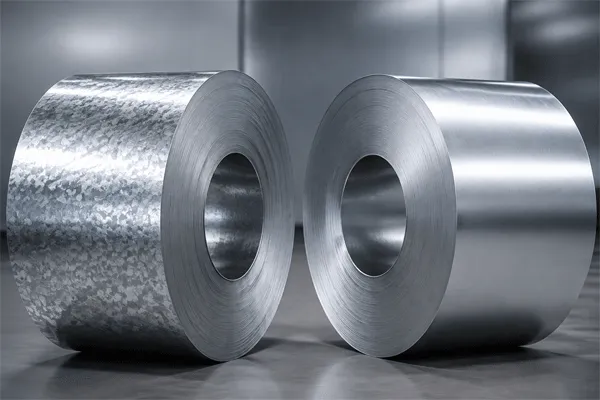
Hot Dip Galvanized Steel Coil vs Electro-Galvanized Coil
Two coatings, two standards, two different products
The confusion starts with the word “galvanized,” which importers use for both products and mills do not.
Continuous hot dip galvanizing (HDG, also written HDGI or simply GI) runs steel strip through molten zinc. The zinc reacts with the iron at the interface and forms a metallurgical bond, with intermetallic zinc-iron layers under a free zinc top layer. In Europe the governing delivery standard is EN 10346, Continuously hot-dip coated steel flat products for cold forming, which covers zinc (Z), zinc-iron (ZF), zinc-aluminium (ZA), aluminium-zinc (AZ) and aluminium-silicon (AS) coatings under one document.
Electro-galvanizing (EG, EZ, or “electrolytic zinc coated”) deposits zinc from an electrolyte using an applied current. There is no molten metal and no alloy interlayer, so the coating sits on the steel as a fine-grained, mechanically adherent layer. Its European delivery standard is a separate document: EN 10152, Electrolytically zinc coated cold rolled steel flat products for cold forming.
Read those two titles again. EN 10346 says “flat products.” EN 10152 says “cold rolled flat products.” The substrate is written into the scope of the electro-galvanized standard and is not written into the hot dip one. That single difference explains most of the ordering mistakes covered below.
Coating mass is the specification. Microns are a consequence.
Most supplier pages on this topic quote a micron range and stop. Micron figures are useful for a coating inspector holding a gauge; they are not what a mill produces to and not what your contract should say.
Both product families are ordered by coating mass in grams per square metre, total of both surfaces, carried in the designation itself. Z275 means 275 g/m² total. The prefix identifies the coating type, so Z is zinc, ZF is galvannealed zinc-iron and AZ is aluminium-zinc. Getting the prefix right matters more than the number: an AZ150 and a Z150 are not interchangeable products even though the digits match.
| Ordering dimension |
Hot dip galvanized coil |
Electro-galvanized coil |
| Delivery standard (EN) |
EN 10346 |
EN 10152 |
| Delivery standard (other) |
ASTM A653, JIS G3302 |
ASTM A879 / A591 family, JIS G3313 |
| Coating applied by |
Immersion in molten zinc bath |
Electrolytic deposition |
| Coating structure |
Zn-Fe intermetallic layers plus free zinc |
Single fine-grained zinc layer, no alloy layer |
| Typical ordered coating mass |
Z60 to Z600, commonly Z100–Z275 in construction |
Roughly 10–50 g/m² total in general industrial practice |
| Substrate permitted |
Hot rolled or cold rolled base |
Cold rolled base (defined in the standard scope) |
| Spangle / surface |
Spangle visible unless zero-spangle ordered |
Uniform matte-bright, no spangle |
| Paintability as delivered |
Needs passivation/phosphating discipline |
Accepts phosphate and paint readily |
| Sacrificial life outdoors |
Proportional to zinc mass; the practical outdoor choice |
Short; red rust appears quickly in coastal or humid air |
| Cost per tonne |
Higher zinc content, higher price |
Lower coating cost, but usually a narrower supply base |
The coating-mass figures above for electro-galvanized product are general industry reference values, not a Luyuan published parameter. Luyuan’s published coated flat portfolio is hot dip product.
Mapping coating class to service environment
This is the step competitor articles in this category skip. They describe the two processes accurately and then leave the buyer to guess which number to write on the order.
| Service environment |
Sensible zinc mass range |
Notes |
| Indoor, dry, painted afterwards (appliance housings, cabinets, ducting) |
Z60–Z100, or electro-galvanized |
Coating is a paint base more than a corrosion barrier |
| Indoor, humid (food plants, laundries, greenhouses under cover) |
Z120–Z180 |
Condensation cycles, not rain, drive the requirement |
| General outdoor roofing and cladding, inland |
Z180–Z275 |
The mainstream export construction band |
| Coastal, industrial atmosphere, high chloride |
Z275 and above, or aluminium-zinc (AZ) substrate instead |
Consider AZ150 before pushing Z-class higher |
| Immersed, buried, or in contact with wet concrete |
Neither product as delivered |
Requires a different material decision entirely |
Two things follow. First, if the answer lands in the top two rows, electro-galvanized becomes a live option and the price case for it is real. Second, if the answer lands in the bottom two rows, the question is no longer HDG versus EG at all; it is zinc versus aluminium-zinc.
Galvanized-Steel-Coil-1
Substrate is a separate line on the RFQ
Buyers routinely write “cold rolled galvanized coil” or “hot rolled galvanized coil” as if these were coating types. They are substrate descriptions, and they belong in a different field of the enquiry.
| |
Hot rolled base |
Cold rolled base |
| Typical gauge band |
Thicker sections, structural end uses |
Thin gauge, tight thickness tolerance |
| Surface before coating |
Pickled, rougher |
Smooth, mill-finish |
| Formability |
Adequate for bending and roll forming |
Higher; suits deep drawing and complex stamping |
| Flatness and thickness consistency |
Wider spread |
Tighter, matters for automated line feeding |
| Available with electro-galvanizing |
No under EN 10152 |
Yes |
| Available with hot dip galvanizing |
Yes |
Yes |
Practical consequence for an importer: “hot rolled galvanized coil” is a valid product and “hot rolled electro-galvanized coil” generally is not, at least not under the European delivery standard your customer’s specification is likely to cite. If your enquiry mixes those two ideas, expect a quotation that quietly substitutes something else.
Where each one actually disappoints people
Balanced coverage of this comparison is usually shallow, so here are the failures that cost money rather than the failures that fill a bullet point.
Hot dip, gauge below the standard’s default range. EN 10346 states its thickness scope as 0.35 mm to 3 mm unless otherwise agreed. A great deal of exported thin-gauge GI sits below 0.35 mm. That material is perfectly orderable, but the thickness tolerance, flatness and coating adhesion criteria have to be agreed explicitly between buyer and mill rather than assumed from the standard. Buyers ordering 0.20 mm material and later claiming against an EN 10346 tolerance table discover the gap during the dispute, not before it.
Hot dip, welding and cut edges. Zinc burns off in the heat-affected zone. Cut edges rely on the sacrificial behaviour of adjacent zinc, which works over a narrow width and works less well as gauge increases. Fabricators who slit heavily should say so at enquiry stage, because the coating decision and the slitting plan interact.
Hot dip, spangle and paint. Regular spangle telegraphs through thin paint films. If the coil is going to be painted or laminated downstream, zero-spangle or minimum-spangle needs to be requested by name. It is not a default.
Electro-galvanized, outdoor exposure. A coating in the tens of grams per square metre offers a thin sacrificial reservoir. In coastal air, red rust arrives in months rather than years. No amount of passivation converts an indoor product into an outdoor one.
Electro-galvanized, supply reality for exporters. Electrolytic lines are concentrated in mills serving automotive and appliance customers on annual contracts. For a distributor buying mixed lots, the practical outcome is often longer lead time, higher minimum order quantity per specification, and a thinner set of alternative sources if the first mill declines the enquiry. That is a commercial constraint, not a metallurgical one, and it decides more orders than corrosion data does.
Grade designations: the cross-reference table your customer will ask for
Coating class and steel grade are independent. A single coil is described by both, for example DX51D + Z120.
| Standard |
Commercial / forming entry grade |
Structural grade example |
| EN 10346 |
DX51D |
S350GD |
| JIS G3302 |
SGCC |
SGC440 |
| ASTM A653 |
CS Type B |
Grade 50 |
Treat these as approximate equivalents rather than substitutions. Published comparison tables of these standards note, for instance, that SGCC under JIS G3302 carries no minimum elongation requirement, while DX51D under EN 10346 does. If a drawing calls for DX51D and a mill certificate returns SGCC, the two are commercially interchangeable in most construction supply and are not interchangeable in a formability dispute. Ask which standard the mill actually tested to, and confirm it on the Mill Test Certificate rather than in the quotation email.
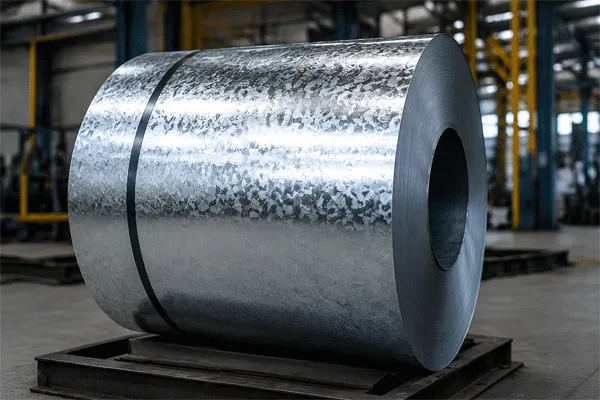
Luyuan Steel GI Coil DX51D/SGCC Z120: published parameters
Luyuan Steel’s published galvanized coil listing covers the following:
- Product:GI Coil DX51D/SGCC Z120
- Grades:DX51D / SGCC
- Coating:Z120 (zinc, hot dip)
- Thickness:18–0.30 mm as published on the product listing
- Process:Continuous hot dip galvanizing
- Documentation:Full English Mill Test Certificate supplied with shipment; batch traceability from furnace number through to shipment
- Inspection:100% pre-shipment inspection; third-party inspection by SGS, Bureau Veritas, Intertek or a buyer-appointed inspector accepted
Two notes for anyone quoting from this listing. Z120 places the product in the indoor-humid to light-outdoor band of the table above; for exposed roofing in a coastal market, ask for a heavier class. Luyuan’s agriculture and manufacturing application pages reference zinc coating ranges reaching Z275 depending on product and application, so the Z120 listing describes one stocked configuration rather than the ceiling of what can be produced. Confirm the available coating class for your gauge and volume in writing at enquiry stage.
The published 0.18–0.30 mm band also sits below the default thickness scope of EN 10346 discussed earlier. For material in that band, agree thickness tolerance and coating adhesion criteria explicitly in the contract.
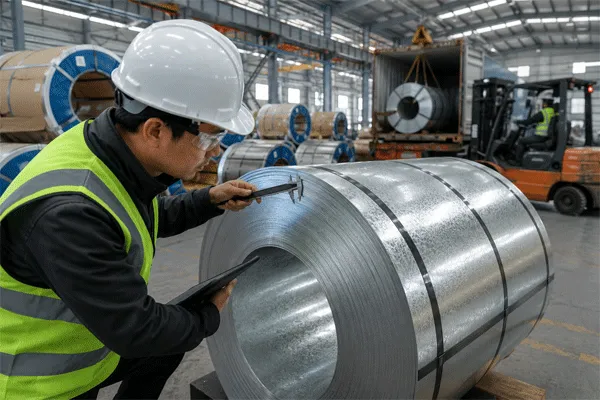
Hot Dip Galvanized Steel Coil vs Electro-Galvanized Coil
Writing the enquiry so the quotation comes back comparable
- State the coating process by name: hot dip galvanized, or electrolytic zinc coated. Do not write only “galvanized.”
- State the coating designation with its prefix and the standard it is quoted against, for example Z120 to EN 10346, or Z12 to JIS G3302 if that is the convention your mill uses. Prefix and standard together, never the number alone.
- State the steel grade separately from the coating: DX51D, SGCC, S350GD, CS Type B.
- State the substrate if it matters to your forming operation: hot rolled base or cold rolled base.
- Give thickness in millimetres with the tolerance you require, plus width and coil inner diameter.
- Specify surface: regular spangle, minimum spangle, zero spangle; and passivation, oiling, or none.
- Name the surface condition your downstream process needs, particularly if the coil will be painted, laminated or powder coated.
- Require an English Mill Test Certificate listing heat number, chemical composition, mechanical test results and coating mass.
- State Incoterms and destination port, since coating class and gauge both affect weight per coil and therefore container loading.
A quotation that answers all nine is comparable against another quotation that answers all nine. A quotation that answers four is a price, not an offer.
Price: what is published and what is not
Luyuan Steel publishes indicative listing prices for parts of its catalogue in a band of roughly USD 410–650 per metric tonne, varying by product type and specification. There is no verified public listing price for GI coil specifically, so galvanized coil is treated as Price on Request.
That is not evasion, and the reason is worth understanding before you compare quotations. Zinc coating mass is a direct materials cost that scales with the class you order, so the gap between Z100 and Z275 on the same base steel is a real per-tonne difference rather than a positioning difference. Gauge, width, spangle requirement, passivation, coil weight, order volume, Incoterms and destination each move the number as well. Any supplier quoting a firm galvanized coil price without knowing your coating class and gauge is quoting a different product from the one you will receive.
FAQ
Q: Is hot dip galvanized coil always better than electro-galvanized coil?
A: No. It is more corrosion resistant per unit area because it carries more zinc, which makes it the correct choice outdoors. For a painted indoor part where surface uniformity and dimensional consistency matter more than sacrificial life, electro-galvanized material performs the job at lower coating cost. “Better” only has meaning once the service environment is defined.
Q: What does Z120 mean, and how does it convert to microns?
A: Z120 designates 120 g/m² of zinc, total across both surfaces. Since zinc has a density near 7.1 g/cm³, 120 g/m² total corresponds to roughly 8–9 µm per side as a nominal average. Use the g/m² figure in contracts and the micron figure for inspection discussion, not the reverse.
Q: Can I order electro-galvanized coil on a hot rolled base?
A: EN 10152 defines electrolytic zinc coated flat products on a cold rolled base, so under that standard the answer is no. If a supplier offers “hot rolled electro-galvanized coil,” ask which standard and which mill, and expect the specification to be non-standard.
Q: My drawing says SGCC but the offer says DX51D. Do I accept it?
A: For most construction and general fabrication supply, yes, subject to the Mill Test Certificate showing the actual tested properties. For deep drawing or any application where elongation is a controlled parameter, treat the two as different and check the certificate values against your requirement, because the minimum requirements in the two standards do not align.
Q: Does a heavier zinc coating change how the coil forms?
A: It can. Heavier hot dip coatings have thicker zinc-iron intermetallic layers, which are harder and more brittle than free zinc, so very heavy classes can powder or flake at tight bend radii. If you are roll forming a tight profile at Z275 or above, ask for the mill’s bend-test data for that coating class and gauge rather than assuming it behaves like the Z100 you formed last year.
Q: What documentation should arrive with a galvanized coil shipment?
A: A Mill Test Certificate in English, traceable to the heat number, showing chemical composition, mechanical properties and coating mass; packing list with coil numbers and weights; and the inspection report if third-party inspection was agreed. Luyuan supplies English MTCs with shipments and accepts SGS, BV, Intertek or buyer-appointed inspection.
Q: How do I decide between a heavier zinc class and switching to aluminium-zinc?
A: Aluminium-zinc coated product (AZ designation) generally offers longer atmospheric life per unit coating mass in chloride-bearing environments, while zinc offers better cut-edge protection and better behaviour under painting in some systems. Once your environment analysis pushes you past Z275, price both routes rather than escalating the Z class by default.






 08-21 2026