Luyuan Steel Technical Team | Technical Content & Export Specification Support | Published: 22 August 2026
Deformed bar and rebar usually mean the same thing: ribbed steel bar for concrete reinforcement. The real comparisons hidden behind the phrase are deformed versus plain round bar, deformed bar anchors as a welded embed, and grade designations such as HRB500 against ASTM A615 Grade 60.
Deformed Bar vs Rebar: Grades, Bond and Where Each Is Used
The phrase hides three unrelated questions
Search this term and you get answers to three different problems presented as if they were one. Some pages compare ribbed bar with smooth round bar. Some discuss deformed bar anchors, which are a welded connection detail in structural steel work. Some compare Grade 40 with Grade 60, which is a grade question and has nothing to do with whether a bar is deformed.
They are all legitimate answers. None of them is the answer, because the question is three questions.
So this article separates them. Comparison 1 is a product-form decision. Comparison 2 is a design-detail decision that a purchasing department should recognise but rarely specifies. Comparison 3 is the one that costs money when it goes wrong.
Comparison 1: deformed bar vs plain round bar
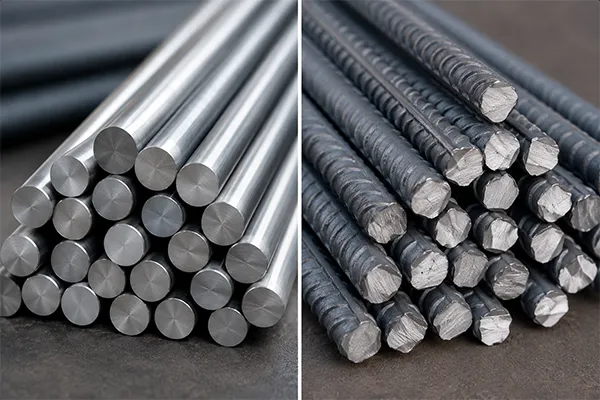
Deformed bar carries rolled ribs and transverse lugs. Plain round bar has a smooth cylindrical surface. The difference is mechanical, and it is not a matter of degree.
A plain bar transfers load to concrete through adhesion and friction along its surface. Once the adhesive bond breaks at a load well below yield, the bar begins to slip. A deformed bar transfers load mainly through rib bearing: the concrete presses against the face of each rib, and the load path becomes mechanical interlock rather than surface friction. This is why development length for a deformed bar is a fraction of what a plain bar of the same diameter would need, and why plain bars in structural applications usually get hooks or bends at the ends to compensate.
| |
Deformed bar |
Plain round bar |
| Surface |
Longitudinal ribs plus transverse lugs |
Smooth |
| Load transfer to concrete |
Rib bearing, mechanical interlock |
Adhesion and friction |
| Typical yield range |
400–500 MPa in current construction grades |
Lower; commonly around 235–300 MPa in plain reinforcing grades |
| Chinese designation family |
HRB (Hot rolled Ribbed Bar) |
HPB (Hot rolled Plain Bar) |
| End anchorage |
Straight embedment usually sufficient |
Hooks or bends generally required |
| Structural use |
Main reinforcement, stirrups in higher grades |
Stirrups and ties in light work, spacers, non-structural |
| Site handling |
Ribs help bar chairs and tie wire grip |
Rolls in the stack; ties slip |
Note the designation logic, because it makes ordering easier. In the HRB family, H is hot rolled, R is ribbed, B is bar, and the number is the minimum yield strength in MPa. HRB500 is a hot rolled ribbed bar with a 500 MPa minimum yield. HPB300 is a hot rolled plain bar at 300 MPa. Once you read the prefix as a description rather than a code, the plain-versus-deformed question answers itself on the packing list.
Deformed Bar vs Rebar: Grades, Bond and Where Each Is Used
Comparison 2: deformed bar anchors are a detail, not a product line
A deformed bar anchor (DBA, also written as deformed rebar anchor or DRA) is a length of deformed bar welded to a steel embed plate and cast into concrete, used to attach brackets, pipe supports, cladding rails and equipment to a concrete structure. It is a connection component. It is not a category of rebar you buy by the tonne.
Two things matter here for anyone reading tender documents.
First, the anchor is usually specified by the structural engineer with a required embedment depth, bar diameter, spacing and weld detail. The bar itself is ordinary deformed reinforcing bar. If a drawing calls for DBAs, your material enquiry is still for reinforcing bar in the stated grade and diameter, plus a fabrication step.
Second, the design basis is thinner than most people assume. Published research on tension-loaded deformed bar anchors notes that ACI anchorage provisions were developed largely from tests on headed studs, hooked bars, headed bolts and adhesive anchors, and that straight deformed bar anchors have comparatively limited test data behind them. Concrete breakout is a governing failure mode in anchor groups. The practical consequence for a contractor: do not let a supplier substitute bar diameter or grade on a DBA detail as a convenience, because the anchor calculation is tied to the specific bar and embedment the engineer used.
Comparison 3: grade designations, and the substitution that changes your structure
Here is where money and liability sit. The three grade families a contractor sourcing internationally will meet are the Chinese HRB series, the American ASTM series and the European EN system.
| System |
Standard |
Common grades |
Minimum yield |
| China |
GB/T 1499.2 |
HRB400 / HRB400E |
400 MPa |
| China |
GB/T 1499.2 |
HRB500 / HRB500E |
500 MPa |
| USA |
ASTM A615 |
Grade 40 |
40 ksi (approx. 280 MPa) |
| USA |
ASTM A615 |
Grade 60 |
60 ksi (approx. 420 MPa) |
| USA |
ASTM A615 |
Grade 80 |
80 ksi (approx. 550 MPa) |
| USA |
ASTM A706 |
Grade 60 (low-alloy, weldable) |
60 ksi (approx. 420 MPa) |
| Europe |
EN 10080 / BS 4449 |
B500B, B500C |
500 MPa |
Now the substitution that goes wrong. ASTM A615 Grade 60 is not the equivalent of HRB500. Grade 60 is 60,000 psi, which converts to roughly 420 MPa, so its nearest counterpart in the HRB series is HRB400. HRB500 sits above Grade 60 and closer to Grade 75 or Grade 80 territory.
That cuts both ways on a project:
- Quoting HRB500 against a Grade 60 specification means you are supplying a higher-strength bar than the drawing requires. That is not automatically acceptable. Higher-strength bars are often less ductile, and some codes place limits on the yield strength that may be used in seismic-resisting elements precisely because over-strength reinforcement changes where a member fails.
- Quoting Grade 60 against an HRB500 specification means the bar is under the specified yield. The structure was designed with less steel because the designer counted on 500 MPa.
The E suffix is the other detail buyers skip. HRB400E and HRB500E carry additional requirements aimed at seismic performance, including a tensile-to-yield ratio and elongation criteria. If the project is in a seismic zone, HRB400 and HRB400E are not interchangeable, and the mill certificate has to show the E-grade values, not just a 400 MPa yield result.
Similarly on the American side, A615 and A706 are different specifications. A615 covers plain carbon reinforcing bar and does not address weldability. A706 is the low-alloy weldable specification with controlled carbon equivalent. If bars will be welded on site, the difference between those two designations is the whole point of the conversation.
Compared with the general-supplier and definition pages that currently rank for this phrase, which typically answer one of the three questions and leave the grade cross-reference either absent or wrong, the cross-reference above is the part worth printing and keeping near the buyer’s desk.
What the ribs do that a certificate cannot show you
Bond performance depends on rib geometry, specifically the relative rib area: the projected rib area bearing against concrete divided by the bar’s nominal surface area. Standards set a minimum for this. It is measured on the bar, and it is a rolling-mill parameter controlled by the roll pass design.
Two implications for site work.
Worn rolls produce bars that meet the chemistry and tensile requirements on the certificate while the rib profile drifts toward the lower limit. Yield strength and rib geometry are separately controlled properties, and a mill test certificate that reports tensile results does not by itself confirm the rib geometry conforms. If a project has bond-critical detailing, ask for the rib dimension record or have it checked at inspection.
Heavy surface rust is the more common site argument. Light surface rust actually improves bond slightly. Loose flaking scale that comes off in the hand reduces the effective rib profile and is a legitimate rejection ground. The distinction is whether the rust wire-brushes off leaving intact ribs, or whether it takes material with it.
Deformed Bar vs Rebar: Grades, Bond and Where Each Is Used
- Product:Steel Rebar, listed grade HRB500
- Listed diameter range:5–16 mm on the product listing
- Lengths:6 m / 9 m / 12 m, or coil
- Related grades referenced on Luyuan project solution pages:HRB400, HRB500, ASTM A615 Grade 60
- Documentation:English Mill Test Certificate supplied with shipment, with batch traceability from furnace number through to shipment
- Testing stated:chemical composition, mechanical properties, surface inspection
- Inspection:100% pre-shipment inspection; SGS, Bureau Veritas, Intertek or buyer-appointed third-party inspection accepted
Read the diameter line carefully before you build a bar schedule around it. A listed range topping out at 16 mm covers slabs, walls, stirrups and light framing. Column and pile cages in most commercial work call for 20 mm, 25 mm or 32 mm main bars. If your schedule needs those diameters, confirm availability in writing at enquiry rather than assuming the listing represents the full production range, and confirm which grades are available at each diameter, since grade availability and diameter availability are not the same question.
The 9 m length is worth noting as well. It is a common fixed length in Chinese mill practice and less common in some import markets, where 12 m is the default assumption. Cutting waste on a 9 m bar against a schedule drawn for 12 m stock is a real cost, so state the length you want rather than accepting mill standard.
Getting a comparable quotation
- Name the grade with its standard, not the number alone: HRB500 to GB/T 1499.2, or Grade 60 to ASTM A615, or B500B to BS 4449.
- State whether a seismic grade is required (the E suffix, or the applicable local equivalent).
- State whether bars will be welded. If yes, say so explicitly, because it changes which specification is acceptable.
- List diameters and quantity per diameter, not just total tonnage.
- State the fixed length you want, and whether coil is acceptable for the small diameters.
- Specify bundle weight and marking requirements for site sorting.
- Require an English Mill Test Certificate with heat number, chemical composition, yield, tensile, elongation, and bend test results.
- State whether rib geometry conformance is to be verified at inspection.
- Give Incoterms and destination port, plus any local certification the destination requires for imported reinforcement.
Point 9 catches people out more than the rest combined. Several markets require third-party certification or registration of imported reinforcing steel before it can be used in permitted construction. That is a destination-country requirement, and it needs to be raised at enquiry, not at customs.
FAQ
Q: Are “deformed bar” and “rebar” the same thing?
A: In normal usage, yes. Rebar is short for reinforcing bar, and nearly all reinforcing bar sold for structural use today is deformed. The term “deformed bar” specifies the surface condition explicitly; “rebar” specifies the function. A supplier who offers you “rebar” is almost certainly offering deformed bar, but if the application is bond-critical, write “deformed” into the enquiry and let the packing list confirm it.
Q: Is HRB500 equivalent to ASTM A615 Grade 60?
A: No. Grade 60 is 60,000 psi, roughly 420 MPa, which lines up with HRB400. HRB500 is a 500 MPa minimum yield bar and sits above Grade 60. Substituting in either direction changes the structural basis of the design and needs the engineer’s written approval.
Q: What does the E in HRB400E and HRB500E mean?
A: It designates the seismic grade, carrying additional ductility requirements including a tensile-to-yield ratio and elongation criteria beyond the base grade. Projects in seismic zones normally specify the E grade, and the mill certificate must report those values.
Q: Can I weld HRB500 rebar on site?
A: Only with a qualified procedure and confirmation of the carbon equivalent from the certificate. Higher-strength carbon rebar is more sensitive to welding heat, and the base specification for plain carbon rebar generally does not guarantee weldability. If welding is part of the method statement, say so at enquiry so that a weldable specification is quoted.
Q: What is a deformed bar anchor, and do I order it as rebar?
A: It is a length of deformed reinforcing bar welded to a steel embed plate and cast into concrete to anchor an attachment. The material you order is reinforcing bar in the specified grade and diameter; the anchor is created by fabrication. Do not substitute bar diameter or grade, because the anchor capacity calculation is tied to the specific bar the engineer assumed.
Q: When is plain round bar still the right choice?
A: For light stirrups and ties in low-load applications, spacers, and non-structural uses where bond is not the controlling mechanism. Where plain bar carries load, end hooks or bends are normally required to make up for the absence of rib bearing.
Q: Does surface rust make rebar unusable?
A: Light surface rust that leaves the rib profile intact after wire brushing is generally acceptable and can marginally improve bond. Loose flaking scale that removes material and reduces the effective rib height is a legitimate reason to reject. The test is what the bar looks like after brushing, not what it looks like on the truck.
Q: What should the mill test certificate show for rebar?
A: Heat number, chemical composition including carbon equivalent, yield strength, tensile strength, elongation and bend test results, against the named standard and grade. Check that the grade on the certificate matches the grade on your purchase order, including any seismic suffix, rather than only checking that the numbers look high enough.
Q: Is coil rebar a lower grade than straight bar?
A: Coil is a delivery form, not a grade. Small diameters are commonly supplied in coil for decoiling and cutting on site or in a rebar shop. The grade is whatever the order specifies. What does change is straightening: coil requires a decoiler and straightener, and the straightening process should not be allowed to damage the rib profile.






 08-22 2026