Automotive Cold Rolled Steel: Grades and Applications
Automotive Cold Rolled Steel: Grades and Applications
08-17 2026
By Luyuan Steel Technical Team | Updated August 17, 2026
Automotive cold rolled steel is specified by forming severity, strength, surface quality, thickness tolerance, and the coating or paint system used after stamping. SPCC suits general forming, SPCD supports deeper drawing, and SPCE is selected for more demanding draw operations when the purchase specification confirms the required mechanical properties.
Information basis: This guide uses Luyuan Steel’s published cold rolled product range and JIS G 3141:2021 terminology. A vehicle drawing, approved material standard, and stamping trial remain the controlling documents for production.
Automotive cold rolled steel at a glance
Grade family
Typical forming level
Common automotive use
What the RFQ must control
SPCC
General forming
Brackets, covers, housings, and parts with limited draw depth
Thickness, tensile properties, surface finish, flatness, and edge condition
SPCD
Drawing quality
Stamped panels and components with more severe shape change
Elongation, forming direction, surface class, oiling, and dimensional tolerance
SPCE
Deep drawing quality
Body-panel or shell geometries that require higher formability
Approved mechanical-property range, draw performance, surface defects, and trial-coil acceptance
JIS G 3141:2021 is the Japanese standard for cold-reduced carbon steel sheet and strip and includes SPCC, SPCD, and SPCE designations. A grade name alone does not release a coil for an automotive program. The purchase order should identify the governing standard and edition, required mechanical properties, surface condition, dimensions, and inspection method.
Why cold rolling fits stamped vehicle parts
Cold rolling gives sheet producers tighter control over thickness, flatness, and surface condition than a general hot rolled finish. Those controls matter when a blank passes through progressive dies, deep-draw tooling, hemming, resistance welding, adhesive bonding, or a visible paint system. Consistent gauge helps stabilize press force and part dimensions, while a controlled surface reduces the risk of defects showing through paint.
Cold rolled mild drawing steel also has limits. Higher forming demand can expose splitting, wrinkling, galling, or springback if the grade, lubrication, blank-holder force, and die radii are not matched. Bare cold rolled steel needs corrosion protection during storage and in the finished vehicle system.
Automotive component production where material consistency affects tooling and part repeatability.
Choose the grade from forming severity
SPCC for general forming
SPCC is a practical starting point for parts that require bending, shallow forming, or simple stamping. It can be economical, but buyers should not use it for a deep-drawn geometry merely because the thickness is available. Confirm the drawing ratio, bend radius, hole expansion, and any exposed-surface requirement before release.
SPCD for drawing operations
SPCD is intended for greater drawing demand than a commercial-quality grade. It can suit stamped automotive components where elongation and stable deformation matter more than maximum strength. Procurement should define the mechanical-property window rather than relying on the letters SPCD alone.
SPCE for deeper draws
SPCE is associated with deep drawing and is relevant to more demanding panel shapes. It is not automatically the correct choice for every visible body part. Surface class, stretcher-strain control, texture, lubrication, aging behavior, and paint preparation can be as important as drawability.
Surface and dimensional requirements belong on the order
Control item
Why it affects production
Useful acceptance evidence
Thickness and tolerance
Changes press force, mass, stiffness, and weld settings
Coil inspection record and agreed measurement positions
Width and edge condition
Affects blank yield, feeder tracking, and edge cracking
Width report plus mill, slit, or trimmed-edge designation
Flatness and shape
Camber or waviness can disturb feeding and blank positioning
Agreed flatness method and receiving inspection plan
Surface class
Visible panels can reveal scratches, pits, roll marks, or inclusions after paint
Approved sample, defect limit, and inspection lighting
Oiling and packaging
Controls temporary corrosion protection and handling cleanliness
Oil type or mass, wrapping specification, and storage limit
Mechanical properties
Influence splitting, wrinkling, springback, and dimensional recovery
MTC values and a trial-coil or first-article result
A common mistake is to request only grade, thickness, and width. That leaves the supplier to guess which surface, temper, tolerance, oiling, and edge condition the press shop expects. The missing details often appear later as tool adjustment, sorting, or rework.
Luyuan’s published cold rolled range
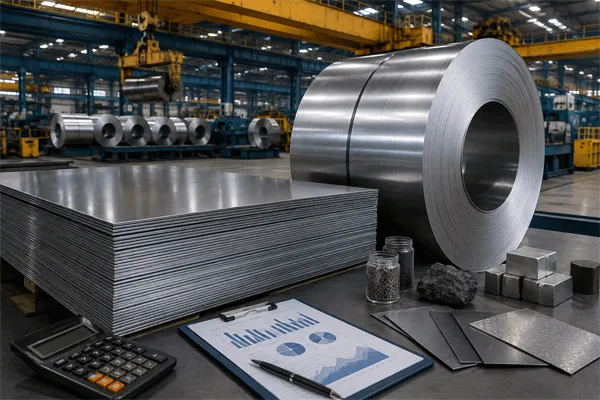
Luyuan Steel’s current cold rolled steel catalog publishes CR coil thickness from 0.12 to 5.0 mm and coil IDs of 508 or 610 mm. The published CR sheet thickness is 0.20 to 0.50 mm. Manufacturing applications reference SPCC, SPCD, and SPCE grades.
Available processing listed for the product family includes cutting, bending, punching, annealing, black annealing, welding, and decoiling, depending on the product. These are portfolio parameters, not a statement that every thickness, grade, surface class, and coil ID can be combined. Send the part drawing and annual demand for an availability review.
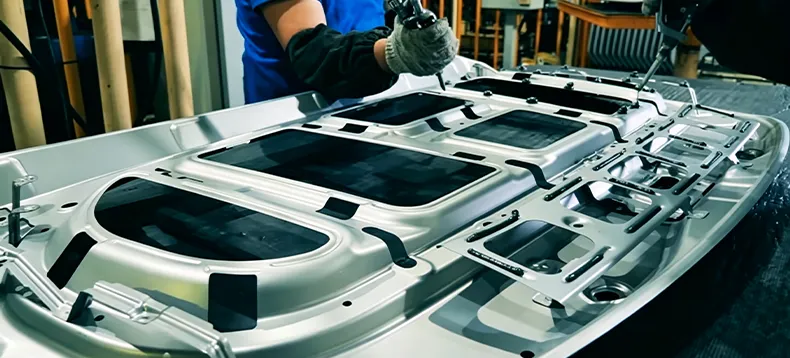
A stamped automotive panel illustrates why drawability, surface condition, and dimensional consistency must be specified together.
Cold rolled drawing steel compared with AHSS
Compared with common advanced high-strength steel categories, mild cold rolled drawing grades generally offer easier forming and simpler springback control. Their lower strength can require a thicker section or a different structural design. Advanced high-strength steels can support mass reduction and crash-performance targets, but they may demand higher press loads, revised radii, stronger trim tools, and different welding schedules.
The tradeoff should be decided by the vehicle engineer and stamping team, not by material price alone. If the drawing calls for dual-phase, complex-phase, martensitic, or another specified automotive steel, SPCC, SPCD, or SPCE should not be substituted without written engineering approval.
From RFQ to stamping trial
Send the part drawing, blank layout, forming sequence, annual volume, and target vehicle program.
State the standard, edition, grade, thickness, width, coil ID, maximum coil mass, and surface side.
Agree on the MTC, inspection report, defect limits, sample plan, and third-party inspection if required.
Run a trial coil through the actual die and record splits, wrinkles, springback, press settings, and surface results.
Freeze the approved specification and change-control process before serial shipments.
The trial should use production tooling and a representative coil position. A laboratory coupon can confirm tensile properties, but it cannot reproduce every interaction among lubrication, die wear, blank shape, and press control.
Common selection errors
Buying by grade name alone. The same designation can be ordered with incomplete surface or tolerance requirements.
Ignoring exposed versus unexposed surfaces. A mechanically acceptable coil may still fail a visible paint panel inspection.
Changing coil source without revalidation. Chemistry and property variation within a standard can change press behavior.
Using a deep-drawing grade to solve a tooling problem. Poor radii, lubrication, or blank-holder settings can still split an SPCE blank.
Leaving packaging undefined. Moisture, edge damage, and telescoping can make conforming steel unusable on arrival.
Inspection and traceability
Request an English MTC linked to the coil number, plus dimensional and surface inspection records written into the contract. Luyuan states that it provides batch traceability, 100% pre-shipment inspection, and accepts SGS, Bureau Veritas, Intertek, or buyer-appointed inspection. The scope still needs to identify which properties, surfaces, and coil positions the inspector will check.
At receiving, confirm coil identity before removing labels. Check packaging condition, edge damage, rust, width, thickness, flatness, and visible surface condition. Quarantine any coil that does not match the approved release documents so it does not enter serial production.
Price and supply planning
Luyuan’s public listing reference for cold rolled steel coil is approximately USD 585 to 635 per metric ton. It is not a fixed quotation. Grade, thickness, surface requirement, coil mass, processing, test scope, quantity, Incoterms, and destination can change the final price.
A lower material quote can be offset by poor blank yield, press downtime, sorting, or rejected painted parts. Compare suppliers on the landed cost of an approved, traceable coil rather than the base steel price alone.
FAQ
Is SPCE always the best automotive cold rolled steel?
No. SPCE is relevant to deep drawing, but a simple bracket may not need that forming level. Select from the drawing, required properties, surface class, and validated die trial.
Can SPCC be used for automotive parts?
It can be used for suitable general-forming parts when the approved specification allows it. Do not assume it will meet deep-draw, exposed-panel, or crash-related requirements.
What must be listed on a cold rolled steel RFQ?
Include the standard and edition, grade, dimensions and tolerances, coil ID and mass, mechanical properties, surface class, edge, oiling, packaging, quantity, inspection, and destination.
Does cold rolled steel arrive corrosion-proof?
No. Bare cold rolled steel normally needs controlled oiling, dry storage, suitable packaging, and a final coating or paint system defined by the vehicle program.
Should buyers approve a trial coil?
Yes for a new part, new source, difficult geometry, or critical surface. The trial connects mill data to actual tooling performance before serial volume is committed.
Next step: Send the part drawing, forming process, grade, thickness, surface class, coil dimensions, annual demand, and delivery destination through Luyuan’s contact page for a specification review.
About the author
Luyuan Steel Technical Team supports steel processing, product specification, quality-control documentation, and international project supply across cold rolling, cutting, slitting, inspection, and shipment preparation.






 08-17 2026