Luyuan Steel Technical Team | Technical Content & Export Specification Support | Published: 23 August 2026
ASTM A240 covers stainless plate, sheet and strip for pressure vessels and general applications. Type 304 (UNS S30400) requires minimum 515 MPa tensile, 205 MPa yield and 40% elongation. For ASME Code vessels, order to ASME SA-240 rather than A240, and confirm the edition on the certificate.
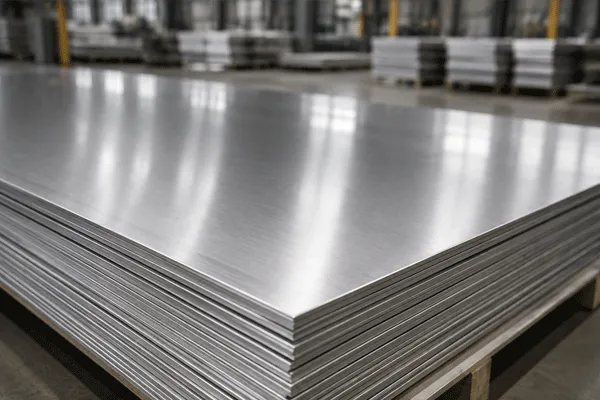
ASTM A240 304 Stainless Steel Sheet: Specs & Uses
What A240 actually covers, and what it leaves to another standard
What A240 does not do is set dimensional tolerance, flatness, edge condition or surface finish designation. Those sit in ASTM A480/A480M, the general requirements specification for flat-rolled stainless. In practice this means a purchase order reading only “ASTM A240 304, 3 mm” has specified the metallurgy and left the thickness tolerance, flatness and finish unspecified. Most disputes over stainless sheet deliveries are A480 disputes, not A240 disputes.
There is a third document buyers encounter and misuse. ASTM A959 is a guide for harmonised standard grade compositions for wrought stainless steels. It is a composition reference, not a product specification, so “A959 304 plate” is not something a mill produces to. If a petrochemical enquiry arrives written that way, the material specification you actually need is A240 (or SA-240), with A959 relevant only as a cross-reference to the equivalent grade designation in another national system.
Type 304 chemistry under A240
| Element |
Limit (% by mass) |
| Carbon (C) |
0.07 max |
| Manganese (Mn) |
2.00 max |
| Phosphorus (P) |
0.045 max |
| Sulphur (S) |
0.030 max |
| Silicon (Si) |
0.75 max |
| Chromium (Cr) |
17.5–19.5 |
| Nickel (Ni) |
8.0–10.5 |
| Nitrogen (N) |
0.10 max |
| Iron (Fe) |
Balance |
One caution before you copy this into a specification. A large number of datasheets in circulation still list Type 304 as carbon 0.08 max with chromium 18.0–20.0. Those are legacy figures carried over from earlier editions and from the AISI designation, and they are not identical to the harmonised limits shown above. When a mill certificate and a customer specification disagree on the carbon ceiling, the argument is almost always an edition mismatch rather than a non-conforming heat. Name the edition on the purchase order and the problem disappears.
Mechanical minima, and why 304L is on the same page
| Property |
304 (S30400) |
304L (S30403) |
| Tensile strength, min |
515 MPa (75 ksi) |
485 MPa (70 ksi) |
| Yield strength (0.2% offset), min |
205 MPa (30 ksi) |
170 MPa (25 ksi) |
| Elongation in 50 mm, min |
40% |
40% |
| Hardness, max |
201 HBW / 92 HRB |
201 HBW / 92 HRB |
| Carbon, max |
0.07 |
0.030 |
The trade-off is visible in one line of that table. Dropping carbon to 0.030 max suppresses chromium carbide precipitation at grain boundaries during welding, which is what causes sensitisation and subsequent intergranular corrosion in the heat-affected zone. You pay for it with roughly 30 MPa of tensile and 35 MPa of yield.
For welded pressure-containing equipment that will see corrosive service, that trade is usually worth making, which is why 304L appears so often in petrochemical specifications where the drawing says “304 or 304L.” For thin sheet where the weld cools fast and the section is light, standard 304 is frequently acceptable.
A practical middle route exists. Many mills now produce heats that satisfy the 304L carbon ceiling while still meeting the 304 mechanical minima, and certify the material to both. Dual-certified 304/304L stock lets a fabricator draw one material for welded and unwelded parts on the same job. If you are stocking rather than buying to a single order, ask whether dual certification is available before splitting your inventory into two grades.
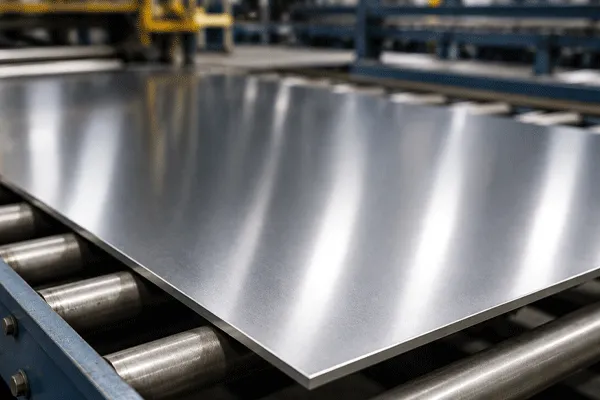
ASTM A240 304 Stainless Steel Sheet: Specs & Uses
For pressure vessels, the letters in front of the number decide everything
This is the point that separates a compliant order from an expensive one.
ASME Boiler and Pressure Vessel Code, Section II Part A, contains ferrous material specifications designated with SA numbers. ASME describes these as identical with or similar to specifications published by ASTM and other recognised bodies. The stainless flat-product entry is SA-240.
If a vessel is being built to the ASME Code and stamped, the material must be supplied to SA-240 and certified accordingly. Material certified only to ASTM A240 is not automatically acceptable to the Authorised Inspector, even when the chemistry and mechanical results are identical, because Code acceptance runs on the SA designation and on the associated documentation requirements. Confirming this at enquiry stage costs one email. Discovering it at the inspection stage costs a re-order and the schedule.
Three follow-on points that belong in the same conversation:
- If the vessel is being built to a European code instead, the reference is normally the EN system, where the equivalent austenitic grade appears as 1.4301 for 304 and 1.4307 for 304L. A CEN-referenced specification and an ASTM-referenced specification are not interchangeable on paper even when the metal is comparable.
- Impact testing, additional NDT, and supplementary requirements are usually invoked by the vessel code, not by A240 itself. Those need to be stated on the order as supplementary requirements or the mill will not perform them.
- Positive material identification at receiving is common practice in petrochemical work. It verifies alloy content, not grade conformance, so it does not replace the certificate.
Product form: sheet, plate and strip are defined by dimensions
A240 covers three product forms. The distinction is dimensional, and it matters because tolerance tables and often pricing follow the form rather than the alloy.
| Form |
Thickness |
Width |
Typical supply |
| Sheet |
Under 4.76 mm (3/16 in) |
600 mm and over |
Coil or cut sheet, cold rolled |
| Strip |
Under 4.76 mm |
Under 600 mm |
Coil, slit |
| Plate |
4.76 mm and over |
250 mm and over |
Cut plate, hot rolled and annealed |
The practical consequence: a buyer asking for “304 sheet, 8 mm” is asking for plate, and will get plate tolerances, plate surface condition and plate pricing. That is not a supplier being difficult. Hot rolled annealed plate arrives with a No.1 surface, which is dull and slightly scaled compared with the 2B finish a cold rolled sheet buyer expects, and no amount of ordering will make an 8 mm hot rolled product look like 2B unless it is separately polished.
Surface finishes and where each one is actually appropriate
Finish designations for flat-rolled stainless are defined in A480. The five most commonly stocked:
| Finish |
Production route |
Appearance |
Where it belongs |
| 2B |
Cold rolled, annealed, pickled, light skin pass |
Smooth, slightly reflective grey |
The default for fabrication, tanks, process equipment, anything to be welded or later polished |
| BA (Bright Annealed) |
Cold rolled, bright annealed in controlled atmosphere |
Bright, reflective, no pickling scale |
Where reflectivity is needed without polishing cost; appliance panels, some hygienic equipment |
| No.4 |
Mechanically abraded, uniform short grain |
Brushed, directional matte |
Architectural panels, kitchen and food equipment, wall cladding |
| HL (Hairline) |
Mechanically abraded, long continuous grain |
Fine continuous linear brush |
Lift interiors, façade panels, decorative joinery |
| Mirror (No.8) |
Progressive polishing and buffing |
Highly reflective |
Decorative and reflective applications only |
A misconception worth killing here: surface finish and corrosion performance are not the same lever. A smoother finish reduces the number of crevices where deposits can sit, which helps in hygienic service, but it does not change the alloy’s resistance in a chloride environment. Ordering Mirror finish for a chemical storage tank interior adds significant cost and buys nothing structural. If the concern is chloride pitting, the answer is a molybdenum-bearing grade such as 316L, not a shinier 304.
The reverse case matters too. Material that will be welded and then polished should generally be bought as 2B. Buying a polished finish and then welding through it means paying twice for a surface you destroy.
ASTM A240 304 Stainless Steel Sheet: Specs & Uses
Luyuan Steel stainless sheet: published parameters
- Product:Stainless Steel Sheet
- Published grades:304 / 316L
- Published thickness range:3–12 mm
- Published surface finishes:2B / BA / No.4 / HL / Mirror
- Related published stainless products:Stainless Steel Coil (0.11–2.50 mm), Stainless Steel Pipe, Stainless Steel Bar (304 / 304L / 316 / 316L / 321)
- Processing available:cutting, bending, punching, polishing, welding, moulding, depending on product
- Documentation:English Mill Test Certificate supplied with shipment, with batch traceability from furnace number through to shipment
- Inspection:100% pre-shipment inspection; SGS, Bureau Veritas, Intertek or buyer-appointed third-party inspection accepted
Two honest notes about how that range maps onto this article.
The published 0.3–12 mm band spans both the sheet and the plate side of the dimensional boundary above. The thinner part of it covers linings, tank cladding, ducting, heat exchanger components and light fabricated equipment. Heavy vessel shell plate for high-pressure service commonly runs well above 12 mm, so a shell-plate enquiry needs to be confirmed for availability rather than assumed from this listing.
More importantly: A240 or SA-240 conformance is not stated in Luyuan’s published product data, and no SKU-level certificate number is publicly disclosed. Nothing in this article should be read as a claim that stocked material is certified to A240, SA-240 or any pressure-vessel code. If your application requires that certification, state it as a requirement on the enquiry, ask which specification and edition the material will be certified to, and require that the certificate name it. Any supplier, including this one, should be asked the same question in the same words.
Specifying it so the certificate matches the order
- Name the material specification and edition: ASTM A240/A240M, or ASME SA-240 if the part is Code work.
- Name the grade and UNS number: Type 304, UNS S30400. Add “or dual-certified 304/304L” if that suits your stock plan.
- State the product form you expect: sheet, strip or plate. Do not let the thickness contradict the word.
- Give thickness in millimetres with the tolerance standard: to ASTM A480/A480M, or a stated tighter tolerance.
- State width, length, and whether mill edge or trimmed edge.
- State the finish designation, not a description: 2B, BA, No.4, HL, No.8.
- State the condition: annealed and pickled, or bright annealed.
- State any supplementary requirements the vessel code imposes, including intergranular corrosion testing per ASTM A262 if the specification calls for it.
- Require an English Mill Test Certificate showing heat number, full chemical analysis, tensile, yield, elongation, hardness, and the specification and edition certified to.
- State Incoterms, destination and packing. Stainless sheet marks easily, so specify interleaving or PVC film if the surface is a finished face.
Item 6 is the one that generates the most rework. “Brushed finish” is not a specification. No.4 and HL are both brushed and they do not look alike side by side on the same wall.
FAQ
Q: Is ASTM A240 304 the same as AISI 304?
A: They describe closely related material but they are not the same kind of document. AISI 304 is a grade designation from a numbering system that is no longer maintained for new grades. ASTM A240 is a current product specification with defined chemical limits, mechanical minima and testing requirements, and its Type 304 limits are not identical to the legacy AISI figures still quoted on many datasheets. Buy to A240 and cite the edition.
Q: Can I use ASTM A240 material on an ASME Code vessel?
A: Not as a substitution decision you make yourself. Code construction requires material to the SA specification, in this case SA-240, with the documentation the Code requires. Ask for SA-240 certification at enquiry if the vessel will be stamped.
Q: What is ASTM A959 and why does it appear in petrochemical enquiries?
A: It is a guide to harmonised standard grade compositions for wrought stainless steels, useful for cross-referencing grade designations between national systems. It is not a product specification, so material cannot be ordered or certified “to A959.” Convert the enquiry to A240 or SA-240 and keep A959 as a cross-reference.
Q: Should I specify 304 or 304L for a welded tank?
A: If the tank will hold anything corrosive and the welds will not be post-weld solution annealed, 304L is the safer specification because its lower carbon limits sensitisation in the heat-affected zone. You give up about 30 MPa of tensile minimum. Dual-certified 304/304L material satisfies both requirements from one heat and is worth asking about.
Q: What thickness makes something plate rather than sheet?
A: 4.76 mm (3/16 in) is the conventional dividing line, with sheet below it and plate at or above it. The distinction drives which tolerance table applies, which surface condition you receive, and often how the material is priced. Ask for the form you actually want by name.
Q: Does a Mirror finish improve corrosion resistance?
A: Not meaningfully. A smoother surface holds fewer deposits, which helps in hygienic applications where cleanability is the concern, but it does not change how the alloy behaves in chloride service. If pitting is the risk, move to a molybdenum-bearing grade rather than a brighter finish.
Q: What should the mill test certificate show for A240 304 sheet?
A: Heat number, full chemical analysis against the named grade, tensile strength, yield strength, elongation, hardness, heat treatment condition, and the specification and edition certified to. If intergranular corrosion testing was a supplementary requirement, the ASTM A262 practice and result should appear as well. Check that the specification line on the certificate matches the specification line on your purchase order word for word.






 08-23 2026