Choosing the wrong steel beam can lead to higher costs, difficult installation, or weak structural performance. For contractors, distributors, and steel structure companies, the real challenge is not only strength. It is choosing the right beam for the right project.
H-beams are generally stronger than I-beams for heavy-duty structural applications because they usually have wider flanges, thicker sections, and better load distribution. I-beams are still strong and cost-effective for many standard construction projects, especially where vertical bending loads are the main concern. The best choice depends on span, load, steel grade, design standard, and project use.
Article Outline
What Is an H-Beam?
What Is an I-Beam?
H-Beam vs I-Beam: What Are the Key Differences?
Which Is Stronger, H-Beam or I-Beam?
Why Does Flange Width Affect Beam Strength?
When Should You Choose H-Beam Steel?
When Should You Choose I-Beam Steel?
H-Beam vs I-Beam Comparison Table
How Do Steel Grade, Size, and Surface Treatment Affect Strength?
How to Choose the Right Structural Steel Beam Supplier?
What Is an H-Beam?
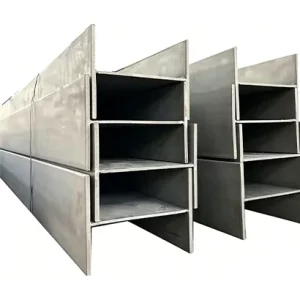
An H-beam is a structural steel section with a shape similar to the letter “H”. It has two wide horizontal flanges and one vertical web. The flanges help resist bending, while the web helps resist shear force. This shape makes H-beams useful for strong, stable, and heavy-duty structures.
In construction and steel structure projects, H-beams are often used for columns, beams, platforms, bridges, workshops, warehouses, and large-span buildings. Their wider flange design gives better load-bearing capacity and stronger resistance to deformation.
For B2B buyers, H-beam steel is usually selected when the project requires higher strength, better stability, and long-term safety. Steel structure companies, construction contractors, and industrial project builders often choose H-beams for main structural frames.
What Is an I-Beam?
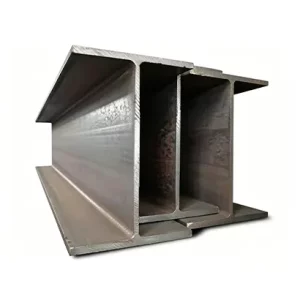
An I-beam is also a structural steel beam. Its cross-section looks like the letter “I”. Compared with many H-beams, an I-beam usually has narrower flanges and a taller web. This makes it efficient for carrying vertical loads and bending forces in many building applications.
I-beams are widely used in floor beams, roof supports, bridge components, building frames, machinery bases, and general steel construction. The web mainly handles shear force, while the flanges resist bending. This is why I-beams are still one of the most common types of structural steel sections.
For projects where the load is moderate and cost control is important, I-beams can be a practical choice. They are often lighter than H-beams of similar height, which can help reduce material cost and make handling easier.
H-Beam vs I-Beam: What Are the Key Differences?
The main difference between an H-beam and an I-beam is the shape and proportion of the flange and web. H-beams usually have wider flanges. I-beams usually have narrower flanges and a more slender shape. In structural design, these shape differences directly affect strength, weight, stability, and application.
The American Institute of Steel Construction provides dimensional tools for rolled steel sections, showing that steel sections are selected by shape, size, weight, and structural properties rather than only by appearance.
In simple terms, an H-beam is usually better for heavy loads, large spans, and strong columns. An I-beam is often better for lighter or medium-load structures where vertical bending support is the main purpose.
Which Is Stronger, H-Beam or I-Beam?
In most heavy-duty construction applications, H-beam is stronger than I-beam. This is because H-beams generally have wider flanges and better material distribution. Wider flanges help the beam resist bending more effectively and improve stability under heavy loads.
However, this does not mean H-beam is always the correct choice. A smaller H-beam may not be stronger than a larger I-beam. Strength depends on the actual beam size, steel grade, section weight, span, load type, and engineering design.
A more accurate answer is this: H-beams are usually stronger for heavy structural support, while I-beams are efficient and economical for many standard building applications. For any load-bearing project, final selection should follow drawings, engineering calculations, and local building standards.
Why Does Flange Width Affect Beam Strength?
The flange is one of the most important parts of a beam. The horizontal flange helps resist bending. When a beam carries weight, the top flange may be under compression, while the bottom flange may be under tension. A wider and thicker flange can help spread the force more effectively.
This is one reason H-beams are often used in columns, large steel frames, and industrial buildings. Their wide flange design improves load distribution and helps reduce bending deformation. According to common steel beam guidance, wide flange beams are designed so the web handles shear force and the flange resists bending force.
For buyers, this means flange width is not just a shape detail. It affects strength, stability, and performance. When purchasing structural steel beams, you should compare flange width, web thickness, total weight, steel grade, and production standard.
When Should You Choose H-Beam Steel?
You should choose H-beam steel when your project needs strong structural support, large-span performance, or high load-bearing capacity. H-beams are commonly used in industrial buildings, steel structure workshops, bridges, warehouses, and heavy equipment platforms.
For example, if you are building a steel structure warehouse, the main columns and beams may need to carry roof loads, wind loads, crane loads, and other forces. In this case, H-beams are often a better choice because they provide strong support and stable performance.
H-beams are also suitable for prefabricated steel structures. Many steel structure companies prefer H-beams because they are easier to connect with plates, bolts, and welded components. Their wider flange surface also helps improve connection strength.
When Should You Choose I-Beam Steel?
You should choose I-beam steel when the project needs reliable support but does not require extremely heavy load capacity. I-beams are often used for floor beams, roof beams, building frames, small bridges, machinery supports, and general construction.
For many standard projects, I-beams provide a good balance between strength and cost. They use material efficiently and can be easier to transport and install. This makes them attractive for contractors and distributors who want stable performance at a reasonable price.
I-beams are also useful when the design requires a beam to carry bending loads mainly in one direction. For example, floor systems and roof systems often use I-beams because they are efficient under vertical loading.
H-Beam vs I-Beam Comparison Table
| Item |
H-Beam |
I-Beam |
| Shape |
Looks like “H” |
Looks like “I” |
| Flange Width |
Usually wider |
Usually narrower |
| Web Thickness |
Usually thicker |
Usually thinner |
| Weight |
Usually heavier |
Usually lighter |
| Strength |
Higher overall strength in many heavy-duty uses |
Strong for standard vertical loads |
| Stability |
Better for large structures and columns |
Good for beams and frames |
| Load Capacity |
Better for heavy loads |
Suitable for medium loads |
| Span Performance |
Better for long spans |
Better for shorter or moderate spans |
| Common Uses |
Warehouses, bridges, steel structures, columns |
Floors, roofs, frames, general construction |
| Cost |
Usually higher |
Usually more economical |
| Best For |
Heavy-duty structural projects |
Cost-effective support projects |
This table gives a practical comparison, but it should not replace engineering design. The final beam choice should always depend on project drawings, load calculations, and local standards.
How Do Steel Grade, Size, and Surface Treatment Affect Strength?
Beam shape matters, but it is not the only factor. Steel grade is also very important. A beam made from higher-strength steel can carry more load than a similar beam made from lower-strength steel. Common structural steel grades may vary by ASTM, EN, JIS, GB, or other standards.
Beam size also matters. A larger I-beam may be stronger than a smaller H-beam. That is why buyers should not compare only the shape. You should check height, flange width, web thickness, weight per meter, length, tolerance, and test certificates.
Surface treatment can also affect long-term performance. For outdoor or humid environments, galvanized steel, painted steel, or anti-corrosion coating may be required. Surface protection does not usually increase the basic structural strength, but it helps protect the beam from corrosion and extends service life.
How to Choose the Right Structural Steel Beam Supplier?
Choosing the right beam is important. Choosing the right supplier is just as important. A reliable steel supplier should provide clear specifications, stable quality, flexible dimensions, and proper export packaging.
As a professional steel and metal materials supplier in China, we support global B2B buyers with H-beams, I-beams, section steel, galvanized steel, hot rolled steel, cold rolled steel, stainless steel, steel pipes, roofing sheets, aluminum, copper, and customized metal solutions.
For importers, distributors, construction contractors, roofing suppliers, steel structure companies, machinery manufacturers, and OEM buyers, we recommend checking these points before ordering:
- Steel grade and standard
- Beam size and weight
- Flange width and web thickness
- Length tolerance
- Surface treatment
- Cutting, drilling, welding, or punching service
- Mill test certificate
- Packing and shipping method
- Delivery time
- Long-term supply capacity
You can also connect this article with related product pages such as section steel, hot rolled steel, galvanized steel coil, steel pipe, roofing sheet, and stainless steel to help buyers explore more structural and construction materials.
Practical Case: Choosing Beams for a Steel Structure Warehouse
Let us imagine a steel structure warehouse project. The buyer needs main columns, roof beams, wall supports, purlins, and connection parts. The building must resist wind load, roof load, and daily operating conditions.
For the main frame, H-beams may be preferred because they offer strong support and better stability. For secondary beams or lighter support areas, I-beams may be enough. This mix helps balance strength and cost.
This is common in real B2B procurement. Buyers do not always choose only one type of beam. They choose different structural steel sections based on each part of the project. That is how they control cost while keeping the structure safe.
Common Mistakes When Comparing H-Beams and I-Beams
One common mistake is saying, “H-beam is always stronger.” This is not always true. A beam’s strength depends on size, grade, weight, and design. A large I-beam can be stronger than a small H-beam.
Another mistake is choosing only by price. Lower price may look attractive, but if the beam does not meet the required standard, the project may face safety risks, installation problems, or replacement costs.
The third mistake is ignoring corrosion protection. For outdoor steel structures, coastal projects, industrial plants, or humid areas, surface treatment is very important. Galvanizing or coating can help protect the beam and reduce maintenance costs.
FAQ About H-Beams and I-Beams
Is H-beam stronger than I-beam?
Yes, in many heavy-duty structural applications, H-beam is generally stronger than I-beam because it usually has wider flanges and better load distribution. But the final strength depends on size, steel grade, and engineering design.
Is I-beam cheaper than H-beam?
In many cases, I-beam is more economical because it is usually lighter and uses less steel. However, price depends on steel grade, size, market cost, surface treatment, and order quantity.
Which beam is better for a warehouse?
For steel structure warehouses, H-beams are often used for main columns and frames because they provide strong support. I-beams may be used for secondary support depending on the design.
Which beam is better for long spans?
H-beams are usually better for long spans because their wider flange and stronger section design help resist bending and deformation.
Can H-beams and I-beams be galvanized?
Yes. H-beams and I-beams can be galvanized or coated for corrosion protection. This is useful for outdoor structures, humid environments, and industrial applications.
Can I order customized beam sizes?
Yes. Many steel suppliers can provide cutting, drilling, punching, welding, surface treatment, and customized lengths based on project drawings and procurement requirements.
Key Takeaways
H-beams are generally stronger than I-beams for heavy-duty structural projects.
I-beams are still strong and cost-effective for many standard construction applications.
Flange width, web thickness, steel grade, and beam size all affect strength.
H-beams are often used in warehouses, bridges, columns, and steel structure buildings.
I-beams are often used in floors, roofs, frames, and moderate-load structures.
Do not choose a beam only by appearance or price.
Always confirm beam selection with project drawings and engineering calculations.
A reliable steel supplier should provide clear specifications, stable quality, processing options, and export support.









 05-20 2026