







Schedule 40 vs Schedule 80 Steel Pipe: How to Choose the Right Wall Thickness
Explore galvanized steel pipe sizes, OD, wall thickness, and schedule 40 charts. Learn how to measure galvanized pipe size and astm a53 specifications.
10-22 2026

 09-16 2026
Luyuan Steel Technical Team | Published September 2026
H beam and I beam both carry structural loads through a vertical web and horizontal flanges, but the flange geometry differs enough to change bending capacity, connection detailing, and cost per ton. This guide compares the two for structural steel specification — not automotive connecting rods, which reuse the same “H-beam vs I-beam” search terms for a completely unrelated part.
H-Träger vs. I-Träger: Auswahl von Profilen für den Stahlbau
If a search engine sent you here looking for H-beam versus I-beam connecting rods for an engine build, this isn’t that article. Automotive con-rods borrow the same cross-section names — I-beam rods for lighter reciprocating mass, H-beam rods for compression strength at high RPM — but they’re forged small parts with no relationship to structural steel sections beyond a shared silhouette. The rest of this guide covers construction and fabrication use, where “H beam” and “I beam” refer to hot rolled steel sections measured in meters, not millimeters.
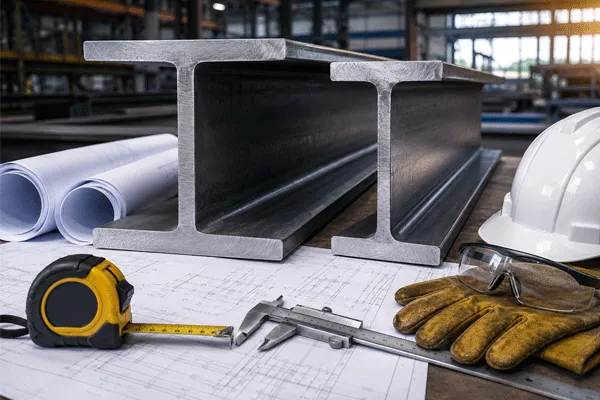
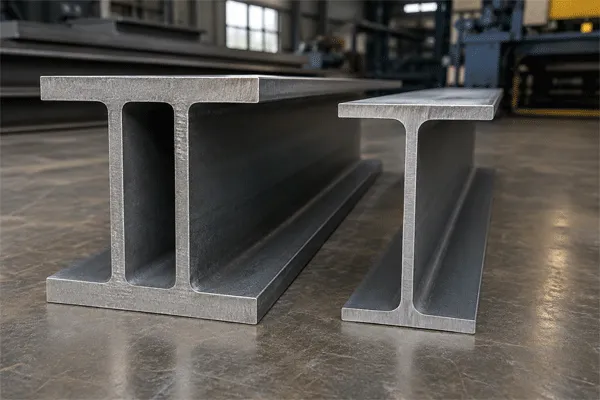
Both shapes look similar in a side profile: two flanges connected by a web, forming an “H” or “I” outline depending on orientation. The difference sits in the flange.
A classic I-beam — the American S-shape, standardized decades before wide-flange sections became common — has flanges with a tapered inner face, sloped at roughly 16.67%, and a flange width that’s typically much narrower than the section depth. A modern H-beam, more precisely called a wide-flange or W-shape section, has flanges with parallel inner and outer faces and a flange width often close to, or equal to, the section depth. That parallel face matters for fabricators: it gives a flat, consistent bearing surface for welding, bolting, and base-plate connections, where a tapered S-shape flange requires shims or matched washers to seat properly.
Compared to catalog listings that repeat generic “flange and web” descriptions without naming a designation system, specifying H beam or I beam by HW/HM/HN, W-shape, or IPE/HEA code tells a mill exactly which section to quote instead of leaving room for interpretation.
Structural sections aren’t labeled the same way worldwide, and mixing systems on a drawing set is a common source of RFQ delay. The table below maps the three designation families most fabricators encounter.
| Region / System | Typical Designation | Example | Standardizing Body |
| Japan and most of Asia | HW / HM / HN prefix + depth × width | HW200×200, HN400×200 | Japanese Industrial Standards Committee (JISC) |
| United States | W-shape + depth × weight per foot | W10×33, W24×76 | ASTM International |
| Europe | IPE / HEA / HEB + depth | IPE300, HEA300, HEB300 | CEN/CENELEC |
| China | Grade + H-section series | Q345/Q355 H-beam | GB/T standard series |
HW sections have roughly equal flange width and depth, built for column applications where load runs in both axes. HN sections are narrower-flanged and depth-dominant, closer to a beam-only role. American W-shapes cover a continuous range rather than three named sub-families, with the number after “W” indicating nominal depth in inches and the number after “×” indicating weight per linear foot. European IPE sections keep the tapered-flange geometry closer to a true I-beam, while HEA and HEB are Europe’s wide-flange equivalents to H-beam.
| Attribute | H Beam (Wide-Flange / W-Shape) | I Beam (S-Shape / Tapered Flange) |
| Flange face | Parallel, flat | Tapered, ~16.67% slope |
| Flange width vs. depth | Often near-equal | Typically much narrower than depth |
| Weak-axis stiffness | Higher | Lower |
| Common connection method | Bolted or welded, flat bearing | Often requires tapered washers/shims |
| Typical use | Columns, beams under biaxial load, fabricated frames | Monorail and crane runway beams, older code-era drawings |
| Standard families | HW/HM/HN, W-shape, HEA/HEB | S-shape, IPE (partial taper) |
| Steel grade (Luyuan) | Q345 listed on current product page | Not a confirmed Luyuan catalog item |
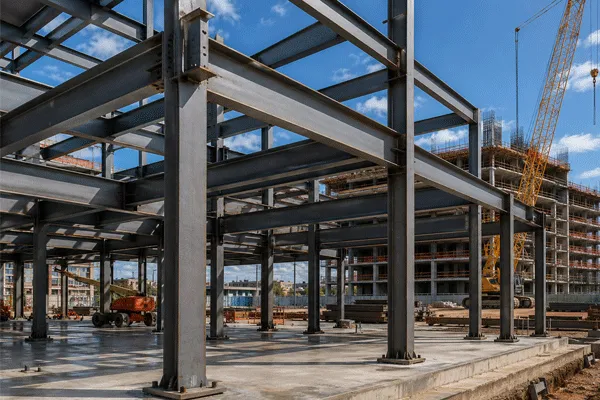
Every I-shaped or H-shaped section has two bending axes. The strong axis (x-x) runs through the web, where the flanges sit farthest from the neutral axis and resist bending most efficiently — this is the orientation both H-beam and I-beam are typically installed in for simple beam spans. The weak axis (y-y) runs through the flange width, and this is where the two shapes separate.
Because a tapered I-beam’s flange is narrow relative to its depth, its weak-axis section modulus is comparatively small — fine for a beam that only needs to resist load in one direction, such as a straight-run crane rail, but a poor choice where lateral loads, wind, or seismic bracing put meaningful force on the weak axis too. A wide-flange H-beam’s broader, parallel flange gives it materially better weak-axis capacity, which is why it’s the default choice for columns and for frames where lateral-torsional buckling resistance matters.
H-Träger vs. I-Träger: Auswahl von Profilen für den Stahlbau
Luyuan’s current H beam listing states Grade Q345 with standard lengths from 1,000 mm to 12,000 mm. A naming note worth flagging for import documentation: Q345 predates the current GB/T 1591 revision, which renumbered the equivalent grade series under Q355. The chemical and mechanical property targets are essentially unchanged between the two labels, but if your import inspection or end-client specification expects the Q355 designation explicitly, confirm which label the mill test certificate will carry before the order is placed.
Section size range (depth × width × flange/web thickness), tolerance class, and surface treatment options are not published on Luyuan’s current H beam listing. Rather than estimate these figures, request them directly at RFQ stage alongside your target designation (HW, HN, or equivalent Q345/Q355 section) — this is standard practice for structural steel sourcing regardless of supplier, since section availability shifts with rolling schedules.
Luyuan does not currently carry a confirmed catalog entry for a classic tapered-flange I-beam (S-shape). If your project genuinely requires that profile rather than a wide-flange H-beam substitute, treat it as a price-on-request item pending mill confirmation, not an assumed stock product.
Luyuan’s published reference listing price for H-beam steel runs approximately USD 440–568 per metric ton, depending on section size, grade, length, and order volume. This is a reference range rather than a fixed quote — final pricing depends on Incoterms, destination port, and quantity. Because a specific I-beam (S-shape) product entry isn’t currently in Luyuan’s confirmed catalog, that profile should be treated as price on request rather than assumed to fall in the same band as H-beam.
H-Träger vs. I-Träger: Auswahl von Profilen für den Stahlbau
The most common mixup isn’t H-beam versus I-beam — it’s assuming the two terms are used consistently across regions. A buyer in a JIS-standard market ordering “H-beam” and a buyer in a European market ordering “HEA” may both mean the same wide-flange geometry, but a drawing set that mixes an American W-shape callout with an Asian HN designation without a conversion table is a routine cause of mismatched shipments. The second common error is assuming any wide-flange section can substitute for a tapered I-beam on a legacy drawing without re-checking the connection details — the flat flange face changes how base plates, clip angles, and crane-rail clips seat, even when the depth and weight per meter are close.
A: Yes — “H-beam” and “wide-flange” (or W-shape in American terminology) describe the same parallel-flange geometry. Regional naming differs, but the cross-section is functionally the same family.
A: For strong-axis bending in a simple span, the two can perform similarly at comparable weight. The real gap is weak-axis stiffness, where H-beam’s wider, parallel flange outperforms a tapered I-beam’s narrower flange.
A: Sometimes, but connection detailing needs review first — base plates, clip angles, and bracing hardware sized for a tapered flange may not seat correctly on a parallel-flange H-beam without redetailing.
A: Grade Q345, in standard lengths from 1,000 mm to 12,000 mm. Section size range, tolerance class, and surface treatment should be confirmed directly at RFQ stage.
A: Not as a confirmed current catalog entry — treat it as a price-on-request item pending mill confirmation rather than an assumed stock product.
A: The names describe a similar cross-sectional silhouette, but automotive con-rods are small forged parts with no structural relationship to steel building sections. If that’s what you searched for, look to performance engine parts retailers instead.
A: This isn’t published on Luyuan’s current listing and should be confirmed in writing before order placement, since tolerance class affects fit-up in bolted connections.
A: Luyuan’s reference range for H-beam is approximately USD 440–568/MT, depending on section, grade, length, and volume — confirm current pricing and Incoterms at RFQ stage rather than relying on a published range as a final quote.
A: An English Mill Test Certificate at minimum, with third-party inspection (SGS, BV, Intertek, or a buyer-appointed inspector) available on request before shipment.
Explore galvanized steel pipe sizes, OD, wall thickness, and schedule 40 charts. Learn how to measure galvanized pipe size and astm a53 specifications.
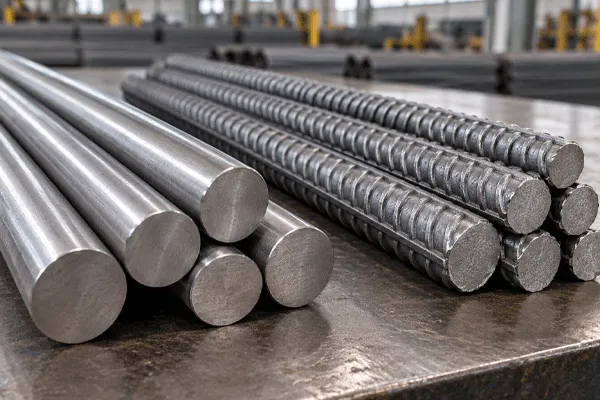
Compare plain round bar and deformed bar in this steel reinforcement guide. Learn which type of steel bar and rebar is best for your construction project.
Wir antworten Ihnen innerhalb von 24 Stunden. In dringenden Fällen fügen Sie bitte WhatsApp/WeChat hinzu: +86 15066120072. Oder rufen Sie direkt unter +86 15066120072 an.
*Wir respektieren Ihre Vertraulichkeit und alle Informationen werden geschützt.
Wir verwenden Ihre Informationen ausschließlich, um auf Ihre Anfrage zu antworten, und senden Ihnen niemals unaufgeforderte E-Mails oder Werbenachrichten.