Ordering an H Beam 200 without a complete specification can result in the wrong dimensions, unexpected weight, connection problems, and higher fabrication costs. The number “200” does not identify one universal section. Understanding beam designation, flange dimensions, and weight helps buyers select the right structural steel.
H-Träger 200 generally refers to a nominal 200-series H-shaped structural steel section, but actual dimensions depend on the standard and series. Under European specifications, HEA 200 is 190 mm high and weighs 42.3 kg/m, HEB 200 is 200 mm high and weighs 61.3 kg/m, while HEM 200 is 220 mm high and weighs approximately 103 kg/m.
H Beam 200 Dimensions: HEA 200 vs HEB 200 vs HEM 200 Size & Weight Guide
What Is H Beam 200 in Structural Steel Construction?
H Beam 200 is a common search term used by construction contractors, steel distributors, structural fabricators, and engineering buyers looking for H-shaped sections in the nominal 200 size family.
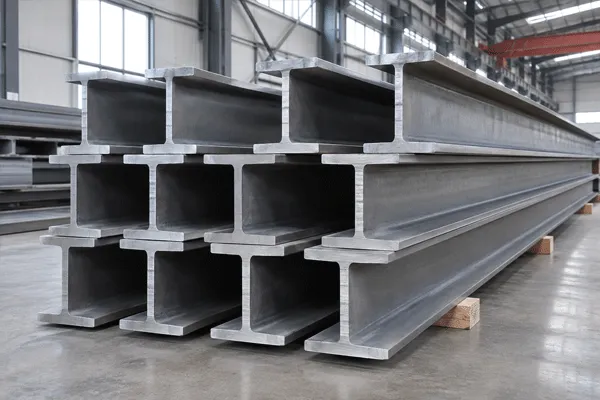
An H beam has two horizontal flanges connected by a vertical web. These components form an H-shaped cross-section that provides bending resistance and makes the section useful in structural frames.
The basic parts include:
- Flange: The horizontal plates at the top and bottom of the section.
- Web: The vertical plate connecting the flanges.
- Beam depth: The overall height of the section.
- Flange width: The overall width across the flange.
- Web thickness: The thickness of the vertical web.
- Flange thickness: The thickness of the horizontal flange.
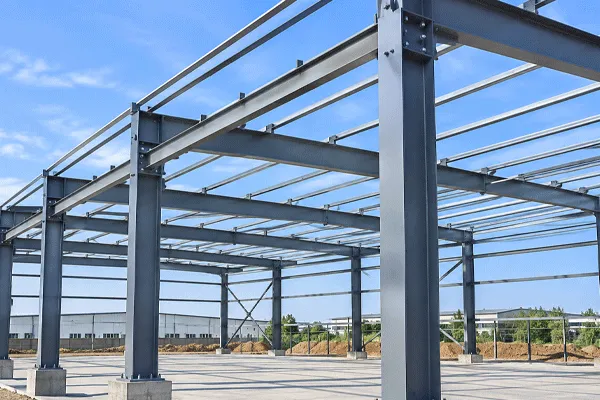
H sections are commonly used as columns, beams, frames, and structural supports in warehouses, factories, commercial buildings, and infrastructure projects.
However, the designation “H Beam 200” is incomplete. Different international standards define different shapes, sizes, and section properties.
A European HEB 200 is not automatically identical to a Chinese H200×200 section or an American wide-flange beam with a similar nominal depth.
For international procurement, the full beam designation is more important than the number 200 alone.
What Are the Standard Dimensions of HEA 200, HEB 200, and HEM 200?
The European HE family includes several section series. The most familiar are HEA, HEB, and HEM.
These profiles share a similar H-shaped geometry but have different dimensions, steel areas, and theoretical weights.
HEA is the lighter series, HEB is the standard-weight series, and HEM is the heavier series. These descriptions identify relative section families, not a universal rule about which section must be used for a particular structure.
The table below uses published European nominal dimensions from EN 10365:2026.
| Spezifikation |
HEA 200 |
HEB 200 |
HEM 200 |
| Nominal series |
200 |
200 |
200 |
| Beam depth (h) |
190 mm |
200 mm |
220 mm |
| Flange width (b) |
200 mm |
200 mm |
206 mm |
| Web thickness (tw) |
6.5 mm |
9.0 mm |
15.0 mm |
| Flange thickness (tf) |
10.0 mm |
15.0 mm |
25.0 mm |
| Cross-sectional area |
53.8 cm² |
78.1 cm² |
131.3 cm² |
| Theoretical weight |
42.3 kg/m |
61.3 kg/m |
103.0 kg/m |
Notice the differences.
HEA 200 has a smaller actual depth, thinner webs, and less metal area. HEB 200 has a full 200 mm depth with heavier flanges. HEM 200 has much thicker flanges and webs, increasing its cross-sectional area and mass.
Although all three carry the number 200, they are not interchangeable without engineering verification.
For buyers comparing steel H beams, this is the most important distinction to understand before requesting a quotation.
HEA and HEB: What Is the Main Difference Between the Two Beam Types?
The main difference between HEA and HEB is the amount and distribution of steel in the cross-section.
HEA is the lighter series, with thinner flanges and webs for the same nominal size family. This reduces the theoretical weight per meter and may lower total material tonnage where the design permits its use.
HEB is the standard series, with thicker flanges and a thicker web. The additional metal increases section area and changes its bending, shear, and axial-load properties.
For the 200 series:
| Merkmal |
HEA 200 |
HEB 200 |
| Actual depth |
190 mm |
200 mm |
| Flange width |
200 mm |
200 mm |
| Web |
Thinner |
Thicker |
| Flansch |
Thinner |
Thicker |
| Weight per meter |
42.3 kg |
61.3 kg |
| Material quantity |
Lower |
Höher |
| Typical selection |
Weight-efficient design where permitted |
Applications needing greater section properties |
HEB 200 contains approximately 45% more steel by theoretical mass per meter than HEA 200.
That difference affects material cost, transportation, handling, welding, connections, and installation.
However, HEB 200 does not automatically provide 45% more load capacity. Actual resistance depends on the type of loading, steel grade, span, lateral restraint, buckling, connection details, and structural design.
For a warehouse frame, a designer may select HEA where its section properties are sufficient. Another frame may require HEB because of greater axial forces, bending demands, or connection requirements.
The correct decision should follow engineering calculations rather than material weight alone.
What Is HEM 200, and When Are Thicker H-Beams Required?
HEM belongs to the heavy series of European H sections.
Compared with HEA and HEB, the HEM series uses substantially thicker webs and flanges. This increases the section area and can provide greater bending stiffness, axial resistance, and shear resistance, subject to the steel grade and design conditions.
For HEM 200, the nominal dimensions are:
- Beam depth: 220 mm
- Flange width: 206 mm
- Web thickness: 15 mm
- Flange thickness: 25 mm
- Theoretical weight: approximately 103 kg per meter
These dimensions make HEM 200 considerably heavier than the other two 200-series sections.
Heavy-duty structural applications may require larger section properties, particularly where a member carries significant compression, bending, or combined forces.
Examples may include certain heavily loaded columns, equipment-support frames, industrial structural members, and specialized building connections.
Nevertheless, choosing the heaviest available section is not always cost-effective.
A heavier member can increase foundation loads, connection requirements, erection weight, and shipping expenses.
For large engineering projects, structural engineers should determine whether the additional section properties justify the higher material and fabrication costs.
H Beam 200 Dimensions: HEA 200 vs HEB 200 vs HEM 200 Size & Weight Guide
How Do You Calculate H Beam 200 Weight per Meter and per Length?
The theoretical weight of an H-shaped steel section depends on its cross-sectional area and steel density.
The basic relationship is:
Weight per meter (kg/m) = Cross-sectional area (m²) × Steel density (kg/m³)
For general theoretical calculations, carbon steel density is commonly taken as approximately 7,850 kg/m³.
However, standard H sections include rolled internal radii and specific geometric details. Therefore, buyers should use the nominal mass published in the applicable steel section standard rather than calculate weight from three simple rectangles.
For HEA 200, HEB 200, and HEM 200, the standard theoretical masses are:
| Profil |
Weight per Meter |
6 m Length |
12 m Length |
| HEA 200 |
42.3 kg |
253.8 kg |
507.6 kg |
| HEB 200 |
61.3 kg |
367.8 kg |
735.6 kg |
| HEM 200 |
103.0 kg |
618.0 kg |
1,236.0 kg |
Calculated from nominal EN 10365 section masses. Actual shipment weights may differ because of rolling tolerances.
Consider a simple procurement example.
A structural fabricator needs 100 pieces of 12-meter-long sections.
The theoretical material weight would be:
| Profil |
Quantity |
Total Theoretical Weight |
| HEA 200 |
100 × 12 m |
50.76 MT |
| HEB 200 |
100 × 12 m |
73.56 MT |
| HEM 200 |
100 × 12 m |
123.60 MT |
This comparison illustrates how section selection affects total project tonnage.
The difference between HEA 200 and HEB 200 would be 22.8 metric tons for this example.
That affects purchasing budgets, loading plans, inland transport, and lifting operations.
For export orders, buyers should also confirm whether the quotation uses theoretical weight or actual measured weight.
How Do H Beam 200 Dimensions Affect Structural Performance?
The performance of a structural beam depends on more than overall depth.
Engineers evaluate the complete section geometry, including the web, flanges, internal radii, material strength, and the orientation of the member.
The flanges are particularly important for bending resistance because they place steel away from the neutral axis of the cross-section.
The web connects the flanges and plays an important role in transferring shear forces.
Important section properties include:
| Property |
Why It Matters |
| Cross-sectional area |
Influences axial resistance and theoretical weight |
| Second moment of area |
Influences bending stiffness |
| Elastic section modulus |
Used in elastic bending stress calculations |
| Plastic section modulus |
Used in plastic bending resistance calculations where permitted |
| Radius of gyration |
Important for compression-member buckling |
| Web area |
Contributes to shear resistance |
| Flange geometry |
Affects bending and connection design |
H-shaped sections have different behavior about their two principal axes.
The strong axis generally provides greater bending stiffness because the flanges are positioned farther from the relevant neutral axis.
The weak axis has lower bending stiffness, so the member’s orientation and lateral restraint can significantly affect performance.
For a column, engineers must also evaluate buckling under compression.
For a beam carrying distributed loads, the span, deflection, lateral restraint, and bending moments become important.
The same H Beam 200 designation does not guarantee the same load capacity across different series, grades, spans, or support conditions.
This is why structural design should rely on verified section properties and applicable design codes, not only on a beam dimensions chart.
Is H Beam 200 the Same as a 200 × 200 Steel H-Beam?
Not necessarily.
In international purchasing, the phrase 200 × 200 H Beam may describe a section with an overall height and width of approximately 200 mm.
However, the actual specification depends on the relevant dimensional standard.
For example, a European HEB 200 has a nominal 200 × 200 mm overall cross-section, while HEA 200 is 190 × 200 mm and HEM 200 is 220 × 206 mm.
In Asian markets, buyers may also encounter H200×200 designations under Chinese or Japanese standards.
Those designations may refer to different flange and web thickness combinations.
The main difference is not just how the profile looks. It includes the complete dimension set and section properties.
Before substituting one profile for another, confirm:
- Actual height.
- Actual flange width.
- Web thickness.
- Flange thickness.
- Fillet radius.
- Theoretical weight.
- Section properties.
- Material grade.
- Dimensional standard.
An American W-shape with a nominal depth near 200 mm is also not automatically equivalent to an HEA 200 or HEB 200.
The different naming systems are explained more broadly in Luyuan’s existing article, H-Träger oder I-Träger: Profilwahl im Stahlbau.
For this article, the important point is straightforward: do not substitute sections based only on similar nominal size.
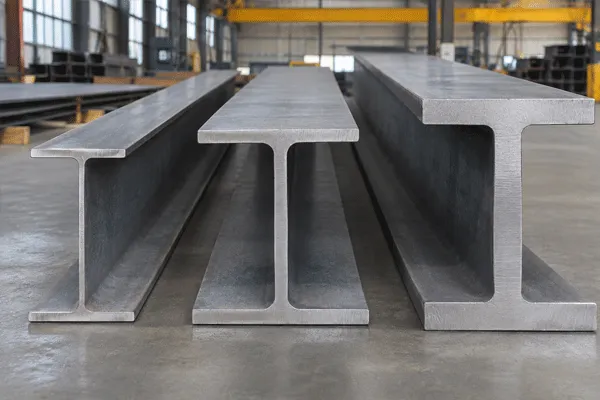
H Beam 200 Dimensions: HEA 200 vs HEB 200 vs HEM 200 Size & Weight Guide
Where Are H Beam 200 Sections Commonly Used in Steel Structures?
H-shaped sections are widely used in modern construction because their geometry allows them to carry bending and axial forces efficiently.
Depending on the steel grade, section properties, and engineering design, 200-series H sections can serve several structural functions.
Industrial Buildings and Warehouses
H sections are commonly used in industrial building frames, columns, equipment platforms, supports, and secondary structural systems.
A warehouse project may combine H sections with C channels, angle steel, hollow sections, and other structural members.
Factory and Machinery Support Frames
Industrial facilities may use H-shaped members for equipment bases, platforms, support columns, and fabricated steel frames.
The required beam size depends on equipment loads, vibration, connection design, and supporting conditions.
Commercial Construction
H sections may be used in building frames, mezzanines, floor supports, and other engineered structural components.
For multi-storey buildings, the designer must evaluate load combinations, fire protection, member stability, and applicable building codes.
Infrastructure and Engineering Projects
H-shaped sections may also be specified for structural supports, temporary works, industrial platforms, and certain infrastructure components.
The final choice depends on the project specification.
| Anwendung |
Main Selection Consideration |
| Warehouse frames |
Structural loads, spans, stability |
| Equipment support |
Concentrated loads and vibration |
| Columns |
Compression and buckling |
| Floor beams |
Bending and deflection |
| Industrial platforms |
Load combinations and connections |
| Fabricated structures |
Cutting, welding and installation |
A 200-series H section can be useful in many projects, but the exact HEA, HEB, HEM, or other profile must be chosen through structural engineering.
What Steel Grades and Standards Should Buyers Specify?
The beam designation describes section geometry. The steel grade describes material properties.
These are different parts of the purchase specification.
For European structural sections, common grades may include S235JR, S275JR, and S355JR under the applicable EN 10025 requirements.
Chinese structural sections may use Q235 or Q355 grades under applicable GB standards.
The choice affects:
- Yield strength.
- Tensile strength.
- Ductility.
- Weldability.
- Impact requirements.
- Fabrication suitability.
- Structural performance.
Luyuan Steel’s current H Beam product listing identifies Q345 as its featured grade and publishes a length range of 1,000–12,000 mm, while also mentioning additional material options. However, the exact European HEA/HEB/HEM 200 dimensions are not confirmed as stocked models on that product page.
Buyers should therefore request confirmation of the exact section series, grade, standard, and availability.
Which Dimensional Standards Matter?
For international procurement, common references include:
| Standard |
Main Purpose |
| EN 10365 |
Dimensions and masses of European hot-rolled I and H sections |
| EN 10034 |
Shape and dimensional tolerances of structural I and H sections |
| EN 10025 |
Relevant European structural steel material grades |
| GB/T 11263 |
Chinese hot-rolled H and T sections |
| JIS G 3192 |
Japanese dimensions and tolerances of hot-rolled steel sections |
| ASTM A6/A6M |
General requirements for certain structural steel products |
For European HE sections, EN 10365 defines nominal dimensions, while EN 10034 provides relevant rolling tolerances.
Refer to ArcelorMittal’s structural section range for additional information about European H-section standards and steel grades.
Never assume that similar-looking beam types from different standards are dimensionally or mechanically interchangeable.
How Should Buyers Specify H Beam 200 for Fabrication and Export?
For a B2B purchaser, an incomplete beam designation can create unnecessary communication and project delays.
A request such as:
Please quote H Beam 200, 100 tons.
does not provide enough technical information.
The supplier still needs to know the exact series, dimensions, steel grade, length, and processing requirements.
A more complete example is:
European HEB 200, EN 10365 dimensions, S355JR according to the applicable EN 10025 specification, 12 m length, 100 metric tons, mill test certificates, specified dimensional tolerances, and seaworthy export packaging.
This is an illustrative engineering RFQ, not a confirmed Luyuan stock specification.
Recommended H Beam RFQ Checklist
| Parameter |
Information Required |
| Produkt |
H-shaped structural steel section |
| Section designation |
HEA 200 / HEB 200 / HEM 200 / specified alternative |
| Dimensional standard |
EN 10365 / GB/T 11263 / other |
| Material grade |
S235JR / S355JR / Q355 / other |
| Beam depth |
Exact dimension |
| Flange width |
Exact dimension |
| Web thickness |
Exact dimension |
| Flange thickness |
Exact dimension |
| Länge |
6 m / 12 m / customized |
| Quantity |
Pieces or metric tons |
| Bearbeitung |
Cutting, drilling, welding, etc. |
| Surface condition |
As-rolled or specified treatment |
| Toleranz |
Applicable dimensional standard |
| Prüfung |
Factory or third-party inspection |
| Documents |
MTC and export documents |
| Lieferung |
Destination port and Incoterm |
If the order includes drilling, cutting, or welding, provide drawings and connection details.
For example, a fabricator may need a specific hole pattern, end cut, or connection plate preparation.
The flange width and web thickness influence the available space for bolts, welds, and fabrication tools.
A structural engineer should also review any proposed substitution because a small change in profile geometry can affect connection design.
For international buyers, confirming these requirements before production reduces the risk of receiving material that cannot be used in the planned structure.
How Can Luyuan Steel Support H Beam and Structural Steel Procurement?
Luyuan Steel is a China-based integrated steel manufacturer and supply partner serving international distributors, construction contractors, steel structure fabricators, industrial buyers, and engineering companies.
Our published product range includes H Beam, U-Profil, L Beam, steel rebar, steel pipe, steel plate, galvanized coil, hot rolled steel, cold rolled steel, stainless steel, aluminum, and copper products.
For H-shaped structural sections, the current Luyuan H Beam product page identifies Q345 material and lengths from 1,000 to 12,000 mm, together with project processing support.
Specific size designations, material alternatives, and availability should be confirmed before order acceptance.
Our OEM/ODM and integrated supply support can include:
- Review of customer drawings and material specifications.
- Coordination of required structural section dimensions.
- Customized cutting lengths where available.
- Cutting, punching, drilling, and welding requirements subject to confirmation.
- Material test certificates and traceability.
- Factory quality inspection.
- Third-party inspection coordination.
- Export packaging.
- International logistics.
- Consolidated procurement of multiple steel categories.
For example, an industrial warehouse project may require H sections together with C beams, angle steel, steel plates, steel pipes, and roofing materials.
Working with an integrated supply partner can simplify communication and reduce the number of separate procurement arrangements.
However, the steel section selection must always follow the approved structural design.
We do not recommend replacing an HEA section with HEB, HEM, or another H-shaped section solely because it appears stronger.
The correct section depends on the required geometry, mechanical properties, connections, and project specification.
If you are sourcing H Beam 200 or other structural steel sections, send us your drawings, required standard, grade, dimensions, lengths, quantity, processing needs, and destination port.
Our team can review the requirements, confirm available supply options, and prepare a project-based quotation.
FAQs About H Beam 200 Dimensions and Weight
What is the standard size of H Beam 200?
There is no single universal size for H Beam 200. Under European standards, HEA 200 measures 190 × 200 mm overall, HEB 200 measures 200 × 200 mm, and HEM 200 measures 220 × 206 mm. Web and flange thicknesses also differ.
How much does HEB 200 weigh per meter?
HEB 200 has a nominal theoretical weight of approximately 61.3 kg/m according to EN 10365. A 6-meter section weighs approximately 367.8 kg, while a 12-meter section weighs approximately 735.6 kg before accounting for permitted dimensional variations.
Is HEA 200 lighter than HEB 200?
Yes. HEA 200 weighs approximately 42.3 kg/m, compared with 61.3 kg/m for HEB 200. HEA uses thinner webs and flanges, giving it a smaller cross-sectional area.
Is HEM 200 the strongest H Beam 200?
HEM 200 has the heaviest section and largest cross-sectional area among HEA 200, HEB 200, and HEM 200. However, actual structural capacity depends on grade, length, loading, restraints, buckling, and connections. It is not correct to identify the strongest member from weight alone.
Is H Beam 200 suitable for warehouse construction?
It may be used in warehouses or industrial buildings when the structural design requires that section. Suitability depends on loads, spans, lateral restraint, steel grade, and member function. A structural engineer must verify the section before it is specified.
Can I replace HEA 200 with HEB 200?
Not without engineering approval. Although the sections belong to the same nominal family, they have different depths, thicknesses, weights, and section properties. A substitution can also affect connections and construction dimensions.
Key Takeaways: How to Choose the Right H Beam 200
- H Beam 200 is a nominal size description, not one universal steel section.
- HEA 200, HEB 200, and HEM 200 have different dimensions, flange thicknesses, and theoretical weights.
- HEA 200 measures 190 × 200 mm and weighs approximately 42.3 kg/m.
- HEB 200 measures 200 × 200 mm and weighs approximately 61.3 kg/m.
- HEM 200 measures 220 × 206 mm and weighs approximately 103 kg/m.
- The HEA series is lighter, HEB is the standard-weight series, and HEM is the heavier series.
- Thicker webs and flanges increase section area, but weight alone does not determine load capacity.
- Structural performance depends on span, loading, material grade, section properties, buckling, and connections.
- EN 10365 defines European H-section nominal dimensions, while EN 10034 specifies relevant dimensional tolerances.
- A European HEB 200 should not automatically be treated as equivalent to a Chinese H200×200 or an American wide-flange section.
- Theoretical weight affects material tonnage, transportation, lifting, and procurement cost.
- Buyers should specify exact dimensions, grade, standard, length, quantity, inspection requirements, and processing needs.
- Any section substitution should be reviewed and approved by the project engineer.
- Confirm the exact H Beam 200 specification and supply availability before placing an international order.
Looking for a reliable H Beam supplier in China?
Luyuan Steel supplies structural steel products and supports global B2B procurement through material sourcing, customization, processing coordination, quality inspection, export packaging, and international logistics.
Send us your required H beam designation, steel grade, dimensions, length, quantity, engineering drawings, and destination port for a tailored quotation.









 11-06 2026