







Schedule 40 vs Schedule 80 Steel Pipe: How to Choose the Right Wall Thickness
Explore galvanized steel pipe sizes, OD, wall thickness, and schedule 40 charts. Learn how to measure galvanized pipe size and astm a53 specifications.
10-22 2026

 10-12 2026
Buying the wrong steel sheet can cause poor fit-up, unstable fabrication, excess waste, and higher project costs. Thickness, grade, tolerance, and surface condition all matter. Understanding the material before you order helps you avoid these problems and choose steel that works from the first cut.
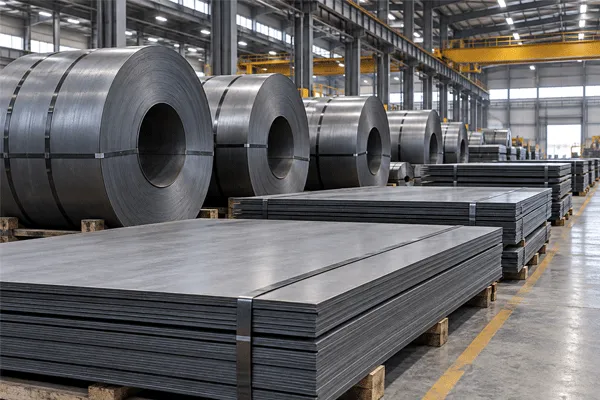
Hot rolled steel sheet is steel rolled at high temperature and supplied as coil or cut sheet for construction, machinery, fabrication, automotive parts, structural components, and general manufacturing. Buyers should choose it by grade, thickness, width, mechanical properties, surface condition, dimensional tolerance, welding needs, and final application—not by price alone.
Hot Rolled Steel Sheet Supplier Guide: Carbon Steel, Mild Steel & Steel Plate Selection
Hot rolled steel is flat steel produced by rolling heated steel slabs through a series of rollers until they reach the required thickness and width. The process takes place at temperatures above its recrystallization range, allowing the metal to deform more easily during rolling.
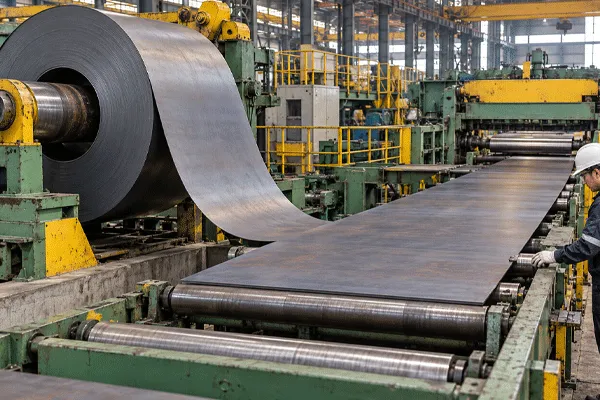
In a modern hot strip mill, heated slabs pass through several rolling stands. Each roller reduces thickness until the material reaches its planned dimensions. The steel is then cooled and usually wound into a coil. Depending on customer needs, it may remain in coil form or be cut into individual sheets.
ArcelorMittal describes its process in a similar way: heated slabs are reduced through a multi-stand hot strip mill and then formed into coil. Hot-rolled material may be shipped in its original condition or cleaned by acid pickling before further use.
A simplified production flow looks like this:
Steel Slab
    ↓
Reheating
    ↓
Rough Rolling
    ↓
Finish Rolling
    ↓
Controlled Cooling
    ↓
Coiling
    ↓
Slitting / Cut-to-Length
    ↓
Hot Rolled Steel Sheet
Because the steel cools from a high temperature after rolling, it may develop mill scale and a rougher surface than precision cold-finished products. For many industrial applications, this is not a disadvantage. Buyers often choose it because it provides a practical balance of cost, strength, formability, and processing efficiency.
The exact performance depends on grade, chemical composition, processing route, thickness, and intended use. However, hot rolled carbon steel is widely valued for good fabrication behavior, useful strength, and economical production.
Many common grades are low carbon materials. Lower carbon content generally supports good forming and weldability, although the final welding procedure should always match the actual grade, thickness, and service conditions.
Important properties include:
| Property | Why It Matters to Buyers |
|---|---|
| Yield strength | Indicates when permanent deformation begins |
| Tensile strength | Shows resistance to pulling forces |
| Elongation | Helps indicate ductility |
| Hardness | Affects forming, machining, and wear behavior |
| Thickness tolerance | Influences fit, weight, and fabrication |
| Flatness | Important for cutting and assembly |
| Surface condition | Matters for painting and further processing |
| Chemical composition | Influences welding and mechanical behavior |
These mechanical properties should be selected according to the finished product. A light fabricated housing does not need the same strength as a load-bearing structural component.
The balance between strength and hardness also matters. Stronger material is not automatically better. A grade that is too strong or too hard can make bending or punching more difficult. In many fabricated products, buyers need a combination of strength, ductility, and formability.
For North American and many international buyers, ASTM A1011/A1011M is one of the key specifications to understand.
The current ASTM A1011/A1011M-25 standard covers hot-rolled carbon, structural, high-strength low-alloy, improved-formability HSLA, and ultra-high-strength steel sheet and strip supplied in coils or cut lengths. It includes several commercial, drawing, structural, and high-strength designations.
You may see buyers use phrases such as A1011 hot, A1011 hot rolled steel, or ASTM A1011 HR sheet in RFQs. These are common purchasing shortcuts, but the complete order should still identify the exact type or grade.
For example, an RFQ should not simply say:
“Need A1011 steel.”
A better request is:
“ASTM A1011/A1011M, required grade/type, 3.0 mm thickness, 1250 mm width, cut-to-length sheets, quantity, surface requirement, packing requirement, and destination port.”
This gives the mill or supplier enough information to check availability and recommend the correct material.
This is an important distinction.
Buyers often search for hot rolled A36 steel, but ASTM A36/A36M is a structural specification covering carbon steel shapes, plates, and bars for general structural applications. ASTM A1011/A1011M, by contrast, specifically covers hot-rolled sheet and strip in coils and cut lengths.
If your project requires a steel plate, structural member, or structural-quality item, A36 may be appropriate. If you require sheet or strip from coil, A1011 may be the more relevant starting point.
The safest approach is simple: specify the product form and standard together.
Hot Rolled Steel Sheet Supplier Guide: Carbon Steel, Mild Steel & Steel Plate Selection
The differences between hot rolled and cold rolled steel begin with how the material is processed.
Hot-rolled material receives its main thickness reduction while hot. Cold-rolled material starts from hot-rolled sheet and goes through additional processing such as pickling, cold reduction, annealing, and temper rolling. This additional processing can improve surface uniformity, shape, and gauge control.
Here is a practical comparison:
| Feature | Hot Rolled | Cold Rolled |
|---|---|---|
| Processing | Rolled hot | Further reduced near room temperature |
| Surface | Scale or pickled condition | Cleaner, more uniform |
| Dimensional control | Generally broader | Generally tighter |
| Cost | Usually more economical | Usually higher |
| Typical use | Structures, machinery, fabrication | Appliances, precision parts, finished surfaces |
| Form availability | Coil, sheet, plate | Coil and sheet |
| Appearance | Industrial | Smoother appearance |
These differences between hot and cold processing affect more than appearance.
Cold working can change the material condition and may introduce internal stresses, while annealing and temper processing help achieve controlled final properties. Hot rolling is often preferred when a perfect smooth finish or very tight dimensions are not essential.
ArcelorMittal describes cold-rolled sheet as hot-rolled material that receives further processing to achieve more specific mechanical properties, better surface finish, gauge tolerance, and strip shape.
So when choosing between hot rolled and cold rolled material, ask one question:
Does the finished component really need the extra dimensional precision and surface quality of cold rolling?
If not, hot-rolled material can often provide better project economics.
Thickness is one of the most important purchasing details.
International steel buyers should preferably specify thickness in millimeters or inches rather than relying only on gauge. Gauge systems can vary by material type and market, and using only a number such as 7-gauge without confirming actual thickness can create confusion.
A better RFQ might state:
A standard sheet size may work for general fabrication, but many factories improve material yield by ordering a custom size.
For example, if a factory cuts 1200 mm components from a 1500 mm-wide sheet, a large strip of material may become scrap. Changing the ordered width can reduce waste significantly over thousands of parts.
Thickness, width, length, flatness, camber, and shape all influence production.
A small difference may not matter for a welded frame, but it can matter greatly when sheets enter automated cutting, stamping, or forming equipment.
ArcelorMittal’s technical references show that hot-rolled product tolerances are classified according to product category, thickness, width, and applicable standards such as EN 10051. SSAB likewise notes that customized dimensional and shape tolerances can be supplied for certain products by agreement.
This is why we recommend confirming dimensional tolerances before placing the order rather than after the material reaches your factory.
For many grades, yes.
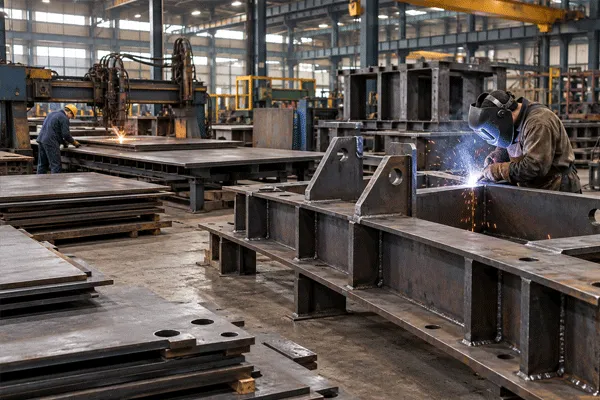
One reason this material is widely used in fabrication is that suitable grades can be cut, bent, punched, drilled, formed, and welded efficiently. A simple machine base, bracket, frame, support, enclosure, or structural reinforcement component may all begin with a hot-rolled sheet or coil.
However, weldability depends on chemistry, thickness, strength level, joint design, filler metal, and welding procedure.
Higher-carbon or certain alloy grades may need more careful welding control than ordinary mild steel. Structural standards also make clear that welding procedures should suit the actual material grade and intended service. ASTM A36, for example, specifically states that an appropriate welding procedure should be used when the material is welded.
For severe forming, also consider:
Some specialty steels may be normalized, thermomechanically processed, or quench and tempered. These should not be treated like ordinary commercial hot-rolled sheet.
For everyday fabrication, the best result comes from matching the grade to the manufacturing process before production starts.
Hot Rolled Steel Sheet Supplier Guide: Carbon Steel, Mild Steel & Steel Plate Selection
This material is one of the basic building blocks of modern manufacturing.
ArcelorMittal lists hot-rolled products across automotive, construction, energy, tubular products, heavy equipment, and other industrial markets.
Typical uses include:
Hot-rolled flat products can be used for fabricated supports, base components, frames, reinforcement parts, brackets, and general construction components.
In steel buildings, they may work together with H beams, C sections, angle steel, pipe, hollow sections, and other structural steel products.
Machinery factories use hot-rolled sheets for:
Its combination of strength and durability makes it practical where appearance is less important than reliable performance.
Certain grades are used in automotive structural components, chassis-related parts, wheels, frames, and other formed components.
The required grade depends strongly on strength, fatigue behavior, forming method, and weight targets.
Hot-rolled coil also serves as feedstock for welded pipe and tube production. Coils can be slit into narrower widths before forming and weld operations.
Factories often buy hot rolled sheet because it can support laser cutting, plasma cutting, shearing, bending, welding, and assembly.
For manufacturing and construction, this versatility is one of its strongest advantages.
There is no single best grade.
The correct choice depends on what the finished part must do.
A useful selection process looks like this:
End Application
      ↓
Required Strength
      ↓
Forming / Bending Needs
      ↓
Welding Requirements
      ↓
Thickness & Dimensions
      ↓
Applicable Standard
      ↓
Surface / Processing Needs
      ↓
Final Grade Selection
Different applications need different grades.
A general fabricated enclosure may prioritize cost and easy forming. A structural support may prioritize minimum yield strength. A heavy machinery component may need higher tensile strength. A deeply formed part may require greater elongation.
The chemical composition also matters. Small changes in carbon, manganese, silicon, or microalloying elements can change how the steel behaves.
In simple terms, chemistry and processing together are what makes the steel suitable—or unsuitable—for a specific task.
Standard uncoated hot-rolled material is a ferrous product and can rust when exposed to moisture.
If long-term corrosion resistance is important, buyers may choose:
If you plan to galvanize the finished part, tell your steel partner early. Material chemistry, dimensions, surface preparation, and fabrication details may affect the downstream process.
Never assume ordinary black hot-rolled sheet will resist outdoor corrosion without protection.
A good RFQ saves time.
Instead of sending only a product name, include the information the steel mill needs to quote correctly.
| Item | Information to Provide |
|---|---|
| Product | Steel sheet, coil, or plate |
| Standard | ASTM, EN, JIS, GB, or other |
| Grade | Exact grade/designation |
| Thickness | mm or inch |
| Width | Required width |
| Length | For cut sheets |
| Quantity | Tons, sheets, or coils |
| Surface | As-rolled, pickled, oiled, etc. |
| Processing | Cutting, slitting, profiling |
| Testing | MTC or additional inspection |
| Packing | Export seaworthy packing |
| Destination | Port/country |
| Delivery terms | FOB, CIF, CFR, etc. |
International buyers should also confirm whether the quotation refers to steel sheet and plate, sheet from coil, discrete plate, or another product form. These terms sometimes get used loosely in everyday trade, but the applicable standards and production routes may differ.
From our experience supplying global B2B customers, many disputes begin with an incomplete RFQ rather than poor steel production.
One party assumes a tight tolerance. The other quotes normal commercial tolerance. One party expects a pickled surface. The order specifies as-rolled material. One party needs a specific MTC format. Nobody confirms it before production.
A few extra lines in the purchase specification can prevent all of these problems.
Steel buyers increasingly need more than standard stock.
As a professional steel manufacturer and integrated steel supply partner in China, we support customers that need coils, sheets, plates, structural sections, tubes, stainless products, aluminum, copper, and other steel materials for international projects.
For hot-rolled flat products, our OEM / ODM support can include:
This is especially useful for distributors and fabricators buying several steel products in one shipment.
Consider a machinery manufacturer that needs thousands of rectangular panels.
The buyer can purchase a common stock dimension and cut every part locally. That is simple, but it may create significant offcuts.
A second option is to tell us the finished component dimensions, nesting plan, and required production quantity. We can then evaluate suitable width and cut-to-length options.
The result may be:
Standard Stock Sheet
Material Utilization   ███████░░░

Optimized Custom Sheet
Material Utilization   █████████░
The exact saving varies by project, but the principle is important: buying the correct size can sometimes save more money than negotiating a small reduction in price per ton.
That is why we approach a steel inquiry as a supply problem, not simply a price request.
Steel procurement is not finished when production ends.
For international shipments, inspection, traceability, packing, and loading are part of product quality.
Depending on the order, quality checks may cover:
For grades covered by ASTM A1011/A1011M, the standard includes chemical and mechanical requirements for the relevant steel classifications, including properties such as yield strength, tensile strength, and elongation for specified grades.
MTC documentation allows buyers to connect delivered material with reported production and test information.
Third-party inspection can also be arranged when required by the customer, EPC contractor, distributor, or project specification.
Uncoated steel can develop surface rust if exposed to water during transportation.
Some hot-rolled products are supplied oiled, but oil provides only temporary protection. SSAB, for example, notes that its surface treatments provide temporary protection during transport and storage and recommends keeping steel dry to prevent corrosion damage.
For ocean shipment, good packing may include:
A lower purchase price is not a saving if damaged or wet material arrives at the destination.
Not exactly. “Hot rolled” describes a production process. Mild steel usually describes low-carbon steel with relatively good formability and welding behavior.
A mild-steel grade can be hot rolled, but not every hot-rolled product is ordinary mild steel. Hot-rolled products also include structural, high-strength low-alloy, and other grades.
No. ASTM A1011/A1011M covers hot-rolled sheet and strip in coils and cut lengths across several carbon and structural classifications. ASTM A36/A36M covers carbon structural shapes, plates, and bars.
Always match the standard with the product form.
Hot rolling occurs at high temperature. As the material cools, oxide scale can form on the surface, and the final surface is usually less uniform than a cold-reduced product.
If you require cleaner material, pickled and oiled hot-rolled steel may be an option.
Many low-carbon grades are weldable and are widely used in fabricated structures.
However, welding procedure, preheat, filler metal, thickness, chemistry, and service conditions must match the specific material. Do not choose a welding procedure based only on the words “hot rolled.”
For international purchasing, specifying actual thickness in millimeters or inches is usually clearer.
You may include gauge as a reference, but the purchase order should state the actual nominal thickness and applicable tolerance.
Yes. Depending on material availability and order requirements, hot-rolled coil can be slit or cut into customized widths and lengths.
Providing the finished component dimensions can also help us recommend a size that reduces scrap.
If you are sourcing hot-rolled coils, sheets, carbon steel, structural material, galvanized products, stainless steel, pipes, sections, aluminum, or copper for an international project, send us your standard, grade, thickness, width, length, quantity, processing requirements, and destination port.
As an integrated steel manufacturer and supply partner in China, Luyuan Steel can support material selection, OEM / ODM processing, MTC documentation, third-party inspection, seaworthy packaging, and international logistics—helping distributors, contractors, manufacturers, and engineering buyers build a more stable steel supply chain.
Explore galvanized steel pipe sizes, OD, wall thickness, and schedule 40 charts. Learn how to measure galvanized pipe size and astm a53 specifications.
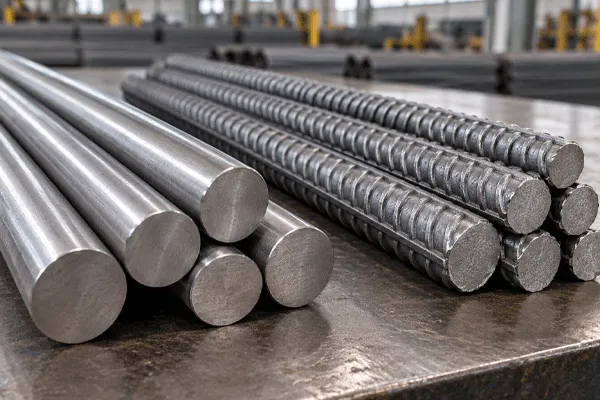
Compare plain round bar and deformed bar in this steel reinforcement guide. Learn which type of steel bar and rebar is best for your construction project.
We will reply you within 24 hours. If for urgent case, please add WhatsApp/WeChat: +86 15066120072,. Or call +86 15066120072 directly.
*We respect your confidentiality and all information are protected.
We will only use your information to respond to your inquiry and will never send unsolicited emails or promotional messages.