Luyuan Steel Technical Team | Steel Manufacturing & Export | Updated September 2026
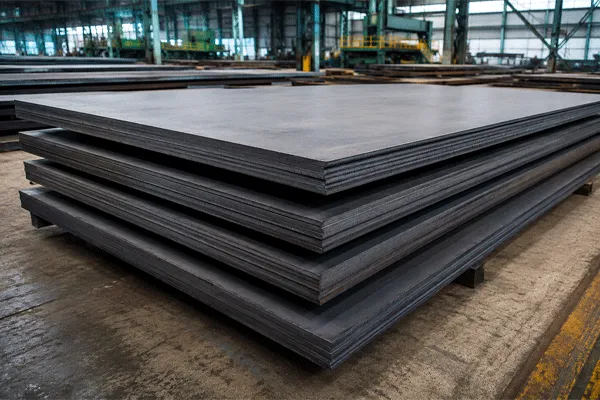
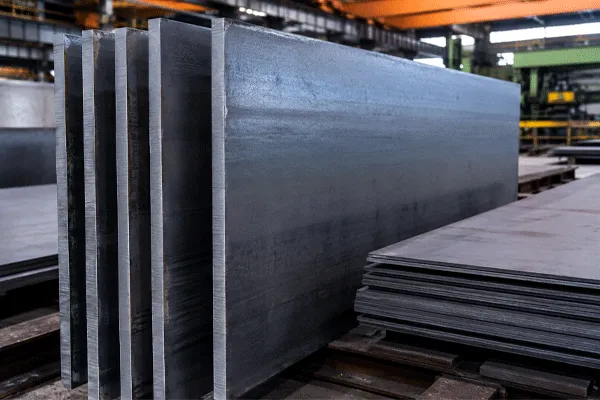
Hot rolled steel sheet is supplied at 2–10 mm thickness with ±1% tolerance, most commonly as Q235B or Q345B, with A36, S235JR and S355JR referenced as international grade equivalents on project specification sheets rather than as separately stocked SKUs.
Hot Rolled Steel Sheet: Grades, Thickness and Tolerances
Sheet, Coil or Plate: Why the Distinction Changes What You Order
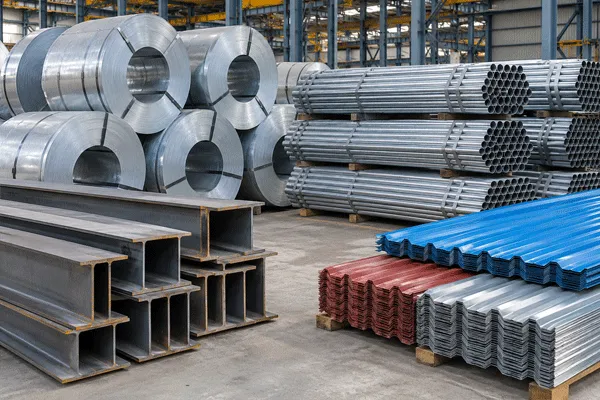
“Hot rolled sheet” gets used loosely, but the three product forms aren’t interchangeable on a purchase order. Sheet is supplied as flat, pre-cut pieces; coil is the same rolled material wound for slitting, decoiling or roll-forming; plate generally starts above the thickness range where sheet stops. Luyuan’s own product line separates these explicitly — HR Coil is published at 0.12–4.0 mm, while HR Sheet runs 2–10 mm. A buyer specifying “hot rolled sheet” at 1 mm, or “hot rolled coil” at 8 mm, is actually asking for a product outside the listed range for that form, and the quote will come back different from what was expected unless the order is corrected to match the right category.
Hot rolling itself also leaves a surface condition — mill scale — that cold rolling removes. That’s relevant for fabricators planning to weld, paint, or bond coatings: mill scale needs to be addressed (typically by pickling, blasting, or grinding) before those downstream processes, and that step should be scoped into the fabrication plan rather than assumed to be included with the base material.
Grade Equivalence: Q235B, Q345B, A36, S235JR and S355JR
Luyuan’s hot rolled sheet product line and project solution pages reference Q235B, Q345B, A36, S235JR, and S355JR. These aren’t identical specifications with different names — they’re separate national and regional standards that happen to produce steel with comparable but not identical mechanical properties.
| Grade |
Standart |
Min. Yield Strength (≤16 mm) |
Notes |
| Q235B |
GB/T 700 |
235 MPa |
China’s most common general structural grade |
| S235JR |
EN 10025-2 |
235 MPa |
European equivalent class to Q235B; CEN’s EN 10025-2 defines the room-temperature impact requirement behind the “JR” suffix |
| A36 |
ASTM A36 |
~250 MPa (36 ksi) |
US structural grade; commonly cross-referenced to Q235B and S235JR, but the specifications are not contractually interchangeable |
| Q345B |
GB/T 1591 |
345 MPa |
Higher-strength Chinese grade, now folded into the newer Q355B designation under GB/T 1591-2018 |
| S355JR |
EN 10025-2 |
355 MPa |
European high-strength equivalent class to Q345B/Q355B |
ASTM International’s own A36 specification and CEN’s EN 10025-2 standard are the reference documents behind the US and European columns above — if a project specification names one of those standards directly, that’s the document to check against, not a converted MPa number from a cross-reference table. Q235B and A36 are commonly treated as substitutable in general construction, but A36’s minimum yield sits roughly 15 MPa above Q235B’s, and the two remain separate, non-identical specifications. A project spec that names A36 specifically should get A36-certified material, not Q235B with an equivalence note attached after the fact.
Hot Rolled Steel Sheet: Grades, Thickness and Tolerances
Thickness and Tolerance: What’s Actually Published
Luyuan’s HR Sheet listing covers 2–10 mm thickness, with a stated tolerance of ±1% across its listed coil and sheet products.
| Spec |
Published Value |
| Thickness range |
2–10 mm |
| Tolerance |
±1% |
| Product form |
Cut sheet (see HR Coil for 0.12–4.0 mm coil-form material) |
For a 6 mm sheet, ±1% works out to roughly ±0.06 mm — tight enough for most fabrication work, but worth confirming against the actual project drawing tolerance before assuming it clears a tighter mechanical spec.
The Gauge-vs-Millimeter Mismatch on Cross-Border Orders
Most publicly available US hot rolled sheet reference pages price and spec material by gauge number against A36 or A1011 — a system built around imperial thickness steps, not millimeter bands. That works fine for a domestic buyer pulling from local service-center stock, but it creates a real conversion problem for a fabricator working from a metric drawing or converting a Q235B/Q345B spec against a gauge-based supplier quote: gauge numbers don’t map cleanly onto millimeter increments, and rounding in either direction can push a sheet outside the tolerance a structural connection was designed around. Ordering directly in millimeters against the grade named on the drawing avoids that conversion step entirely.
Processing Options Available at Order Stage
Luyuan’s HR Sheet line supports several finishing and fabrication steps depending on the order:
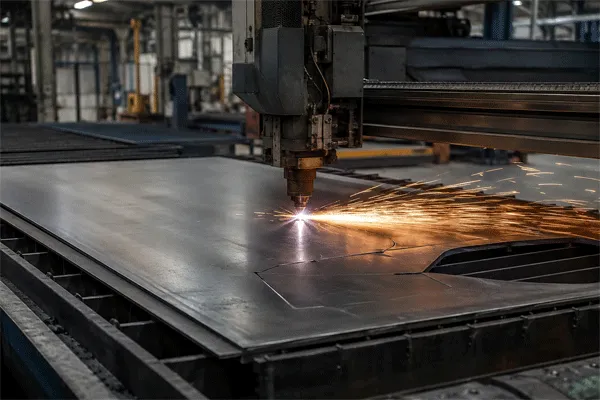
- Cutting— to size, ahead of shipment, rather than as a separate downstream step.
- Bending and punching— for parts going straight into fabrication without a secondary shop visit.
- Welding-stage prep and decoiling— relevant when the order originates from coil stock rather than pre-cut sheet.
Confirming which of these are included in a given quote — versus handled by the fabricator after delivery — is worth doing before the order is placed, since not every processing option applies to every thickness or grade combination.
Certification and Documentation to Request
No SKU-specific certificate number is publicly disclosed for HR Sheet. What is documented and available at the company level: a full English Mill Test Certificate with each shipment, 100% pre-shipment inspection, batch traceability from furnace number through shipment, and chemical composition and mechanical property testing. SGS, Bureau Veritas, Intertek, or a buyer-appointed inspector can be arranged for third-party verification. If a project specification calls for a specific standard — A36, S235JR, or a GB grade — that standard should be named explicitly on the purchase order and confirmed on the MTC, rather than assumed from the grade label alone.
Pricing: What’s Published, What Isn’t
Hot rolled sheet doesn’t currently appear on Luyuan’s public reference price list. Other product lines do — cold rolled steel coil lists at roughly USD 585–635 per metric ton, and H-beam steel at USD 440–568 per metric ton — but HR Sheet pricing depends on grade, thickness, tolerance class, processing, and order volume closely enough that it should be quoted directly rather than estimated from those unrelated product lines.
Hot Rolled Steel Sheet: Grades, Thickness and Tolerances
Where Hot Rolled Sheet Loses to Cold Rolled
Hot rolled sheet isn’t the right material for every application. Cold rolled sheet offers a tighter dimensional tolerance and a smoother, mill-scale-free surface — which matters for parts going straight to paint or powder coating without a secondary cleaning step, or for tolerances tighter than hot rolling can hold consistently. The trade-off is cost and thickness range: cold rolling is a secondary process on top of hot rolling, so cold rolled sheet costs more per ton, and it doesn’t extend as far into heavier gauges. For general structural fabrication where mill scale can be prepped before welding or coating, hot rolled sheet remains the more economical default; for appliance housings, visible panels, or tight-tolerance stamped parts, cold rolled is usually worth the premium.
FAQ
Q: Is Q235B the same as ASTM A36?
A: They’re close but not identical. Q235B has a 235 MPa minimum yield strength under GB/T 700; A36 specifies roughly 250 MPa (36 ksi). They’re commonly cross-referenced but remain separate specifications — order to the standard named on the project drawing.
Q: What thickness range does Luyuan supply for HR Sheet?
A: 2–10 mm, with ±1% tolerance. Thinner material in coil form is available separately at 0.12–4.0 mm under the HR Coil line.
Q: Does hot rolled sheet come with mill scale?
A: Yes, hot rolling leaves a mill-scale surface. If the material is going straight to welding, painting, or coating, factor in a pickling, blasting, or grinding step before that process.
Q: Can I order hot rolled sheet to A36 or S235JR instead of a Chinese grade?
A: Yes — name the specific standard on the purchase order and confirm it’s reflected on the Mill Test Certificate, rather than relying on a general grade-equivalence note.
Q: How is hot rolled sheet priced?
A: It isn’t on Luyuan’s current public reference price list. Pricing depends on grade, thickness, tolerance, processing, and volume, so it’s quoted per order.









 09-03 2026