Choosing between Schedule 40 and Schedule 80 by guesswork can increase material cost, reduce internal flow area, or leave a project with the wrong pipe specification. A thicker wall is not always better. The right choice depends on size, material, service conditions, fabrication, and engineering requirements.
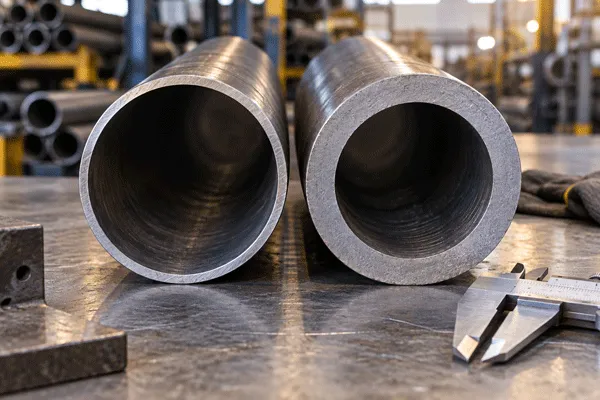
Schedule 80 steel pipe has a thicker wall than Schedule 40 pipe of the same nominal pipe size, while both keep the same outside diameter. The thicker wall reduces the inside diameter and increases pipe weight. Schedule 40 is widely used for general piping and fabrication, while Schedule 80 is selected where the design calls for a heavier wall. Final selection must follow the applicable standard and engineering design.
Schedule 40 vs Schedule 80 Steel Pipe: How to Choose the Right Wall Thickness
Article Outline
- What do Schedule 40 and Schedule 80 actually mean?
- How does wall thickness differ between Schedule 40 and Schedule 80?
- Does the outside diameter change with pipe schedule?
- How do Schedule 40 and Schedule 80 affect inside diameter and flow?
- Is Schedule 80 steel pipe stronger than Schedule 40?
- Does a thicker wall always mean a higher pressure rating?
- Where are Schedule 40 and Schedule 80 pipes commonly used?
- How do weight and cost change between the two schedules?
- Can galvanized, seamless, and welded pipe use Schedule 40 or 80?
- How should international buyers specify pipe schedule in an RFQ?
- Frequently asked questions about SCH 40 and SCH 80
What Do Schedule 40 and Schedule 80 Actually Mean?
A pipe schedule is a standardized way to identify the nominal wall thickness of a steel pipe.
You may see specifications such as:
- SCH 10
- SCH 20
- SCH 40
- SCH 80
- SCH 120
- SCH 160
The schedule number does not directly mean a wall thickness in millimeters or inches. Instead, the actual wall thickness depends on the nominal pipe size, or NPS.
For example, Schedule 40 does not mean “40 mm wall.”
Likewise, Schedule 80 does not mean “80 mm wall.”
ASME B36.10M is the key dimensional standard used for welded and seamless wrought steel pipe. It standardizes outside diameters and wall-thickness series for steel piping. Luyuan Steel’s published pipe range includes wall thickness categories from SCH 10 through SCH 160 and XXS, depending on product and project requirements.
This is why a complete steel pipe specification should normally contain both:
Nominal pipe size + schedule
For example:
NPS 2, Schedule 40
or
NPS 4, Schedule 80
Without the pipe size, the schedule number alone does not defi
ne the actual wall thickness.
How Does Wall Thickness Differ Between Schedule 40 and Schedule 80?
For the same nominal pipe size, Schedule 80 has a thicker wall than Schedule 40.
Consider some common carbon steel pipe dimensions:
| NPS |
Dış Çap |
SCH 40 Wall |
SCH 80 Wall |
| 1/2 |
21.3 mm |
2.77 mm |
3.73 mm |
| 1 |
33.4 mm |
3.38 mm |
4.55 mm |
| 2 |
60.3 mm |
3.91 mm |
5.54 mm |
| 3 |
88.9 mm |
5.49 mm |
7.62 mm |
| 4 |
114.3 mm |
6.02 mm |
8.56 mm |
These dimensions follow the standard steel pipe dimensional system represented in ASME B36.10M-based pipe tables. Published ASTM A53 pipe dimensional data show the same Schedule 40 and Schedule 80 wall values for these common sizes.
Take NPS 2 as an example.
Both pipes have an OD of approximately 60.3 mm.
But:
- Schedule 40 wall = approximately 3.91 mm
- Schedule 80 wall = approximately 5.54 mm
That difference may look small on paper.
Across hundreds or thousands of meters of pipe, however, it changes material weight, internal flow area, welding conditions, handling, shipping cost, and total project cost.
Does Outside Diameter Change Between Schedule 40 and Schedule 80?
No—not when you compare the same nominal pipe size within the same dimensional standard.
That is one of the most useful concepts for buyers to understand.
For example:
NPS 4 Schedule 40
OD: 114.3 mm
Wall: 6.02 mm

NPS 4 Schedule 80
OD: 114.3 mm
Wall: 8.56 mm
The outside diameter remains 114.3 mm.
The thicker wall grows inward.
As a result, the Schedule 80 pipe has a smaller internal opening.
Published ASME B36.10-based data show that an NPS 4 Schedule 40 pipe has an internal diameter of about 102.3 mm, while Schedule 80 reduces that internal diameter to about 97.2 mm.
This fixed OD system is useful because many external components depend on pipe outside diameter.
These may include:
- Supports
- Clamps
- Hangers
- Grooved connections
- Certain fittings
- Fabrication fixtures
However, you should never assume that changing schedule has no effect on the overall system.
The inside diameter changes, and that can matter greatly for fluid flow and process design.
How Do Schedule 40 and Schedule 80 Affect Inside Diameter and Flow?
The inside diameter can be estimated from:
Inside Diameter = Outside Diameter − 2 × Wall Thickness
Because Schedule 80 has a thicker wall, its ID is smaller.
For example:
| NPS |
SCH 40 Approx. ID |
SCH 80 Approx. ID |
| 1/2 |
15.8 mm |
13.9 mm |
| 1 |
26.6 mm |
24.3 mm |
| 2 |
52.5 mm |
49.3 mm |
| 3 |
77.9 mm |
73.7 mm |
| 4 |
102.3 mm |
97.2 mm |
The difference becomes important in systems carrying:
- Water
- Gas
- Steam
- Oil
- Industrial fluids
- Compressed air
- Process media
A smaller internal diameter can increase fluid velocity for the same flow rate and may increase pressure loss.
This means a project engineer cannot select Schedule 80 only because it “looks stronger.”
The hydraulic design still needs to work.
For a structural frame, internal flow area may not matter.
For an industrial pipeline, it can be critical.
That is one reason steel pipe selection should begin with the application, not just wall thickness.
Schedule 40 vs Schedule 80 Steel Pipe: How to Choose the Right Wall Thickness
Is Schedule 80 Steel Pipe Stronger Than Schedule 40?
If the two pipes have the same outside diameter, material grade, manufacturing quality, and other relevant conditions, the thicker Schedule 80 wall provides more metal cross-section than Schedule 40.
That can provide greater resistance to certain mechanical loads and internal pressure.
But buyers should be careful with the word stronger.
The mechanical performance of steel pipe also depends on:
- Steel grade
- Yield strength
- Tensile strength
- Seamless or welded construction
- Weld quality
- Temperature
- Corrosion allowance
- Manufacturing standard
- End connection
- Fabrication quality
- Applicable design code
A Schedule 40 pipe made from one grade cannot automatically be compared with a Schedule 80 pipe made from a completely different material only by looking at wall thickness.
For example, Luyuan’s published pipe portfolio includes structural and general grades such as Q235, Q345, SS400, ASTM A53 Gr.A/B and ASTM A106 Gr.B, as well as API grades for specific line-pipe applications.
The grade and schedule work together.
Neither should be considered alone.
Does Schedule 80 Always Mean a Higher Pressure Rating?
A thicker wall can contribute to higher pressure capability, but Schedule 80 is not itself a pressure rating.
This is an important purchasing point.
Pressure capability depends on several factors, including:
- Outside diameter
- Wall thickness
- Material strength
- Operating temperature
- Joint type
- Corrosion allowance
- Applicable design code
- Safety factor
- Manufacturing specification
Published ASTM A53 Grade B ERW pipe data, for example, show higher working-pressure values for Schedule 80 than for Schedule 40 in comparable pipe sizes, but the manufacturer also states that a safety factor must be applied.
So you should not write a purchase order like:
“Schedule 80 because we need high pressure.”
That is incomplete.
A professional pressure-piping specification should come from the project engineer and applicable piping code.
ASTM A106/A106M-26, for example, covers seamless carbon steel pipe intended for high-temperature service and includes requirements for mechanical testing.
ASTM A53/A53M-24 covers black and hot-dipped zinc-coated welded and seamless steel pipe.
Schedule tells you the wall series. The material standard tells you much more about the pipe itself.
Where Is Schedule 40 Steel Pipe Commonly Used?
Schedule 40 is one of the most widely recognized pipe wall series.
It provides a practical balance between wall thickness, weight, internal diameter, availability, and cost.
Depending on material grade and applicable code, common uses can include:
- General water piping
- Utility systems
- Compressed-air lines
- Mechanical systems
- Fabricated frames
- İnşaat
- Agricultural structures
- Fencing
- General industrial piping
- Certain fire-protection systems
- Equipment fabrication
It is also common in galvanized steel pipe applications where corrosion protection is required.
But “common” does not mean “automatically suitable.”
A construction frame and a pressure system may both use a pipe called Schedule 40 while operating under very different engineering requirements.
For structural buyers, the key concerns may include:
- OD
- Wall thickness
- Uzunluk
- Kalite
- Welding
- Bending
- Surface treatment
For fluid-system buyers, they may instead focus on:
- Internal diameter
- Operating pressure
- Temperature
- Fluid type
- Corrosion
- Fittings
- Connection method
The same pipe dimension can serve different markets, but the purchase specification must reflect the final use.
When Is Schedule 80 Steel Pipe More Appropriate?
Schedule 80 may be considered when the project design requires a heavier wall.
Examples can include more demanding:
- Industrial piping
- Process lines
- Mechanical applications
- High-load fabrication
- Selected pressure systems
- Harsh operating conditions
- Applications with specified corrosion allowance
The exact application depends on grade and engineering design.
A common mistake is to believe that Schedule 80 is the premium choice for every project.
It is not.
A heavier wall brings trade-offs.
You get more steel, but you also get:
- More weight
- Higher material cost
- Smaller internal diameter
- More demanding cutting
- More weld metal in certain joints
- Greater shipping weight
If the design only requires Schedule 40, buying Schedule 80 may add cost without creating useful value.
This is especially important for distributors or contractors buying hundreds of tons.
Even a modest difference in kilograms per meter becomes significant across large quantities.

Schedule 40 vs Schedule 80 Steel Pipe: How to Choose the Right Wall Thickness
How Much Heavier Is Schedule 80 Than Schedule 40?
Because the OD remains the same and the wall becomes thicker, Schedule 80 contains more steel per meter.
Published ASTM A53 pipe tables provide a clear example:
| NPS |
SCH 40 Approx. Weight |
SCH 80 Approx. Weight |
| 1/2 |
1.26 kg/m |
1.62 kg/m |
| 1 |
2.50 kg/m |
3.23 kg/m |
| 2 |
5.45 kg/m |
7.49 kg/m |
| 3 |
11.28 kg/m |
15.27 kg/m |
| 4 |
16.07 kg/m |
22.32 kg/m |
Weights can vary according to applicable dimensional tolerances and product requirements, so these figures should be treated as standard reference values rather than shipment guarantees. The underlying Schedule 40 and 80 weights are published in ASTM A53 pipe dimensional data.
Look at NPS 4.
Schedule 40 is approximately:
16.07 kg/m
Schedule 80 is approximately:
22.32 kg/m
That is a large difference.
For a 6-meter pipe:
- SCH 40 ≈ 96.4 kg
- SCH 80 ≈ 133.9 kg
Across 1,000 pieces, the difference becomes many tons.
This affects:
- Raw material cost
- Container loading
- Inland trucking
- Crane capacity
- Manual handling
- Installation
- Ocean freight
For international buyers, wall thickness therefore affects total landed cost, not just unit price.
Does Galvanized Steel Pipe Come in Schedule 40 and Schedule 80?
Yes, galvanized pipe can be supplied in schedule-based dimensions where the relevant product specification allows it.
ASTM A53/A53M covers black and hot-dipped zinc-coated welded and seamless steel pipe.
The schedule describes the base pipe wall.
The galvanizing describes the protective surface system.
These are different parts of the specification.
A useful RFQ might read:
ASTM A53 Grade B, NPS 2, Schedule 40, hot-dip galvanized, required length, specified end preparation.
Or:
ASTM A53 Grade B, NPS 2, Schedule 80, hot-dip galvanized, required quantity and destination.
However, buyers should always confirm actual availability before assuming that every combination of:
grade + size + schedule + coating + end finish
is available from stock.
At Luyuan Steel, the published Steel Pipe portfolio covers galvanized, bare, lightly oiled, 3PE, and shop-primer finishes across different pipe product categories, while exact project combinations are confirmed according to the order.
Can Seamless and Welded Pipe Both Use Schedule 40 or Schedule 80?
Yes.
Schedule is a dimensional concept and is not limited to one production route.
Both seamless pipe and welded pipe may be supplied in schedule-based dimensions where the applicable specification covers them.
ASTM A53 includes both welded and seamless pipe.
ASTM A106, on the other hand, specifically covers seamless carbon steel pipe for high-temperature service.
This is why the following specifications describe different things:
Seamless
describes the manufacturing route.
Schedule 80
describes the wall
-thickness series.
ASTM A106 Grade B
describes a material/product spe
cification.
A complete pipe description may require all three.
For example:
ASTM A106 Grade B seamless steel pipe, NPS 4, Schedule 80.
This is much more useful than simply asking for:
“4-inch heavy pipe.”
Schedule 40 vs Schedule 80: Which Is Better for Welding and Fabrication?
Both can be welded when the material grade and specification allow it and when an appropriate welding procedure is used.
But thicker-wall pipe changes fabrication requirements.
Schedule 80 may require:
- More cutting energy
- Different bevel preparation
- More weld volume
- More welding time
- Greater heat input control
- Heavier handling equipment
For simple frames, fencing, agricultural structures, or general fabrication, adding unnecessary wall thickness can slow production.
On the other hand, a heavier pipe may be required when the finished structure must carry greater loads and the engineering design specifies it.
The same applies to:
- Bending
- Threading
- Grooving
- Drilling
- Punching
- Beveling
Luyuan’s published steel pipe offering includes processing support such as customized cut-to-length, and its welded pipe product line lists project processing including punching and bending.
For OEM orders, buyers should tell the supplier what happens after the pipe arrives.
That can influence which grade, wall, length, end finish, and processing route make the most sense.
How Should Buyers Choose Between Schedule 40 and Schedule 80?
A practical decision process looks like this:
What is the application?
        ↓
Which standard/code applies?
        ↓
What material grade is required?
        ↓
What pressure/load/temperature applies?
        ↓
What NPS or OD is required?
        ↓
What wall thickness does the design specify?
        ↓
Check weight, ID and fabrication impact
        ↓
Confirm SCH 40 / SCH 80 / Other Schedule
Do not reverse that order.
Starting with “I want Schedule 80 because it is stronger” can lead to overspecification.
Choose Schedule 40 when:
The engineering design allows it and the project benefits from:
- Lower material weight
- Larger internal diameter
- Lower material cost
- Easier handling
- General-purpose fabrication
Choose Schedule 80 when:
The engineering design specifically requires:
- A heavier wall
- More metal section
- Reduced allowance for wall loss
- A wall dimension associated with the selected pressure or mechanical design
The final decision belongs to the engineering specification.
A steel supplier should help confirm dimensions and product availability, but should not replace the project designer’s pressure or structural calculations.
What Should You Include in a Schedule 40 or Schedule 80 RFQ?
A good RFQ should not say:
“Please quote Schedule 40 pipe.”
That leaves too much information missing.
Instead, provide:
| RFQ Item |
Example |
| Ürün |
Carbon steel pipe |
| Standart |
ASTM A53/A106/API 5L/etc. |
| Kalite |
Exact required grade |
| Üretim |
Seamless / ERW / other |
| NPS / OD |
NPS 2 / 60.3 mm OD |
| Schedule |
SCH 40 or SCH 80 |
| Uzunluk |
6 m / 12 m / customized |
| Surface |
Black / galvanized / coated |
| Ends |
Plain / beveled / threaded |
| Quantity |
Tons / meters / pieces |
| Processing |
Cutting / bending / punching |
| Documents |
MTC |
| Inspection |
Factory / third-party |
| Packing |
Export bundles |
| Destination |
Country and port |
This is especially important for international orders.
One buyer may say “2-inch pipe” and mean NPS 2.
Another may mean an actual 50.8 mm outside diameter tube.
Those are not the same product.
A complete RFQ prevents that mistake before production.
How Can Luyuan Steel Support Pipe Procurement?
Luyuan Steel supplies steel products for distributors, contractors, manufacturers, infrastructure projects, machinery factories, agricultural projects, and engineering buyers.
Our published Steel Pipe range covers:
- Welded pipe
- Seamless pipe
- API 5L
- API 5CT
- SHS / RHS
- Galvanized pipe options
- Multiple wall-thickness series
The current Steel Pipe specification range lists OD from approximately 1/2″ to 48″ across the broader portfolio, wall categories from SCH 10 through SCH 160 and XXS, and 6 m, 12 m, or customized cut-to-length supply depending on product.
For global B2B orders, support can include:
- Specification review
- Customized lengths
- Cutting
- Slitting and related steel processing
- Surface treatment requirements
- MTC documentation
- Third-party inspection
- Export packing
- Consolidated steel procurement
- International logistics
A pipe order may also be combined with steel plate, section steel, coils, stainless materials, aluminum, or copper for larger project procurement.
The goal is simple:
Buy the pipe that matches the project—not simply the thickest pipe available.
FAQs About Schedule 40 vs Schedule 80 Steel Pipe
Is Schedule 80 thicker than Schedule 40?
Yes. For the same nominal pipe size, Schedule 80 has a thicker wall than Schedule 40.
For example, NPS 2 steel pipe has an OD of approximately 60.3 mm. Schedule 40 has a wall of about 3.91 mm, while Schedule 80 has a wall of about 5.54 mm.
Do Schedule 40 and Schedule 80 have the same outside diameter?
Yes, when they have the same NPS under the same dimensional system.
The outside diameter remains the same. The thicker Schedule 80 wall reduces the inside diameter.
Is Schedule 80 always better than Schedule 40?
No. Schedule 80 contains more steel and has a thicker wall, but it also costs more, weighs more, and reduces internal flow area.
If a project is designed for Schedule 40, replacing it with Schedule 80 may add unnecessary cost and weight.
Is Schedule 80 rated for twice the pressure of Schedule 40?
No. There is no universal rule that Schedule 80 has twice the pressure rating of Schedule 40.
Pressure capacity also depends on material grade, diameter, temperature, joint design, corrosion allowance, code requirements, and safety factors.
Can galvanized pipe be Schedule 80?
Yes, where the applicable pipe standard and manufacturing capability allow that combination.
ASTM A53 covers black and hot-dip zinc-coated welded and seamless steel pipe.
Always specify the required schedule and galvanized finish separately.
Which is heavier, Schedule 40 or Schedule 80?
Schedule 80 is heavier for the same NPS because it contains more steel in the pipe wall.
For example, published NPS 4 ASTM A53 dimensional data show approximately 10.8 lb/ft for Schedule 40 versus 15 lb/ft for Schedule 80.
Key Things to Remember About Schedule 40 vs Schedule 80
- Schedule identifies a pipe wall-thickness series; it is not a direct millimeter measurement.
- Schedule 80 has a thicker wall than Schedule 40 for the same NPS.
- Both schedules keep the same outside diameter when the nominal pipe size is the same.
- Schedule 80 therefore has a smaller inside diameter.
- A smaller ID can affect fluid flow and pressure loss.
- Schedule 80 contains more steel and therefore weighs more.
- Greater weight can increase material, handling, transport, and installation costs.
- A thicker wall can improve mechanical and pressure capability, but schedule alone is not a pressure rating.
- Steel grade, temperature, joint type, corrosion allowance, standard, and design code also matter.
- Schedule 40 is widely used for general piping, construction, and fabrication where the engineering design permits it.
- Schedule 80 is used where the design requires a heavier wall.
- Galvanized, black, seamless, and welded steel pipes may use schedule-based dimensions depending on the applicable product specification.
- ASTM A53 and ASTM A106 describe different product requirements; they should not be treated as synonyms.
- Always state NPS or OD together with schedule when requesting a quotation.
- A complete RFQ should also identify grade, standard, length, surface, ends, quantity, inspection, and processing requirements.
- Do not select Schedule 80 simply because “thicker sounds safer.” Follow the engineering specification.
If you are sourcing Schedule 40 or Schedule 80 steel pipe, seamless pipe, welded pipe, galvanized pipe, API line pipe, or structural tubing, send Luyuan Steel your required standard, grade, NPS or OD, schedule, length, quantity, surface finish, end preparation, inspection requirements, and destination port.
We can support global steel buyers with specification confirmation, OEM / ODM processing, customized lengths, MTC traceability, third-party inspection, seaworthy packaging, multi-product procurement, and international logistics.









 10-22 2026