Luyuan Steel Technical Team | Published September 2026
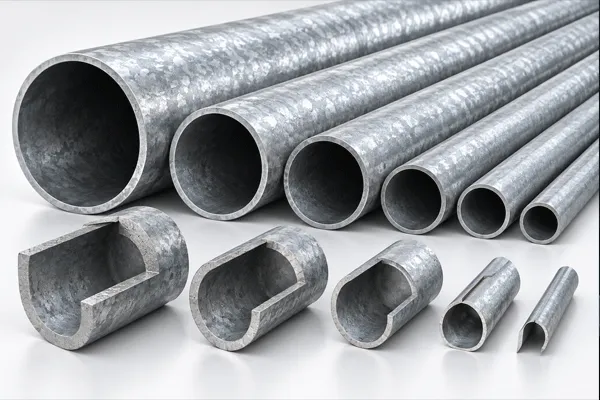
A “2 inch” galvanized pipe has an actual outside diameter of 60.3 mm, not 2 inches (50.8 mm) — NPS and DN are naming conventions, not measurements. This guide gives the real OD and wall thickness for the sizes ordered most often, plus where SHS/RHS square tube uses a completely different sizing system.
Galvanized Steel Pipe Sizes: NPS, DN and Wall Thicknesss
NPS and DN Aren’t the Same Number, and Neither Is the Real Diameter
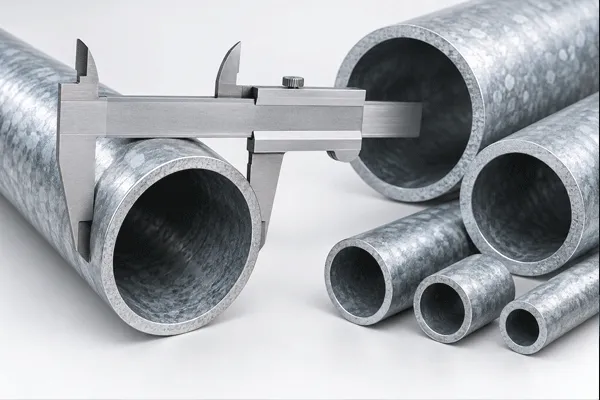
Nominal Pipe Size (NPS, used in North America and much of Asia’s English-language documentation) and Diamètre Nominal (DN, the metric equivalent used across Europe and in most mill certificates) both describe a size class, not a physical measurement. NPS 2 and DN50 refer to the same pipe. Neither number matches the pipe’s actual outside diameter once you check a schedule table — NPS 2 has an actual OD of 60.3 mm, and that OD stays fixed across every wall thickness in that size class. A Schedule 40 NPS 2 pipe and a Schedule 80 NPS 2 pipe share the same 60.3 mm outside diameter; only the wall thickness, and therefore the inside diameter, changes. This is the detail that causes the most fitting and threading errors on a jobsite: assuming “2 inch pipe” is one fixed product instead of a size family with several wall options inside it.
Master NPS to DN to OD to Wall Thickness Table
The table below covers the sizes buyers search for most, cross-referencing NPS, DN, actual outside diameter, and wall thickness at the two most commonly specified schedules.
| NPS |
DN |
OD (mm) |
OD (in) |
Sch 40 Wall (mm) |
Sch 80 Wall (mm) |
| 1/2″ |
DN15 |
21.3 |
0.840 |
2.77 |
3.73 |
| 3/4″ |
DN20 |
26.7 |
1.050 |
2.87 |
3.91 |
| 1″ |
DN25 |
33.4 |
1.315 |
3.38 |
4.55 |
| 1-1/4″ |
DN32 |
42.2 |
1.660 |
3.56 |
4.85 |
| 1-1/2″ |
DN40 |
48.3 |
1.900 |
3.68 |
5.08 |
| 2″ |
DN50 |
60.3 |
2.375 |
3.91 |
5.54 |
| 2-1/2″ |
DN65 |
73.0 |
2.875 |
5.16 |
7.01 |
| 3″ |
DN80 |
88.9 |
3.500 |
5.49 |
7.62 |
| 4″ |
DN100 |
114.3 |
4.500 |
6.02 |
8.56 |
These dimensions follow the schedule conventions set out under ASTM pipe specifications such as ASTM A53, which governs black and hot-dip galvanized welded and seamless steel pipe. They hold regardless of which mill supplies the pipe — the OD-to-schedule relationship is a standard, not a proprietary spec.
Schedule 40 vs. Schedule 80: Same OD, Different Wall
Schedule number describes wall thickness relative to pressure rating, not overall size. A 3″ Schedule 40 pipe and a 3″ Schedule 80 pipe both measure 88.9 mm OD — the Schedule 80 version simply has a thicker wall (7.62 mm versus 5.49 mm) and a correspondingly smaller bore. This matters for two practical reasons. First, threaded fittings are cut to match the OD, so Schedule 40 and Schedule 80 pipe in the same NPS thread onto the same fittings. Second, flow capacity drops as schedule increases, since the thicker wall eats into the usable bore — a detail worth checking before defaulting to Schedule 80 “for strength” on a run where flow rate actually matters more than pressure rating.
Galvanized Steel Pipe Sizes: NPS, DN and Wall Thicknesss
What “Galvanized” Actually Needs to Specify
“Galvanized steel pipe” describes a coating process, not a single fixed product, and the coating detail isn’t automatically implied by the NPS/DN size call-out. Hot-dip galvanizing (pipe dipped in molten zinc after fabrication, typically referenced against ASTM A123 for fabricated steel or the coating provisions within ASTM A53) and continuously galvanized or pre-galvanized coil-formed pipe are not the same product, and they don’t carry the same zinc coating weight or corrosion life. Luyuan’s current published pipe listings do not itemize a specific zinc coating class per pipe product — this should be confirmed directly against your project spec at RFQ stage rather than assumed from the word “galvanized” alone. If your specification calls out a coating weight or a specific galvanizing standard, put that requirement in writing on the RFQ, not just in the product name.
SHS/RHS Steel Pipe: A Different Sizing System Entirely
Square Hollow Section (SHS) and Rectangular Hollow Section (RHS) pipe are sized by cross-section dimension in millimeters — for example 50×50 mm or 100×50 mm — with a separate wall thickness callout, not by NPS or DN. Luyuan’s SHS/RHS line is produced in Q235 and Q355 grades, using the ERW (electric resistance welding) process, in standard 6 m and 12 m lengths. If a project genuinely calls for square or rectangular tube rather than round pipe, size it by section dimension and wall thickness directly — NPS/DN conversion tables don’t apply to this product family, and requesting an “NPS equivalent” for SHS/RHS will produce a mismatched quote.
Luyuan’s Round Pipe Options: Welded and Seamless
For round pipe sized under the NPS/DN system covered above, Luyuan’s catalog centers on two product lines. Welded Pipe is produced in Q235B and Q355B grades using ERW or EFW (electric fusion welding) processes, in a standard 6 m length. Seamless Pipe is available under ASTM A106, ASTM A53, or API 5L material options, with outside diameters from 10 mm to 700 mm and lengths from 6 to 12 meters, or cut to custom length. Both processes are compatible with the OD/wall relationships in the master table above; which one fits a given project depends more on pressure rating and joint integrity requirements than on size alone — seamless pipe is generally specified where a continuous, weld-seam-free wall is required for higher-pressure service.
Galvanized Steel Pipe Sizes: NPS, DN and Wall Thicknesss
Pricing: What Luyuan Publishes, What’s Price on Request
Luyuan’s published reference price for galvanized steel pipe runs approximately USD 608–623 per metric ton. This range is indicative, not a fixed quote — final pricing depends on grade, wall schedule, coating specification, length, and order volume, plus Incoterms and destination. Where a specific coating class or a less common size falls outside this published range, treat it as price on request rather than assuming the published band applies uniformly across every schedule and coating combination.
Where Buyers Get Pipe Sizing Wrong
The most frequent mistake is ordering by NPS alone and assuming schedule is implied — a supplier quoting Schedule 40 against a spec written for Schedule 80 will deliver pipe with the correct OD and the wrong wall thickness, which often isn’t caught until it fails a pressure test. The second frequent mistake is treating DN and NPS as directly interchangeable without checking that both parties are reading from the same schedule table; DN50 and NPS 2 describe the same pipe, but a buyer specifying “DN50” to a supplier working from inch-based documentation can end up with a mismatched OD if the conversion isn’t confirmed in writing. The third is requesting “galvanized” without a coating standard, which leaves coating weight and process up to the mill’s default rather than the project’s actual corrosion requirement.
FAQ
Q: Is a 2 inch galvanized pipe actually 2 inches wide?
A: No. NPS 2 has an actual outside diameter of 60.3 mm (2.375 in) — the “2 inch” label is a size class name, not a physical measurement.
Q: What’s the difference between NPS and DN?
A: They’re the same size classification system expressed in two units — NPS in inches (common in North America and English-language specs), DN in millimeters (common in European and international documentation). NPS 2 equals DN50.
Q: Does Schedule 40 or Schedule 80 have a bigger outside diameter?
A: Neither — both share the same OD within a given NPS/DN size. Schedule 80 has a thicker wall and smaller inside diameter than Schedule 40 at the same nominal size.
Q: What size is 1 inch steel pipe, really?
A: NPS 1 / DN25 has an actual outside diameter of 33.4 mm, with a Schedule 40 wall thickness of 3.38 mm.
Q: Is SHS/RHS pipe sized the same way as round galvanized pipe?
A: No. SHS/RHS square and rectangular tube is sized by cross-section dimension in millimeters (e.g., 50×50 mm) plus wall thickness, not by NPS or DN — the two systems aren’t interchangeable.
Q: What coating standard should I specify for galvanized pipe?
A: This depends on your project spec; hot-dip galvanizing is commonly referenced against ASTM A123. Confirm the specific coating weight and standard with your supplier in writing, since it’s not always implied by the word “galvanized” alone.
Q: Does Luyuan supply seamless or only welded galvanized pipe?
A: Both. Seamless pipe is available under ASTM A106, ASTM A53, or API 5L with OD 10–700 mm; welded pipe is available in Q235B/Q355B grades via ERW or EFW in standard 6 m lengths.
Q: How is galvanized steel pipe priced?
A: Luyuan’s reference range is approximately USD 608–623 per metric ton, varying with grade, schedule, coating, and volume — confirm current pricing and coating specification at RFQ stage.
Q: What documentation should accompany a galvanized pipe order?
A: An English Mill Test Certificate at minimum, plus third-party inspection (SGS, BV, Intertek, or buyer-appointed) on request before shipment.









 09-17 2026