Luyuan Steel Technical Team | Published September 2026
Cold rolled steel coil carries a published reference range of approximately USD 585–635 per metric ton. That range moves within itself based on grade, thickness, coil ID, and order volume — and several related products buyers search for alongside it, including rebar and hot rolled sheet, don’t have a confirmed public price at all yet.
Precios del acero laminado en frío: rangos y factores que influyen en una cotización
Why a Price Range Isn’t a Quote
A published reference range tells you the ballpark a mill is likely to quote from, not what your specific order will cost. Compared to typical index-tracker pages that report a single regional average, the breakdown below starts from actual product-line listing ranges and works through the variables that move an individual order within that range — grade, coating, thickness, volume, and Incoterms — so a quote can be sanity-checked against something more specific than a chart.
Confirmed Reference Price Ranges by Product Line
The table below covers products with a currently published, verifiable listing range. Products without one are addressed separately in the section that follows — they’re not omitted because they’re unimportant, but because publishing an estimated figure would violate this project’s price discipline standard.
| Product Line |
Published Reference Range (USD/MT) |
Estado |
| PPGI / PPGL steel coil |
~460–650 |
Confirmed listing range |
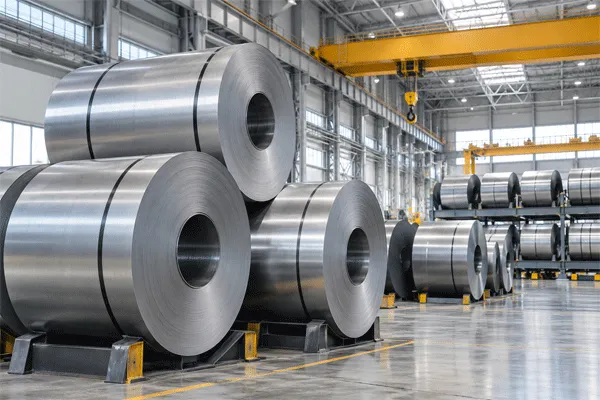
| Bobina de acero laminado en frío |
~585–635 |
Confirmed listing range |
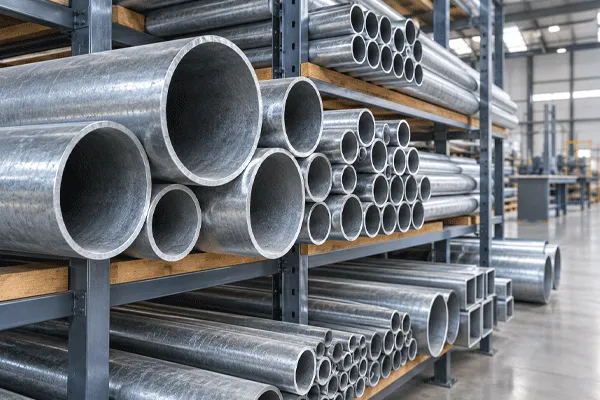
| Tubo de acero galvanizado |
~608–623 |
Confirmed listing range |
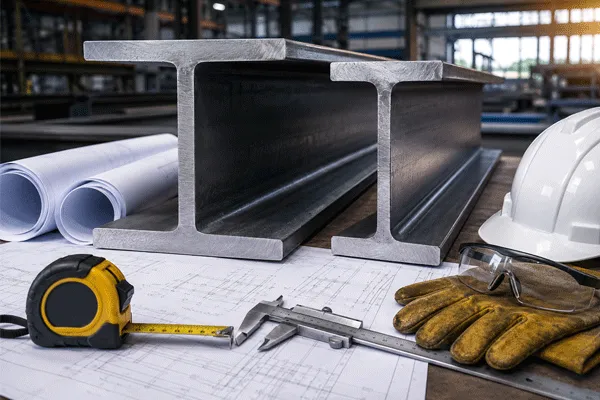
| Viga de acero en H |
~440–568 |
Confirmed listing range |
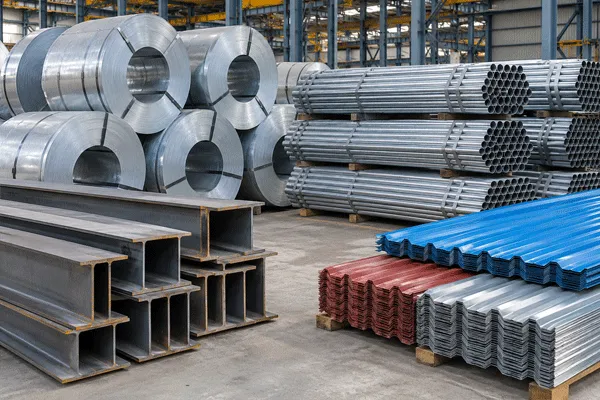
| Productos seleccionados de acero para cubiertas |
~410–450 |
Confirmed listing range — see clarification note below |
Cold Rolled Steel Coil: What the Published Range Covers
Luyuan’s CR Coil listing runs 0.12–5.0 mm in thickness, with coil ID available in 508 mm or 610 mm. Related cold rolled products include CR Sheet at 0.20–0.50 mm and CR Rod in tool-steel-adjacent grades — 1.2436, D7, SKD2, and X210CrW12 — which sit in a different pricing tier from coil due to grade and processing differences. Manufacturing-application pages additionally reference SPCC, SPCD, and SPCE commercial cold rolled grades, the family most relevant to general fabrication and stamping buyers rather than tool-steel applications.
The published USD 585–635/MT range applies to standard CR coil rather than the tool-steel-grade CR Rod line, which typically carries a separate cost basis not covered by this listing range. If your RFQ is for CR Rod in one of the tool-steel grades above, treat the coil range as a non-reference point and request rod pricing separately.
Precios del acero laminado en frío: rangos y factores que influyen en una cotización
Products Without a Published Price — And Why That’s Not a Non-Answer
Several of the products buyers search for alongside cold rolled steel prices — deformed steel bar/rebar, hot rolled sheet, galvanized steel coil, and round steel bar — don’t have a confirmed listing price in Luyuan’s current resource library. That’s a gap in published data, not a gap in supply capability, and it’s handled the same way across this entire content program: no figure is estimated or interpolated from an adjacent product’s range.
| Product Searched |
Confirmed Price Status |
Note |
| Deformed steel bar / rebar (HRB400, HRB500) |
Precio a consultar |
No published listing range in current resource library |
| Hot rolled sheet |
Precio a consultar |
HR Coil and HR Sheet exist as products; neither carries a published price range |
| Galvanized steel coil (GI / Galvalume) |
Precio a consultar |
Galvanizado pipe has a published range; galvanized coil does not — these are separate products |
| Round steel bar |
Precio a consultar |
Applies across CR Rod, HR Rod, and stainless bar; none carry a published range |
A supplier quoting a firm number for any of these products without referencing a current mill confirmation is quoting from something other than published data — worth a direct follow-up question before treating it as comparable to the ranges above.
A Note on the “Roofing Steel” Range vs. the PPGI Range
The resource library lists “selected roofing steel products” at USD 410–450/MT alongside PPGI/PPGL at USD 460–650/MT. The lower bound of the roofing category sits below the lower bound of the PPGI range, which raises a fair question: is roofing steel a separate, lower-cost product line, or does it overlap with PPGI’s lower end and reflect a labeling inconsistency in the source listing?
This hasn’t been internally resolved as of publication. Rather than merge the two ranges or guess which one is correct, they’re presented here as they appear in the source listing — as two distinct categories — with the overlap flagged for buyers to confirm directly: if you’re quoting “roofing steel” against a project that specifies PPGI coating class, ask the supplier explicitly whether the roofing-steel quote includes a color coating, or whether it’s an uncoated or differently processed product priced below the PPGI band for that reason.
What Actually Moves a Quote Within a Published Range
| Variable |
How It Moves Price |
| Grado |
Higher-strength or tighter-tolerance grades (e.g., API 5CT pipe grades vs. standard structural grades) generally price above baseline within a product family |
| Coating weight / class |
Heavier zinc coating (higher Z-class or AZ weight) adds material cost per ton |
| Thickness and dimensional tolerance |
Thinner gauges and tighter tolerance bands typically cost more per ton to produce consistently |
| Order volume |
Larger tonnage orders generally move toward the lower end of a published range; small or mixed-SKU orders trend toward the higher end |
| Incoterms and destination |
FOB, CFR, and CIF quotes aren’t directly comparable — freight, insurance, and destination port all sit outside the base material price |
| Requisitos de inspección |
Third-party inspection (SGS, BV, Intertek, or a buyer-appointed inspector) beyond Luyuan’s standard 100% pre-shipment inspection can add cost depending on scope |
Material grade specification itself is generally set against ASTM or equivalent GB standards, and that specification — not just the raw tonnage — is what a mill prices against; two orders at the same weight but different grade call-outs won’t return the same quote.
How to Read a Supplier’s Quote Against These Ranges
- Identify which Incoterm the quote uses.A CIF quote and an FOB quote for the identical product can differ by a meaningful margin without either being wrong — they’re pricing different scopes.
- Check whether the quote states a specific grade.A quote that only says “Bobina de PPGI” without a substrate or coating class isn’t directly comparable to the published range, which assumes a standard specification.
- Confirm the tonnage the range assumes.Published listing ranges typically reflect standard order volumes; a small trial order may reasonably quote above the top of the range.
- Ask what inspection is included.Standard pre-shipment inspection is typically baked into a mill’s base quote; third-party inspection beyond that is often a separate line item.
- Treat “price on request” products as a request, not a wall.For rebar, hot rolled sheet, galvanized coil, and round bar, ask for a current quote rather than assuming these fall inside a neighboring product’s published range.

Precios del acero laminado en frío: rangos y factores que influyen en una cotización
RFQ Checklist for Price-Sensitive Orders
- Specify exact product, grade, and standard (e.g., ASTM/GB reference) rather than a general category name.
- State target thickness, coating weight or class, and dimensional tolerance.
- Confirm order volume/tonnage — this affects where in a range the quote lands.
- Specify Incoterms (FOB, CFR, CIF) and destination port before comparing quotes across suppliers.
- State inspection requirements beyond standard pre-shipment inspection, if any.
- For products without a published range (rebar, hot rolled sheet, galvanized coil, round bar), request current pricing explicitly rather than estimating from an adjacent product.
- Request an English Mill Test Certificate as part of the quote package.
Preguntas frecuentes
Q: What is the current price range for cold rolled steel coil?
A: Approximately USD 585–635 per metric ton, as a reference listing range — final pricing depends on grade, thickness, coil ID, and order volume.
Q: What is the price of an H beam?
A: Luyuan’s published reference range for H-beam steel is approximately USD 440–568 per metric ton, varying by section, grade, and volume.
Q: What is the price of deformed steel bars or rebar?
A: There’s no published listing range for rebar in the current resource library. Treat it as price on request and confirm current pricing directly.
Q: How much does hot rolled sheet cost?
A: Hot rolled sheet doesn’t currently carry a published price range. Request a current quote rather than assuming it falls near cold rolled or PPGI pricing, since production process and cost basis differ.
Q: Is galvanized steel coil priced the same as galvanized steel pipe?
A: No — these are separate products. Galvanized steel pipe has a published reference range (~USD 608–623/MT); galvanized coil (GI or Galvalume) does not currently have a confirmed published range.
Q: What’s the price of round steel bar?
A: This varies by material family — CR Rod, HR Rod, and stainless bar are all considered “round bar” depending on context — and none currently carry a published price range. Request a quote specifying the exact grade.
Q: Why does “roofing steel” show a lower price than PPGI?
A: This overlap is currently unresolved in the source data. The two are published as separate categories with different ranges; confirm directly with the supplier whether a roofing-steel quote includes the same coating class as PPGI before comparing them.
Q: Does order volume change the price per ton?
A: Yes — larger tonnage orders generally trend toward the lower end of a published range, while small or mixed-SKU orders trend toward the higher end.
Q: Why do two quotes for the same product show different prices?
A: Most commonly it’s an Incoterms mismatch (FOB vs. CIF), a grade or coating specification difference, or a volume difference — confirm all three before assuming one quote is simply cheaper.









 09-18 2026