Luyuan Steel Technical Team | Published September 2026
H beam and I beam both carry structural loads through a vertical web and horizontal flanges, but the flange geometry differs enough to change bending capacity, connection detailing, and cost per ton. This guide compares the two for structural steel specification — not automotive connecting rods, which reuse the same “H-beam vs I-beam” search terms for a completely unrelated part.
العارضة على شكل حرف H مقابل العارضة على شكل حرف I: اختيار المقاطع في الأعمال الإنشائية
Wait — Is This About Engine Connecting Rods?
If a search engine sent you here looking for H-beam versus I-beam connecting rods for an engine build, this isn’t that article. Automotive con-rods borrow the same cross-section names — I-beam rods for lighter reciprocating mass, H-beam rods for compression strength at high RPM — but they’re forged small parts with no relationship to structural steel sections beyond a shared silhouette. The rest of this guide covers construction and fabrication use, where “H beam” and “I beam” refer to hot rolled steel sections measured in meters, not millimeters.
H Beam vs I Beam: Where the Cross-Sections Actually Diverge
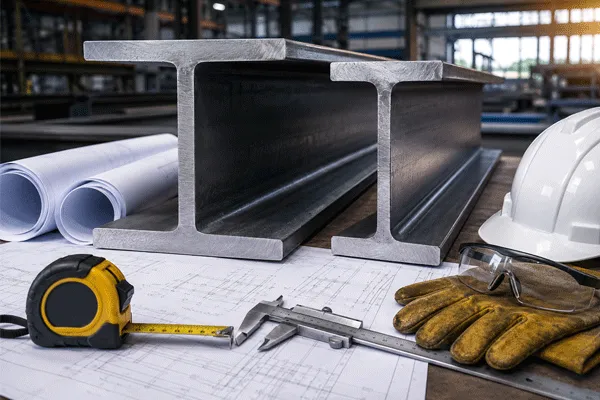
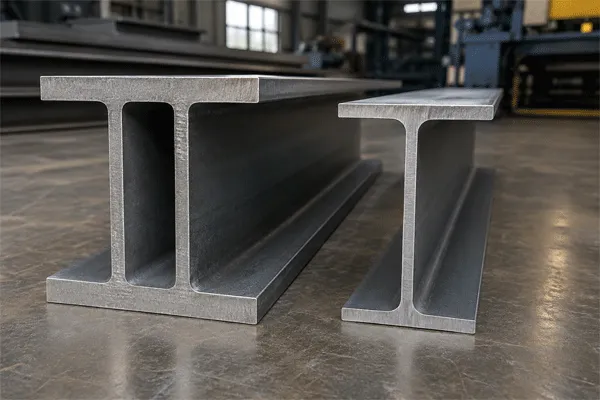
Both shapes look similar in a side profile: two flanges connected by a web, forming an “H” or “I” outline depending on orientation. The difference sits in the flange.
A classic I-beam — the American S-shape, standardized decades before wide-flange sections became common — has flanges with a tapered inner face, sloped at roughly 16.67%, and a flange width that’s typically much narrower than the section depth. A modern H-beam, more precisely called a wide-flange or W-shape section, has flanges with parallel inner and outer faces and a flange width often close to, or equal to, the section depth. That parallel face matters for fabricators: it gives a flat, consistent bearing surface for welding, bolting, and base-plate connections, where a tapered S-shape flange requires shims or matched washers to seat properly.
Compared to catalog listings that repeat generic “flange and web” descriptions without naming a designation system, specifying H beam or I beam by HW/HM/HN, W-shape, or IPE/HEA code tells a mill exactly which section to quote instead of leaving room for interpretation.
Standard Designation Systems: HW, HM, HN, W-Shapes, IPE, HEA
Structural sections aren’t labeled the same way worldwide, and mixing systems on a drawing set is a common source of RFQ delay. The table below maps the three designation families most fabricators encounter.
| Region / System |
Typical Designation |
مثال |
Standardizing Body |
| Japan and most of Asia |
HW / HM / HN prefix + depth × width |
HW200×200, HN400×200 |
Japanese Industrial Standards Committee (JISC) |
| United States |
W-shape + depth × weight per foot |
W10×33, W24×76 |
ASTM International |
| أوروبا |
IPE / HEA / HEB + depth |
IPE300, HEA300, HEB300 |
CEN/CENELEC |
| الصين |
Grade + H-section series |
Q345/Q355 H-beam |
GB/T standard series |
HW sections have roughly equal flange width and depth, built for column applications where load runs in both axes. HN sections are narrower-flanged and depth-dominant, closer to a beam-only role. American W-shapes cover a continuous range rather than three named sub-families, with the number after “W” indicating nominal depth in inches and the number after “×” indicating weight per linear foot. European IPE sections keep the tapered-flange geometry closer to a true I-beam, while HEA and HEB are Europe’s wide-flange equivalents to H-beam.
H Beam vs I Beam: Comparison Table
| Attribute |
H Beam (Wide-Flange / W-Shape) |
I Beam (S-Shape / Tapered Flange) |
| Flange face |
Parallel, flat |
Tapered, ~16.67% slope |
| Flange width vs. depth |
Often near-equal |
Typically much narrower than depth |
| Weak-axis stiffness |
أعلى |
أدنى |
| Common connection method |
Bolted or welded, flat bearing |
Often requires tapered washers/shims |
| الاستخدام النموذجي |
Columns, beams under biaxial load, fabricated frames |
Monorail and crane runway beams, older code-era drawings |
| Standard families |
HW/HM/HN, W-shape, HEA/HEB |
S-shape, IPE (partial taper) |
| Steel grade (Luyuan) |
Q345 listed on current product page |
Not a confirmed Luyuan catalog item |
Strong Axis, Weak Axis: Why Orientation Changes the Answer
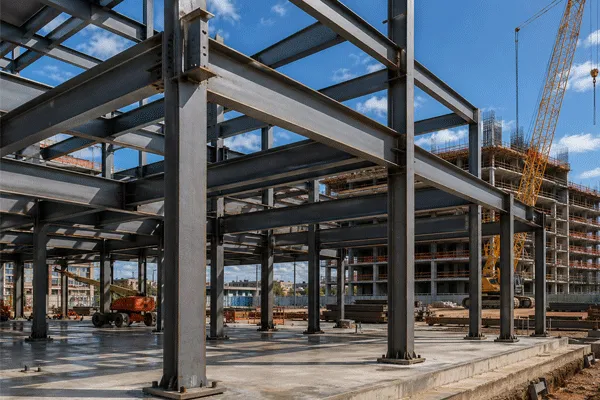
Every I-shaped or H-shaped section has two bending axes. The strong axis (x-x) runs through the web, where the flanges sit farthest from the neutral axis and resist bending most efficiently — this is the orientation both H-beam and I-beam are typically installed in for simple beam spans. The weak axis (y-y) runs through the flange width, and this is where the two shapes separate.
Because a tapered I-beam’s flange is narrow relative to its depth, its weak-axis section modulus is comparatively small — fine for a beam that only needs to resist load in one direction, such as a straight-run crane rail, but a poor choice where lateral loads, wind, or seismic bracing put meaningful force on the weak axis too. A wide-flange H-beam’s broader, parallel flange gives it materially better weak-axis capacity, which is why it’s the default choice for columns and for frames where lateral-torsional buckling resistance matters.
العارضة على شكل حرف H مقابل العارضة على شكل حرف I: اختيار المقاطع في الأعمال الإنشائية
5 Steps to Decide Between H Beam and I Beam
- Identify the load direction.If the member only resists load along one axis — a straight crane runway, a simple-span beam under gravity load alone — a tapered I-beam profile can still be appropriate, particularly on legacy drawings already specified that way.
- Check for biaxial or lateral loads.Columns, moment frames, and any member exposed to wind or seismic bracing forces need the weak-axis stiffness a wide-flange H-beam provides.
- Review the connection detailing.Bolted base plates, welded gusset connections, and flush-mounted bracing all seat more predictably against a parallel-face flange than a tapered one.
- Confirm what’s actually stocked.Wide-flange H-beam sections dominate current mill production; classic tapered S-shape I-beam is increasingly a special-order item outside legacy infrastructure replacement work.
- Match the designation to the supplying market.A drawing calling out IPE300 and a mill quoting HN300×200 are not describing the same part — confirm which designation system the fabrication shop is actually pricing against before issuing a PO.
Luyuan H Beam: Grade, Length, and What’s Still Unconfirmed
Luyuan’s current H beam listing states Grade Q345 with standard lengths from 1,000 mm to 12,000 mm. A naming note worth flagging for import documentation: Q345 predates the current GB/T 1591 revision, which renumbered the equivalent grade series under Q355. The chemical and mechanical property targets are essentially unchanged between the two labels, but if your import inspection or end-client specification expects the Q355 designation explicitly, confirm which label the mill test certificate will carry before the order is placed.
Section size range (depth × width × flange/web thickness), tolerance class, and surface treatment options are not published on Luyuan’s current H beam listing. Rather than estimate these figures, request them directly at RFQ stage alongside your target designation (HW, HN, or equivalent Q345/Q355 section) — this is standard practice for structural steel sourcing regardless of supplier, since section availability shifts with rolling schedules.
Luyuan does not currently carry a confirmed catalog entry for a classic tapered-flange I-beam (S-shape). If your project genuinely requires that profile rather than a wide-flange H-beam substitute, treat it as a price-on-request item pending mill confirmation, not an assumed stock product.
H Beam Pricing: What’s Confirmed, What’s Price on Request
Luyuan’s published reference listing price for H-beam steel runs approximately USD 440–568 per metric ton, depending on section size, grade, length, and order volume. This is a reference range rather than a fixed quote — final pricing depends on Incoterms, destination port, and quantity. Because a specific I-beam (S-shape) product entry isn’t currently in Luyuan’s confirmed catalog, that profile should be treated as price on request rather than assumed to fall in the same band as H-beam.
العارضة على شكل حرف H مقابل العارضة على شكل حرف I: اختيار المقاطع في الأعمال الإنشائية
Where Buyers Get This Wrong
The most common mixup isn’t H-beam versus I-beam — it’s assuming the two terms are used consistently across regions. A buyer in a JIS-standard market ordering “H-beam” and a buyer in a European market ordering “HEA” may both mean the same wide-flange geometry, but a drawing set that mixes an American W-shape callout with an Asian HN designation without a conversion table is a routine cause of mismatched shipments. The second common error is assuming any wide-flange section can substitute for a tapered I-beam on a legacy drawing without re-checking the connection details — the flat flange face changes how base plates, clip angles, and crane-rail clips seat, even when the depth and weight per meter are close.
الأسئلة الشائعة
Q: Is an H beam the same as a wide-flange beam?
A: Yes — “H-beam” and “wide-flange” (or W-shape in American terminology) describe the same parallel-flange geometry. Regional naming differs, but the cross-section is functionally the same family.
Q: What’s the practical difference in load capacity between H beam and I beam?
A: For strong-axis bending in a simple span, the two can perform similarly at comparable weight. The real gap is weak-axis stiffness, where H-beam’s wider, parallel flange outperforms a tapered I-beam’s narrower flange.
Q: Can an H beam replace an I beam on an existing structural drawing?
A: Sometimes, but connection detailing needs review first — base plates, clip angles, and bracing hardware sized for a tapered flange may not seat correctly on a parallel-flange H-beam without redetailing.
Q: What grade and length does Luyuan’s H beam come in?
A: Grade Q345, in standard lengths from 1,000 mm to 12,000 mm. Section size range, tolerance class, and surface treatment should be confirmed directly at RFQ stage.
Q: Does Luyuan supply true I-beam (S-shape, tapered-flange) sections?
A: Not as a confirmed current catalog entry — treat it as a price-on-request item pending mill confirmation rather than an assumed stock product.
Q: Why do engine connecting rods also use the terms “H-beam” and “I-beam”?
A: The names describe a similar cross-sectional silhouette, but automotive con-rods are small forged parts with no structural relationship to steel building sections. If that’s what you searched for, look to performance engine parts retailers instead.
Q: What tolerance standard applies to H beam sections?
A: This isn’t published on Luyuan’s current listing and should be confirmed in writing before order placement, since tolerance class affects fit-up in bolted connections.
Q: How is H beam priced relative to other structural sections?
A: Luyuan’s reference range for H-beam is approximately USD 440–568/MT, depending on section, grade, length, and volume — confirm current pricing and Incoterms at RFQ stage rather than relying on a published range as a final quote.
Q: What documentation should accompany an H beam order?
A: An English Mill Test Certificate at minimum, with third-party inspection (SGS, BV, Intertek, or a buyer-appointed inspector) available on request before shipment.









 09-16 2026